
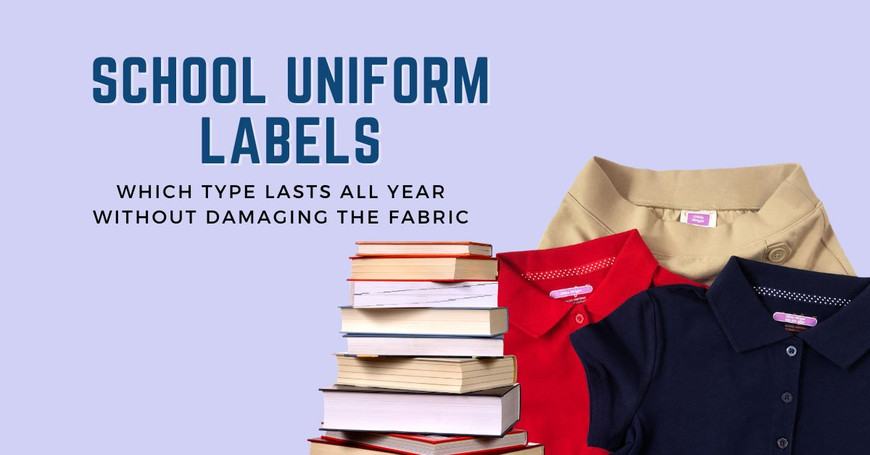
School uniforms are the clothing category that needs labels most — and the one most likely to end up in the wrong child's bag, hanging unclaimed in the lost-and-found, or quietly borrowed and never returned. Every child in the school is wearing the same shirt in the same color in the same size. Without a name on it, there is absolutely nothing to tell them apart.
The labeling question for uniforms isn't whether to label — it's which label type goes on which piece. Uniform clothing comes in every configuration: care tags, tagless imprints, elastic waistbands, knitwear, and fabric types that respond differently to heat. Using the right label on the right surface is the difference between a label that lasts the school year and one that peels off in the second week.
This guide covers every uniform piece, the correct label type for each, the placement that makes labels easy to find and last through weekly washing, the special considerations for different uniform fabrics, and how to build a labeling system that holds up from September through to the end of the year.
From the founder of Sticky Monkey Labels
I'm Dodie — founder of Sticky Monkey Labels, boy mom of three sons, two with food allergies and one with special needs, and 15 years in business since 2011. Back to school labeling is one of the most common reasons parents call us in August. Uniforms specifically are where the most questions come in — because the label type decision isn't always obvious. This guide makes it clear.
What's in this guide
- Why school uniforms need labels more than regular clothing
- Iron-on vs stick-on for uniforms — the decision that matters
- Piece-by-piece label guide for every uniform item
- Uniform fabric types and what they mean for labeling
- Application tips for uniform clothing
- Sensory-safe labeling for uniform items
- Planning for hand-me-downs before you label
- The uniform labeling session — how to get it done efficiently
- Frequently asked questions
1. Why School Uniforms Need Labels More Than Regular Clothing
Regular children's clothing is varied enough that a distinctive shirt, jacket, or pair of trousers can often be identified without a label — by its color, print, or style. School uniforms eliminate that distinction entirely. Every child in the school is wearing a polo shirt in the same color, trousers or skirts in the same fabric and cut, and a sweatshirt with the same school logo. There is nothing visual to distinguish ownership.
Where uniforms go missing
- PE class — children change out of uniforms, change back in, and identical shirts end up in the wrong pile. Without a label, there's no way to sort ownership.
- After-school activities — jumpers and cardigans left behind at after-school clubs or sports sessions with no name on them go straight to lost-and-found.
- School laundry — some schools wash PE kit communally. Unlabeled uniform pieces that go through this system rarely come back to the right child.
- End-of-day mix-ups — in younger year groups where children share coat hooks and changing areas, identical jumpers get picked up by the wrong child accidentally and then can't be identified.
School uniform is also one of the higher-cost children's clothing categories — branded uniform pieces with the school logo carry a price premium that makes losses genuinely expensive. A label that costs a few pence is the only protection against uniform pieces that cost significantly more to replace.
2. Iron-On vs Stick-On for Uniforms — The Decision That Matters
Both iron-on and stick-on clothing labels work on school uniforms — and the choice between them comes down to the specific uniform piece, the surface available, and your preference for permanence vs flexibility.
Stick-on clothing labels — fast, flexible, and removable
Stick-on labels use a specially formulated super-sticky adhesive and go on the care tag or the largest flat area of a tagless imprint. Peel and press — no iron needed. They last for years with home laundry and are the fastest option when you have a full set of uniform to label. The key advantage for uniforms: removable when uniform pieces are passed down to a younger sibling or sold on. If your child's uniform will move to another child, plan for stick-on from the start.
Iron-on clothing labels — permanent, flat, and sensory-safe
Iron-on labels use heat-activated adhesive that melts into fabric fibers and bonds at the fiber level — which means the bond is permanent and there is no raised edge on the surface. Required for any tagless uniform item where the imprint is too small for a stick-on label, and the only option for uniform socks and sports kit with no care tag. For children with sensory sensitivities, iron-on is the sensory-safe choice — no raised edge against skin when correctly applied. The trade-off is permanence: iron-on labels cannot be removed, so uniform pieces can't be relabeled for the next child.
3. Piece-by-Piece Label Guide for Every Uniform Item
| Uniform Item | Label Type | Placement and Notes |
|---|---|---|
| Polo shirt / shirt with care tag | Stick-on or Iron-on | Stick-on on the flat face of the care tag. If tagless: stick-on on the largest flat area of the tagless imprint, or iron-on into fabric at back collar if imprint is too small. |
| School jumper / sweatshirt | Stick-on or Iron-on | Care tag, inside back collar seam area or inside side seam. Jumpers are one of the most commonly lost uniform items — label before the first day, without exception. |
| School cardigan | Stick-on or Iron-on | Care tag. Cardigans get taken on and off constantly throughout the school day and left behind more than any other single uniform piece. |
| School trousers / shorts | Stick-on or Iron-on | Care tag inside the waistband. If no care tag: stick-on on tagless imprint, or iron-on on the flat fabric panel of the inner waistband alongside the elastic — never on the elastic itself. |
| School skirt / pinafore | Stick-on or Iron-on | Care tag at the inner waistband. If tagless, inside waistband flat fabric panel. |
| School tie | Stick-on or Iron-on | Care tag on the back of the tie, or iron-on on the flat lining fabric on the reverse. Ties are high-loss items in secondary school. |
| School blazer / jacket | Stick-on preferred | Care tag at the inside back collar. Blazers are expensive — label before the first day. Stick-on preferred for potential resale or hand-me-down. |
| PE shirt / sports top | Stick-on or Iron-on | Care tag or tagless imprint. PE kit goes into changing rooms and communal laundry — label the PE bag itself too with a waterproof label. |
| PE shorts / joggers | Stick-on or Iron-on | Care tag inside waistband. If no care tag: iron-on on the flat waistband fabric alongside elastic. |
| PE socks / sports socks | Iron-on only | Inside cuff. Every individual sock. No care tag exists on socks. Open to a single flat layer on the firm ironing board section before applying. |
| Tights / leggings | Iron-on preferred | Care tag inside waistband if one exists. If tagless with too-small imprint, iron-on on the flat waistband fabric. The waistband area of tights is often elastic with no stable surface — find the flat woven panel. |
| School bag / PE bag | Waterproof | Smooth plastic or metal hardware on the exterior front. Bags with no smooth surface — use a luggage tag on the handle. |
| School shoes | Shoe labels | Inside heel — both shoes. Clear overlay required. Not standard waterproof labels. Labels will not stick to rubber soles or exterior surfaces. |
4. Uniform Fabric Types and What They Mean for Labeling
School uniforms come in a wider range of fabrics than most everyday children's clothing — from polycotton polo shirts to wool-blend blazers to polyester performance PE kit. The fabric type affects which label option works and how you need to approach application.
Cotton and polycotton (most polo shirts, shirts, trousers)
The most label-friendly fabric. Both stick-on and iron-on work well. Iron-on at cotton setting bonds fully into the fiber weave. Stick-on on care tags holds reliably through weekly washing. The most common uniform fabric — straightforward for any label type.
Acrylic or wool-blend knitwear (jumpers, cardigans)
For stick-on on care tags — works well as the care tag surface is independent of the knit fabric. For iron-on directly into knitwear — check the care label first. Some acrylic blends are not iron-safe at cotton setting. If the care label says do not iron or iron on low only, use stick-on on the care tag rather than attempting iron-on on the knit fabric. Never apply iron-on directly to knit fabric without confirming the iron setting is safe for that fabric.
Polyester and performance fabrics (PE kit, sports tops)
PE kit is often made of lightweight performance polyester. Check the care label before using iron-on — some performance fabrics are not suitable for cotton-setting heat. Stick-on on the care tag is a reliable approach for performance fabrics that can't be ironed. If the PE kit is tagless and the imprint is too small, check the iron setting recommendation on the care label before applying iron-on to the fabric itself.
Wool-blend blazers and formal jackets
School blazers often have a woven inner lining — this is typically the best surface for stick-on labels via the care tag, which is usually sewn into the lining near the back collar. The outer fabric of a blazer is not a suitable surface for iron-on application. Use stick-on on the care tag only for blazers and formal jackets.
5. Application Tips for Uniform Clothing
The application principles for uniform labels are the same as for any clothing label — but uniform items go through the wash more frequently than most clothing, which makes correct initial application more important.
Stick-on on care tags — key points
- Press firmly from center outward — run your thumbnail along every edge for full contact
- Allow 24 hours before the first wash — the adhesive continues curing and sets fully in this window
- Make sure the label sits fully within the smooth face of the care tag — any part of the label extending onto raw fabric will lift at that edge immediately
- If the care tag is very small, use a smaller label that stays within the tag surface rather than a standard-sized label that overhangs
Iron-on on uniform fabric — key points
- Check the care label before applying — confirm the fabric is iron-safe at cotton setting
- Cotton setting, no steam — always
- 60–90 seconds total pressing time using press-and-lift technique — not sliding the iron
- Cool completely before checking edges — at least two minutes undisturbed
- Check all edges with your thumbnail after cool-down — any edge that lifts needs to be re-pressed immediately before the first wash
- 24 hours before the first wash
For the complete step-by-step iron-on application guide, see How to Apply Iron-On Labels Step by Step.
6. Sensory-Safe Labeling for Uniform Items
For children with sensory processing differences, school uniform labeling carries additional weight — because uniform items are worn for longer stretches without a break, often in environments where a child can't easily change or adjust, and a label edge that's felt all day is a real problem that affects concentration and comfort.
The solution is the same as for any sensory-sensitive child: correctly applied iron-on labels, bonded fully into the fabric fibers so there is no raised edge to feel. For uniform items, the placement choice matters too — labels placed in positions of lower skin contact are less likely to be noticed by a sensory-sensitive child even when correctly bonded.
Sensory-conscious placement for uniform items
- Shirts and polo shirts: Lower back collar area, away from the neck seam. The lower back collar has less direct neck contact than the top of the collar band.
- Trousers and shorts: Back center of the inner waistband flat fabric. Back placement sits against the lower back rather than against the front or sides where there's more movement contact.
- Jumpers and cardigans: Inside back hem area rather than collar — if the school accepts this placement, the back hem label is further from the neck and shoulder area where sensory-sensitive children most commonly react to labels.
- Socks: Inside cuff, upper portion. The upper cuff has less friction during wear than the ankle or foot area.
For the complete guide to sensory-safe label application, including why iron-on is the only option that truly eliminates raised edges, see our sensory-safe clothing labels guide.
7. Planning for Hand-Me-Downs Before You Label
School uniform is one of the most commonly passed-down children's clothing categories. The same pieces that fit your eight-year-old will fit a younger sibling in a few years, and branded school uniform items retain their usability through multiple children if they're well maintained.
The label choice you make now determines whether uniform items can be relabeled for the next child — so it's worth deciding before you apply a single label.
Planning for hand-me-downs: use stick-on
Stick-on clothing labels on care tags peel cleanly without leaving residue and without damaging the care tag. When the uniform moves to the next child, peel off the label and apply a new one with the new child's name. The care tag is undamaged and ready for the next label. This works because stick-on labels bond to the tag surface rather than into fabric fibers.
Iron-on is permanent — plan before you apply
Iron-on labels bond permanently into fabric fibers and cannot be removed. A uniform piece with an iron-on label in it will always have that label — it cannot be overwritten or removed for the next child. If any of your uniform pieces will be passed down, use stick-on on those specific items. If the item is for the current child only, either label type is fine. Decide before you start the labeling session rather than after.
8. The Uniform Labeling Session: How to Get It Done Efficiently
A full set of school uniform — shirt, jumper, cardigan, trousers, PE kit, socks, blazer — is a significant labeling task if approached without a system. With a system, it's a manageable one-off session before the school year starts.
The efficient sequence
- Sort by label type first. Before you start, sort the entire uniform pile into two groups: items that get stick-on (care tag available) and items that get iron-on (socks, tagless items where imprint is too small). This prevents stopping mid-session to switch between methods.
- Stick-on session first (15–25 minutes). Work through everything in the stick-on pile. Peel, press firmly on care tag, move to the next item. No equipment needed — fastest part of the session.
- Iron-on session second (30–45 minutes). Set up the iron. Work through tagless items, school uniforms, PE kit. Press-and-lift technique, 60–90 seconds per label, cool completely before checking edges. Build a rotation for socks: iron one, set aside to cool, move to the next.
- Set everything aside for 24 hours before washing or packing. Don't wash any labeled items that same evening. The cure time applies to both label types.
Browse our iron-on name labels, stick-on clothing labels, and our full range of clothing name labels at Sticky Monkey Labels. Not sure which label type is right for a specific uniform piece? Call us at 1-888-780-7734.
Frequently Asked Questions
Do I need to label every individual uniform item, or just some of them?
Every individual item — including every individual sock and every piece of PE kit. The most-lost uniform items are often the ones parents think are distinctive enough not to need labeling: the school jumper ("it has the school logo on it"), the blazer ("it's an unusual style"). In a school where every child wears identical items, the school logo and style are the same on every child's jumper and blazer. The name inside is the only differentiator. Label every piece.
My child's school uniform is mostly tagless. Do I need iron-on labels for everything?
Not necessarily — check the size of each tagless imprint against the label size you've ordered. If the imprint is large enough to accommodate the label with the full label sitting within the smooth imprint area, a stick-on label works well there. If the imprint is too small — the label would extend onto raw fabric — use iron-on for that item. Many modern uniform pieces have tagless imprints that are large enough for stick-on labels. Measure before deciding.
My child's school jumper is acrylic. Can I use iron-on labels on it?
Check the care label first. Acrylic knitwear often specifies a low iron setting or no ironing — and iron-on labels require cotton-setting heat to bond properly. If the jumper's care label says do not iron or iron on cool/warm only, use stick-on on the care tag rather than attempting iron-on on the fabric. The care tag of an acrylic jumper is typically a woven label that accepts stick-on well regardless of the outer fabric's iron restrictions.
Our school sells second-hand uniform at the end of each year. Should I use stick-on or iron-on?
Stick-on for anything you plan to sell on. Stick-on labels on care tags peel cleanly without residue — the uniform arrives at the second-hand sale without someone else's name permanently inside it. If you use iron-on, the name is permanent and the item goes to the second-hand sale with your child's name in it. For most families, the practical approach is stick-on on everything to keep all options open. Iron-on is reserved for socks and any tagless item where the imprint is too small for a stick-on label.
How many labels do I need for a full school uniform set?
Count every item in the uniform and add extras for mid-year additions or replacements. A typical primary school uniform set for one child — shirts × 5, trousers or skirts × 3, jumper × 2, cardigan × 1, PE top × 2, PE shorts × 2, PE socks × 4 individual socks — adds up to approximately 19–22 labels before shoes, school bag, and PE bag. Most families find a set of 30 covers the full uniform plus spares for replacements through the year. Label packs rather than small quantities are more economical for a full uniform set.
My child's school uniform label peeled off after two weeks. What went wrong?
For stick-on labels: either the label was applied to fabric rather than the care tag, it extended beyond the care tag onto raw fabric, or it wasn't given the 24-hour cure time before the first wash. For iron-on labels: underpressing is the most common cause — less than 60–90 seconds total across the label — or touching the label before it cooled completely. Check which of these applies and reapply correctly. A label applied correctly to the correct surface lasts through the full school year. A label that failed in two weeks failed at application — not from normal washing.