
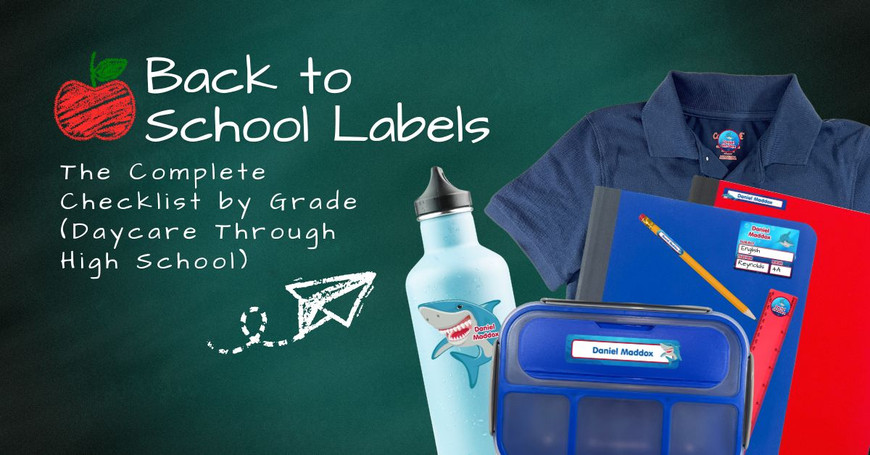
Every August, the same scene plays out in households with school-age kids: a pile of new clothes, a pile of school supplies, and the dawning realization that every single item needs a name on it before the first day. The backpack, the lunchbox, the water bottle, the jacket, the socks, the shoes — all of it.
The mistake most parents make is treating it all the same. One label type, applied the same way, to every surface. That works until the sticker on the sock disappears in the first wash, or the label on the tagless shirt lasts a week and then lifts. The problem isn't the label — it's using the wrong label on the wrong surface.
This is the complete 2026 back to school labeling guide: every item on the checklist, the right label type for each one, the placement that makes labels last, and how to get through the full school wardrobe in a single organized session before the first day. Everything in one place, so you only have to figure this out once.
From the founder of Sticky Monkey Labels
I'm Dodie — founder of Sticky Monkey Labels, boy mom of three sons, two with food allergies and one with special needs, and 15 years in business since 2011. August is our busiest month of the year because back to school labeling questions never change: what goes where, what survives the wash, and how to get through the whole pile without losing your mind. This guide answers all of it.
What's in this guide
- The three label types — and which surface each one is for
- The complete clothing label checklist
- The complete gear and supplies checklist
- Shoe labels — the most consistently skipped category
- Socks and underwear — iron-on only, every individual item
- Water bottle labels — size, placement, and the lid rule
- Sensory-safe labels for kids who feel everything
- How to run the back to school labeling session
- When to order and how much time you need
- Frequently asked questions
1. The Three Label Types — and Which Surface Each One Is For
Every back to school labeling mistake comes from one source: using the wrong label on the wrong surface. Before you label a single item, understand which of the three label types goes where — and why the distinction matters.
Iron-on clothing labels — for fabric items with no usable smooth surface
Iron-on labels use heat-activated adhesive that melts into fabric fibers and bonds at the fiber level — which means no raised edge, no surface-level sticker, and a bond that is permanent for the life of the garment. Required for: socks (no care tag exists), underwear (elastic waistband, no stable surface for adhesive), and any tagless clothing where iron-on into the fabric produces a more durable result than stick-on on the imprint. The only label that works on knit fabric. Sensory-safe when correctly applied — no raised edge for sensitive children to feel.
Stick-on clothing labels — for care tags and tagless imprints
Stick-on clothing labels use a specially formulated super-sticky adhesive that bonds to the smooth, stable surface of a care tag or the largest flat area of a tagless imprint — and also works on hard surfaces like water bottles, lunchboxes, and school supplies. Peel and press — no iron needed. Last for years with home laundry on correctly applied surfaces. Not for commercial washers, dryers, or dry cleaning. Not for direct application to fabric. If a tagless imprint is too small for the label size you ordered, use iron-on instead — the label needs something other than raw fabric to adhere to.
Waterproof labels — for all hard smooth surfaces
Waterproof labels bond to smooth hard surfaces — plastic, stainless steel, glass, metal. Dishwasher safe, sterilizer safe, and rated to last years. For: water bottles, lunchboxes, school supply cases, binders, and any hard-surface item going to school. Not for fabric of any kind. Always prep the surface with alcohol before applying and allow 24 hours before the first dishwasher run.
2. The Complete Clothing Label Checklist
Label every item that leaves your house with your child. Every piece of clothing that goes to school, gym, after-school activities, or any shared space needs a label. The following table gives you the right label type and placement for every item.
| Item | Label Type | Placement |
|---|---|---|
| T-shirts with care tag | Stick-on | Care tag — flat face of the tag |
| Tagless t-shirts | Stick-on or Iron-on | Largest flat area of tagless imprint for stick-on. If the imprint is too small for the label, use iron-on directly into the fabric at back collar. |
| School uniform shirts | Stick-on or Iron-on | Care tag or largest flat area of tagless imprint. Iron-on into fabric if no care tag and imprint is too small for the label. |
| School uniform trousers/skirts | Stick-on or Iron-on | Care tag or tagless imprint for stick-on. Iron-on on flat waistband fabric if no care tag and imprint too small — not on elastic. |
| Pants and shorts with care tag | Stick-on | Care tag — not the waistband elastic or fabric |
| Hoodies and sweatshirts | Stick-on | Care tag — accessible inside back collar or side seam |
| Jackets and coats | Stick-on | Care tag — visible without having to search inside pockets. Removable for hand-me-downs. |
| Socks | Iron-on only | Inside cuff — every individual sock. No care tag exists. Open to a single flat layer on the firm section of the ironing board before applying. |
| Underwear | Iron-on only | Flat fabric of inner waistband — not on elastic. Back center placement. |
| PE kit / sports uniform | Stick-on or Iron-on | Care tag or tagless imprint for stick-on. Iron-on if no usable smooth surface. PE kit goes through frequent washing and changing rooms. |
| Swimsuit | Stick-on or Iron-on | Care tag for stick-on. Iron-on if tagless — check care label first. Swimwear stretches constantly, which stresses any care-tag stick-on bond over time. |
| Pajamas with care tag | Stick-on | Care tag — label top and bottom separately, they separate in the wash. |
| Items intended for hand-me-downs | Stick-on | Care tag — peels cleanly for relabeling. Iron-on is permanent. Plan before you label. |
3. The Complete Gear and Supplies Checklist
Every item that goes to school — not just clothing — needs a label. Hard-surface items use waterproof labels applied to a clean, alcohol-prepped surface with 24 hours of cure time before the first wash or use.
| Item | Label Type | Notes |
|---|---|---|
| Backpack / school bag | Waterproof | Exterior front panel on smooth plastic or metal hardware. Interior label too if space allows. |
| Lunchbox | Waterproof | Exterior front and interior — both. Lost lunchboxes get found; unlabeled ones don't come back. |
| Water bottle — standard | Waterproof | Upper body nearest the spout + lid separately. See Section 6. |
| Water bottle — Stanley / Hydro Flask / YETI | Waterproof large | Large die-cut labels sized for wider diameter. Powder-coated body above the silicone base boot. Lid separately. |
| Food containers and snack containers | Waterproof | Body and lid separately — every container. Upper panel nearest the lid. |
| Pencil case / supply box | Waterproof | Smooth exterior front panel. |
| Binders and folders | Waterproof | Front cover — smooth plastic or hard surface. Semi-permanent marker also works well on smooth folder surfaces. |
| Calculator | Waterproof | Smooth back panel. |
| Headphones / earbuds case | Waterproof | Smooth exterior of the case. High-loss item in middle and high school. |
| Glasses case | Waterproof | Smooth front panel of the case exterior. |
| Sports equipment bags | Waterproof | Smooth plastic handle or hard zipper pull area. If all fabric, use the hard plastic hardware. |
4. Shoe Labels — The Most Consistently Skipped Category
Shoes are left unlabeled more consistently than any other back to school item. The thinking is usually: my child knows their shoes. That's true at home. It's not true in the PE changing room, at the pool, or in the shared shoe rack at the school entrance — where identical pairs belong to multiple children.
Shoe labels go inside the heel — the upper smooth heel lining of each shoe. Both shoes of every pair get their own label. Every shoe label order includes a clear overlay that goes over the name label — required, not optional. The overlay protects the label from the constant friction of the heel sliding against it with every step.
Key rules for school shoe labels
- Inside the heel only — not the tongue, not the sole, not the toe box
- Both shoes of every pair — pairs separate in PE changing rooms and shoe racks
- For shoes with material insoles: clean of any loose fibers and ensure completely dry before applying
- Clear overlay included with every order — apply over the name label after pressing
- Shoe labels are laundry safe for household machines
- Standard waterproof labels are not recommended for shoes — use shoe labels specifically
- Labels will not stick to rubber soles or the exterior of rubber boots — interior smooth lining only
- Crocs: made from a proprietary non-stick foam — nothing adheres to them. Use permanent marker on the interior strap.
For the complete shoe labeling guide including every footwear type, see our shoe labels guide.
5. Socks and Underwear — Iron-On Only, Every Individual Item
Socks and underwear have no care tag and no smooth surface for adhesive to grip. Iron-on is the only option that bonds reliably to the knit fabric these items are made of — and it needs to go on every individual sock, not every pair.
Socks
Iron-on label inside the cuff of each individual sock. Open the sock to a single flat layer on the firm section of the ironing board — one thickness of fabric between the label and the board surface. Label every individual sock because pairs separate in PE changing rooms and lost-and-found bins. Cotton setting, no steam, 60–90 seconds total pressing time, complete cool-down, 24 hours before first wash. For the complete guide, see how to label socks.
Underwear
Iron-on label on the flat fabric of the inner waistband — not on the elastic itself. Back center placement keeps the label away from direct skin contact at the front and sides. Label every piece individually.
6. Water Bottle Labels — Size, Placement, and the Lid Rule
The water bottle is the most commonly lost item at school. It goes everywhere your child goes, it gets set down constantly in shared spaces, and an unlabeled one has no path home from lost-and-found.
Standard water bottles (plastic or stainless, 14–24oz)
Waterproof label on the upper smooth body of the bottle — away from the base, away from silicone sleeves or textured grip areas. Label the lid separately with a small label. Clean with alcohol first. 24 hours before first dishwasher use. Labels last years with correct application.
Large insulated bottles (Stanley, Hydro Flask, YETI, 24–40oz)
Use our large die-cut name labels — sized for the wider diameter and fun cutout shapes that kids can spot instantly in a lineup of identical bottles. Apply to the powder-coated body above the silicone base boot. Label the lid separately. The $40 Stanley without a name on it is a $40 gift to whoever finds it in the gym.
Silicone-sleeved bottles
Silicone is non-stick — find the smooth plastic or metal area above the sleeve and apply there. If the sleeve covers the entire body, apply to the smooth area of the lid. The lid needs a label anyway.
7. Sensory-Safe Labels for Kids Who Feel Everything
For children with sensory processing differences, ASD, tactile hypersensitivity, or any condition that heightens sensitivity to physical sensation, the label edge inside a shirt collar isn't a minor annoyance — it's an input that doesn't fade. A raised edge against skin is registered continuously by a sensory-sensitive nervous system.
The solution is a correctly applied iron-on label. When the heat-activated adhesive melts into the fabric fibers and bonds at the fiber level, there is no raised edge — the label and the fabric move as one. Running a fingernail across a correctly bonded iron-on label, the transition from label to surrounding fabric is undetectable. This is what sensory-sensitive children need, and correct application achieves it every time.
8. How to Run the Back to School Labeling Session
Don't try to label everything in one chaotic evening. The labeling session is faster and less frustrating when you approach it in order — separate the surfaces, gather the right tools, and work through each category before moving to the next.
Session order that works
- Hard surfaces first (30–45 minutes): Set up at a table. Work through the backpack, lunchbox, water bottle, food containers, supplies. Clean each item with alcohol, apply, press firmly. Once done, set aside for 24-hour cure — do not put in the dishwasher or use until tomorrow.
- Stick-on clothing next (20–30 minutes): Work through everything with a care tag. Peel, press on tag, move on. Fast and simple — no equipment needed.
- Iron-on clothing last (45–60 minutes): Set up the iron. Work through school uniforms, tagless items, PE kit. Use press-and-lift technique, 60–90 seconds per label. Cool completely before checking edges.
- Socks — a dedicated sub-session (45–60 minutes): Every individual sock. Open to a single flat layer on the firm ironing board section. Build a rotation: iron one sock, cool one sock, check one sock. For a full drawer of 14–16 pairs, plan an hour.
- Shoes last (15–20 minutes): Both shoes of every pair, inside the heel. Dry and clean of any loose fibers. Apply label, then apply clear overlay over it. 24 hours before first wear.
9. When to Order and How Much Time You Need
We ship all orders within 1–2 business days. Here's the timeline that works without rushing.
- 3 weeks before school starts: Ideal order time. Labels arrive with a full week before your labeling sessions begin — no pressure, no rushing the cure time.
- 2 weeks before school starts: Still comfortable. Order arrives, you have a full week for two relaxed sessions.
- 1 week before school starts: Workable. Order early in the week, dedicate a weekend to both sessions, give everything the 24-hour cure time before packing.
- Less than a week: Call us at 1-888-780-7734. We'll tell you exactly what's possible with your timeline and make sure you have what you need.
Browse our clothing name labels, waterproof name labels, and shoe labels at Sticky Monkey Labels — everything you need for the complete back to school labeling session, in one place, shipped within 1–2 business days. Questions about your specific setup? Call us at 1-888-780-7734.
Frequently Asked Questions
Do I really need to label every item, or just the obvious ones?
Every item. The lost-and-found items at schools are almost entirely unlabeled — hoodies, jackets, PE kits, water bottles, and lunch containers that belong to identifiable children but have no name on them. The obvious items get labeled. The "obvious enough" items don't. And those are exactly the items that don't come home. Every item that goes to school with your child needs a name on it before the first day.
Can I use just one type of label for everything?
No — and this is the most common back to school labeling mistake. Iron-on bonds into fabric fibers and won't work on hard surfaces. Waterproof labels bond to smooth hard surfaces and will peel immediately from fabric. Stick-on clothing labels bond to care tags, tagless imprints, and hard surfaces — but not directly to raw fabric. The surface determines the label type. Match the label to the surface and it holds. Use it on the wrong surface and it fails within days.
My child's school has a uniform. Do I need to label every piece?
Yes — especially uniforms. School uniforms are the clothing most likely to be swapped, mixed up, or picked up in error because every child in the school is wearing exactly the same thing. The only way to distinguish your child's uniform from any other child's is the name inside it. Iron-on for uniform shirts and trousers is the most durable choice because uniforms go through multiple washes per week for the full school year.
How long do labels last once correctly applied?
Iron-on labels are permanent for the life of the garment when correctly applied. Stick-on clothing labels last for years on care tags with home laundry. Waterproof labels last for years on correctly prepped hard surfaces. The common thread in all three is correct application — the right surface, properly prepped, with full cure time. Labels that fail early almost always failed at application, not from normal use.
Do name labels for school need to include anything other than the name?
For most school items, the name alone is sufficient — the goal is identification, and a full name on a jacket is enough for a teacher to return it. For food containers and water bottles, some schools and daycares require additional information (date, contents). For medical alert situations, an allergy label with the specific allergen is more useful than a name label alone. Check your school's specific requirements, especially for younger children in programs with food labeling requirements.
I labeled everything last year and some labels failed by spring. What should I do differently?
Look at which labels failed and on which surfaces. Waterproof labels that peeled — almost always an alcohol prep or cure time issue. Iron-on labels that lifted at the edges — underpressed (less than 60–90 seconds total), touched before cooling, or applied to damp fabric. Stick-on labels that peeled — applied to fabric rather than the care tag, or tagged through more aggressive washing than home laundry. The label itself rarely fails when correctly applied to the correct surface. The fix for next year is matching the label type to the surface and following the application steps exactly — not switching brands.