
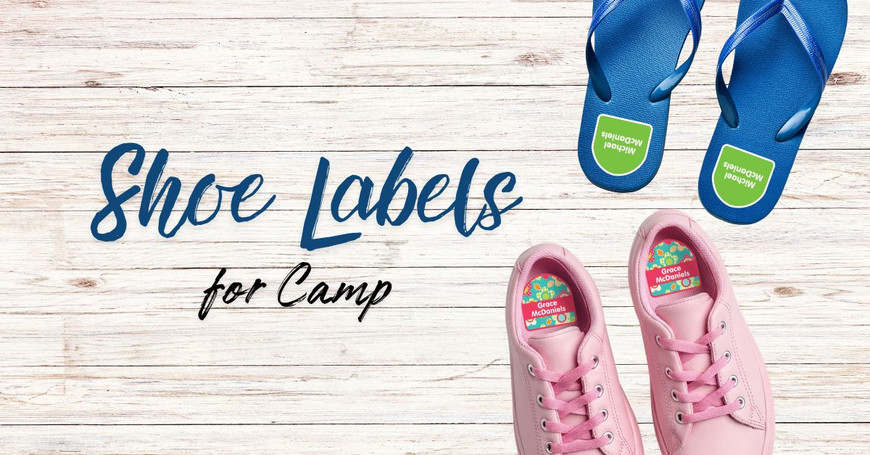
At camp, shoes come off multiple times every day. Flip-flops at the pool deck. Sneakers at the cabin door. Water shoes at the lake. Hiking boots before rest hour. Every time shoes come off in a group, they land in a pile — and in a pile of identical shoes belonging to eight or ten kids, an unlabeled pair has no way home.
Shoes are one of the most consistently lost items at camp and one of the most consistently unlabeled. Parents who labor over getting every sock and piece of underwear labeled sometimes forget entirely that every pair of shoes going to camp needs a label too. A missing pair of sneakers two weeks into a month-long session is an expensive and avoidable problem.
This guide covers the correct placement for shoe labels at camp, why shoe labels are different from standard waterproof stickers, how to label every type of camp footwear, and why both shoes in every pair need their own label — not just one per pair.
From the founder of Sticky Monkey Labels
Dodie here — 15 years making labels for camp families, starting in 2011 in Little Rock, Arkansas. Shoes come up in almost every conversation about what parents wish they'd labeled before camp. The answer is always the same: inside the heel, both shoes, every pair. This post explains why.
What's in this guide
- Why shoes go missing at camp
- Why inside the heel is the only placement that works
- Why both shoes need their own label
- Shoe labels vs. regular waterproof stickers — what's different
- Labeling guide by footwear type
- How to apply shoe labels correctly
- Shoe labels for school and daycare — same rules
- Frequently asked questions
1. Why Shoes Go Missing at Camp
Shoes at camp face a specific set of conditions that make them particularly easy to lose. Unlike at home, where shoes live near the door and belong to a small known group of people, camp shoes enter a high-volume shared environment multiple times every day.
The conditions that cause shoe losses at camp
- Multiple daily removals in group settings. Shoes come off at the pool, at the cabin door, at activity areas that require bare feet or water shoes, before rest hour. Every removal is a potential separation event.
- Identical footwear across the cabin. Basic white sneakers, standard flip-flops, and common athletic shoes all look the same across a group of same-age campers. Without a name, there's nothing to distinguish yours from the pile.
- Pairs that separate. A left shoe and a right shoe are two individual items, not one. In a pile they can end up in different places — one shoe found, one not. A labeled pair stays identifiable even when the shoes are separate.
- No systematic return process. At school, a teacher manages the classroom. At camp, activity transitions happen fast and counselors are focused on the activity, not shoe inventory. Found shoes go to lost-and-found. Labeled shoes come back.
2. Why Inside the Heel Is the Only Placement That Works
Inside the heel. That's the placement for every shoe label, every shoe type, every time. It's not a suggestion — it's the conclusion of every placement option tested against the conditions shoes face at camp.
Why the heel works
- The inside heel is a smooth, relatively flat surface — better adhesive contact than the curved, textured exterior of most shoes
- It's protected from direct abrasion during walking — the foot slides over it but the label isn't ground against external surfaces
- It's visible when the shoe is picked up and turned over to check — the standard way anyone looks for a name in a found shoe
- Every shoe label order includes a clear overlay that goes over the name label — this is required, not optional. The overlay protects the label from the constant friction of the heel sliding against it with every step. Without the overlay, even a correctly applied shoe label will wear down faster than it should.
- Shoe labels are laundry safe for household washing machines — so if a shoe interior gets washed, the label holds
Why other placements fail
- Outside sole: Direct abrasion against every surface the shoe walks on. Any label here wears off within days at camp.
- Tongue of the shoe: The tongue flexes with every step. Any label placed on a flexing surface experiences constant adhesive stress.
- Toe box exterior: Curved, often textured, exposed to scrapes and impacts. Labels lift quickly.
3. Why Both Shoes Need Their Own Label
One label per pair is not enough. Label both shoes — one label in the left shoe, one label in the right shoe.
Shoes separate. In a pile at the pool deck, a left shoe and a right shoe end up in different spots. Someone finds the left shoe and puts it in lost-and-found. The right shoe gets kicked under a bench. A few hours later your child has one shoe and the other is somewhere on the camp property. A labeled left shoe can come home. A labeled right shoe can come home. An unlabeled shoe of either kind is just a shoe in a pile.
4. Shoe Labels vs. Regular Waterproof Stickers — What's Different
Our shoe labels are specifically designed for the inside heel environment and come with three important differences from standard waterproof labels:
- Adhesive formulated for shoe interiors — rated for the combination of sweat, friction, moisture, and repeated flex that the heel environment creates. Standard waterproof labels are not recommended for shoes and will not perform the same way.
- Clear overlay included — required, not optional — every shoe label order includes a clear overlay that goes over the name label after it's applied. This overlay protects the label from the constant friction of the heel rubbing against it with every step. Apply the name label first, then apply the clear overlay on top. Without the overlay, the label surface will wear down from heel friction regardless of adhesive quality.
- Laundry safe for household machines — shoe labels survive household washer and dryer use, so if shoe interiors get washed the label holds.
5. Labeling Guide by Footwear Type
| Footwear Type | Placement | Both Shoes? | Notes |
|---|---|---|---|
| Sneakers / athletic shoes | Inside heel — smooth upper heel area | Yes — both | The highest-volume footwear at camp. Cabin piles make these the most frequently mixed up. Label both before packing. |
| Flip-flops and sandals | Inside heel strap or underside of footbed — smoothest available area | Yes — both | Pool areas are the highest-loss spot for flip-flops. The inside of the heel strap on a sandal or the smooth underside of the footbed both work. Avoid textured footbed surfaces. |
| Water shoes | Inside heel — upper smooth area | Yes — both | Water shoes are wet by design — allow full dry time after activity before checking label adhesion. Apply labels before the first use, not after the first lake session. |
| Rain boots | Inside upper shaft — smooth lining area | Yes — both | Rain boots get left outside cabin doors. Apply to the smooth fabric or synthetic lining inside the upper shaft — not the rubber exterior, which is too textured and flexible for reliable adhesion. |
| Hiking boots | Inside heel — smooth upper heel lining | Yes — both | Hiking boots have a deeper heel cup — the label goes on the smooth lining fabric in the upper heel area, not deep in the toe box. |
| Crocs and foam clogs | Labels will not stick | N/A | Crocs are made from a proprietary foam material with a non-stick surface — nothing adheres to it reliably. Labels cannot be applied to Crocs. If your child is bringing Crocs to camp, use a permanent marker on the interior strap or send a different pair of shoes as the labeled pool footwear. |
6. How to Apply Shoe Labels Correctly
The application process for shoe labels is the same as any label — clean surface, firm pressure, cure time. The surface-specific considerations are what make shoe labels succeed or fail.
Step 1 — Make sure the heel area is completely dry
Label new shoes before they're worn for the first time if possible. If labeling shoes that have already been worn, allow them to dry completely — at least 24 hours in a dry environment after any moisture exposure. For shoes with a fabric or material insole, brush or shake out any loose fibers from the heel area before applying — loose fibers prevent full adhesive contact the same way a textured surface does. The surface must be dry, clean, and free of debris.
Step 2 — Clean the heel surface
For smooth heel surfaces wipe the inside heel area with alcohol on a cloth or cotton pad. Shoe interiors have manufacturing residue, foot oil residue from previous wear, and sometimes anti-odor treatments that all prevent adhesion. For material shoe liners, clean the specific area where the label will go of any fuzz or loose materials.
Step 3 — Apply to the smooth upper heel area with firm pressure
Position the label on the smooth upper heel lining — the area your heel rests against when the shoe is on, above the base. Press firmly from center outward, running your thumbnail along every edge. Hold firm pressure for a full 10–15 seconds. The heel area curves slightly — make sure every edge is making full contact with the surface rather than bridging over a curved area.
Step 4 — Apply the clear overlay over the name label
Every shoe label order includes a clear overlay — apply it directly over the name label once the name label has been pressed firmly into place. The overlay protects the printed name from the constant friction of the heel rubbing against it during wear. This step is required, not optional. A shoe label without the overlay will have the print worn away by heel friction even if the adhesive bond holds perfectly. Press the overlay firmly from center outward the same way you pressed the name label.
Step 5 — Allow 24 hours before first wear
Shoe labels need the same 24-hour cure time as any adhesive label. A label applied and immediately worn has not finished bonding. Label shoes at least 24 hours before camp drop-off — ideally several days before, as part of the same labeling session that covers clothing and gear.
7. Shoe Labels for School and Daycare — Same Rules Apply
Camp is where shoe losses are most dramatic, but school and daycare create the same conditions on a smaller and more frequent scale. PE class, swimming lessons, outdoor play areas where shoes come off, and younger children's changing routines at daycare all create shoe mix-up situations throughout the year.
The placement, prep, and application are identical for school and daycare shoes. The difference is timing — rather than labeling a full camp trunk once before summer, school shoes get labeled at the start of the year and any new pairs get labeled as they're bought. Keep a few shoe labels on hand so new shoes get labeled before they go to school the first time — not after the first pair goes missing.
Browse our shoe labels for kids at Sticky Monkey Labels — specifically rated for the sweat, moisture, and friction that shoe interiors face all day. Questions about which shoe label works for a specific footwear type? Call us at 1-888-780-7734.
Frequently Asked Questions
Can I use a regular waterproof sticker instead of a dedicated shoe label?
No — waterproof labels other than shoe labels are not recommended for shoes. The inside heel environment involves sweat, friction, moisture, and repeated flex that standard waterproof labels are not designed for. More importantly, standard waterproof labels do not come with the clear overlay that shoe labels include — and without the overlay, heel friction will wear the print away regardless of how well the adhesive holds. Use shoe labels for shoes. The right label for the right surface.
My shoe label keeps peeling. What is going wrong?
Almost always one of three things: the shoe wasn't completely dry before labeling, the surface wasn't cleaned with alcohol, or the label was worn before the 24-hour cure time. The dryness issue is the most common for camp — shoes that have been worn or stored in a damp environment feel dry from the outside but retain moisture in the heel lining. Allow new shoes to air out at room temperature for 24 hours before labeling. Clean with alcohol, dry completely, apply with firm pressure, and allow 24 hours before first wear.
Do I need to label both shoes or just one per pair?
Both shoes, always. Pairs separate in piles, in lost-and-found bins, and in shared shoe storage areas. One labeled shoe in a separated pair has a path home. The other unlabeled shoe doesn't. Labeling both shoes takes an extra 90 seconds per pair. Not labeling both is the single most common shoe labeling mistake parents make before camp.
Where do I put a shoe label on a flip-flop? There's no heel lining.
For flip-flops, the two best options are the inside of the heel strap where it's smooth, or the smooth underside of the footbed near the heel end. Avoid any textured grip surface on the footbed. The heel strap of most flip-flops has a smooth inner facing that bonds well when cleaned with alcohol and given full cure time. This is a smaller surface area than a shoe heel lining, so using a small label rather than a standard size gives better edge-to-surface contact.
How many pairs of shoes should I label for camp?
Every pair going to camp gets labeled — both shoes of every pair. A typical overnight camp trunk includes sneakers, flip-flops or sandals, water shoes, and rain boots — that's four pairs, eight individual shoes. A longer session might also include hiking boots. Label all of them before packing. The pairs you think are distinctive enough not to mix up are exactly the pairs that end up in someone else's pile. Label everything and stop thinking about it.
Can I label shoes that have already been worn, or do they need to be new?
You can label worn shoes — the shoe doesn't need to be new, it needs to be dry and clean at the label surface. Allow worn shoes to air out completely — at least 24 hours in a dry environment. Then clean the heel area thoroughly with alcohol, allow to dry, and apply. The alcohol step is especially important for worn shoes that have accumulated foot oil and sweat residue in the heel area. Clean preparation of a worn shoe produces the same result as labeling a new one.