
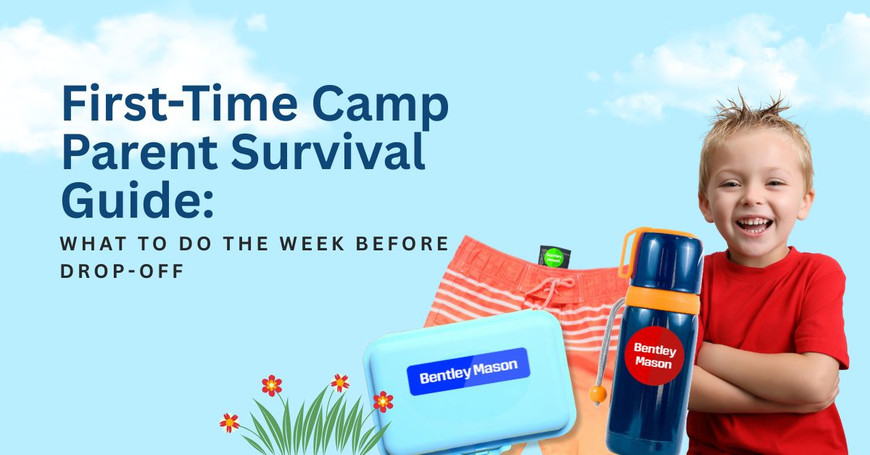
The week before your child's first overnight camp drop-off is a specific kind of chaos. The trunk is half-packed. The packing list has seventeen items highlighted in three different colors. Your child is simultaneously thrilled and terrified, and you're trying to project calm confidence while quietly wondering if you've forgotten something important.
You've probably forgotten the labeling. Or started it and not finished. Or labeled some things correctly and some things not quite right. Most first-time camp parents arrive at drop-off with a combination of labeled, partially labeled, and completely unlabeled items — and spend the first week of camp getting notes from the director about what still needs a name on it.
This guide is the week-before roadmap: what needs to happen in what order, how to run the labeling sessions efficiently, what consistently gets forgotten, and what you can stop worrying about because it actually doesn't matter as much as it feels like it does right now.
From the founder of Sticky Monkey Labels
I'm Dodie — founder of Sticky Monkey Labels, boy mom of three sons, two with food allergies and one with special needs, and 15 years in business since 2011. I've shipped label orders to first-time camp families every single summer for 15 years. The calls and messages I get from that group are always the same — and the mistakes are always fixable. Here's what to do with the week you have left.
What's in this guide
1. The Week-Before Timeline — What to Do When
Seven days sounds like a lot. It isn't, once you account for the fact that labels need 24 hours of cure time before washing, washed items need to dry before packing, and you still have a normal week of everything else running simultaneously. Work backward from drop-off day and the timeline gets tighter than expected.
Seven days out — order labels if you haven't
We ship within 1–2 business days. Order today and they arrive by midweek, leaving you enough time for labeling sessions and cure time before packing. If you're reading this with less than five days to go, call us at 1-888-780-7734 — we'll tell you exactly what's realistic.
Six days out — wash bedding and clothing
Everything going to camp needs to be clean before labeling. Wash all bedding, clothing, and any fabric items that are going in the trunk. Let them dry completely at room temperature — not warm from the dryer — before you label them. Damp or warm fabric produces steam under iron-on labels and prevents proper bonding.
Five days out — labeling session one: hard surfaces and toiletries
Work through all hard-surface items: water bottle, lunchbox, food containers, toiletry bottles. Clean every surface with alcohol, apply labels, press firmly. Apply clear overlays to sunscreen and bug spray immediately after the name labels. Set everything aside — nothing goes in the dishwasher or gets used until tomorrow. 30–45 minutes.
Four days out — labeling session two: clothing and bedding
Set up the iron. Work through stick-on labels on care tags first — fast, no equipment needed. Then iron-on for uniforms, tagless items, and all fabric items going to camp. Then socks — every individual sock, open to a single flat layer on the firm ironing board section, 60–90 seconds each. Then bedding — sheets, pillowcase, blanket — iron-on on the outside edge of the hem where it's visible without unfolding. 2–3 hours across the session. Allow 24 hours before washing or packing anything labeled today.
Three days out — labeling session three: shoes
Every pair going to camp. Both shoes of every pair. Inside the heel, clean and dry of any loose fibers. Name label first, then clear overlay over it. 24 hours before first wear. 15–20 minutes for a full camp shoe lineup.
Two days out — edge checks and packing
Check every iron-on label that was applied this week. Run your thumbnail firmly around every edge — anything that lifts needs to be re-pressed immediately. Then pack the trunk. Label the trunk itself on the exterior with your child's name. Label the inside of the lid too.
One day out — final check
Walk through the full packing list one more time. Check that every item has a label. Check that every bottle has a body label and a lid label. Check that every shoe is labeled. Check that every sock is labeled individually. Then close the trunk and stop opening it.
2. The Labeling Session Order That Works
The reason to do hard surfaces first is the 24-hour cure time. Water bottles, food containers, and toiletry bottles need 24 hours before they get wet — if you label them on the same day as drop-off morning you're running them into the dishwasher or shower bag before they've finished curing. Do them first, give them the most cure time.
The reason to do bedding last in the iron-on session is size — sheets and sleeping bag liners take more ironing board setup time per item than clothing does. Get the rhythm going on clothing and socks, then transition to bedding when you're already in the groove.
Session order at a glance
- Hard surfaces — water bottle, lunchbox, containers, toiletries (alcohol prep required, 24-hour cure)
- Stick-on clothing — everything with a care tag (peel and press, 24-hour cure before first wash)
- Iron-on clothing — tagless items, PE kit, camp-bound clothing (cotton setting, no steam, 60–90 seconds per label)
- Socks — every individual sock (single flat layer on firm ironing board section)
- Bedding — sheets, pillowcase, blanket (outside hem edge, visible without unfolding)
- Shoes — both shoes of every pair (heel, dry and clean, clear overlay required)
- The trunk itself — exterior and interior lid
3. The Most Consistently Forgotten Items
After 15 years of hearing from camp parents about what didn't come home, these are the items that show up in those conversations most often — because they're the ones that get skipped during the labeling session.
Every individual sock — not every pair, every sock
Parents label socks but label every pair rather than every individual sock — one label on the cuff of one sock from each pair. In communal laundry, pairs separate. A labeled left sock with an unlabeled right sock means one labeled sock coming home and one mystery sock going wherever it goes. Every individual sock. No exceptions. See our sock labeling guide for the full process.
Both shoes of every pair — not one per pair
Same logic as socks. Shoes separate at the pool, the cabin door, and activity areas where children remove them in groups. A labeled left sneaker and an unlabeled right sneaker at the pool deck means one shoe found and one shoe lost. Both shoes. Every pair. All of them.
The lid — separately from the bottle or container
Every bottle and food container needs a body label and a lid label. Separately. Lids detach during washing, during the mealtime rush, and during normal daily use. An unlabeled lid is a missing lid within the first week at camp.
Bedding — every piece separately
Fitted sheet, flat sheet, pillowcase, pillow, blanket — each one separately. They get separated in communal laundry. A pillowcase without a label that gets separated from a labeled fitted sheet has no way back to your child. Outside hem edge, iron-on, visible without unfolding.
Sunscreen and bug spray — without a clear overlay
Parents label sunscreen and bug spray but skip the clear overlay. Over three or four weeks of daily application with product-covered hands, the label ink degrades. The overlay takes the degradation instead of the label. Apply both — label first, clear overlay immediately after. See our clear overlay guide.
The shower caddy and toiletry bag
Parents label the bottles inside and forget to label the caddy itself. If the whole caddy gets left in the bathroom, the caddy label is what brings everything back at once. Label the smooth plastic frame or handle of the caddy with a waterproof label.
The trunk or duffel itself
Every item going to camp is labeled and the trunk they all go in isn't. Label the exterior of the trunk or duffel with a large, visible waterproof label. Label the inside of the lid or lining too. A trunk without a name on it at the end of session pickup is a sorting problem for camp staff.
4. The Label Rules Every First-Timer Needs to Know
These are the rules that prevent the most common camp labeling mistakes — the ones that show up in the notes from the director, the items that come back in a mystery bag at the end of session, or the calls from your child in week two asking if you can send replacements.
Iron-on for all clothing going through communal laundry
Camp clothing goes through communal high-heat institutional laundry. Stick-on clothing labels are designed for home laundry and are not intended for commercial washers or dryers. Iron-on labels bond into fabric fibers and are the correct choice for all clothing items going to overnight camp. Stick-on labels can be used at home on items washed in your home machine — for camp, iron-on is what survives the session.
Alcohol prep before every waterproof label
Every hard surface — water bottle, food container, toiletry bottle, trunk hardware — needs to be cleaned with alcohol before a waterproof label is applied. Even brand-new items. Manufacturing oils, hand oils, and residue all prevent full adhesive bonding. Skip this step and labels peel within days. Do it and labels last the session and beyond.
24 hours of cure time before washing or use
Every label — waterproof, stick-on, or iron-on — needs 24 hours at room temperature after application before the first wash, dishwasher run, or use. The adhesive continues curing during this window. Labels applied and immediately washed have not finished bonding and often fail in the first cycle. This is why the timeline above puts labeling sessions 3–5 days before drop-off, not the night before.
Check edges after iron-on cool-down
After every iron-on label has cooled completely — at least two minutes — run your thumbnail firmly around all four edges. A fully bonded label feels completely flush with the fabric. Any edge that lifts when pressed and released needs to be re-pressed immediately with the parchment sheet for 30 seconds and then cooled again. Catching a partial bond right after application prevents it from becoming a mid-session peeling problem.
5. What Not to Worry About
First-time camp parents tend to spiral on things that don't actually matter much while missing the things that do. Here is the short list of things to stop spending energy on:
Whether the label is perfectly centered
No one at camp reads labels by their aesthetic quality. A label that's slightly off-center and fully bonded is infinitely more valuable than one that's perfectly placed and partially bonded. Bond first. Center second.
Labeling items your child will only ever use at home
Labels prevent things from getting lost in shared spaces. Items that never leave your house don't need labels. Focus your labeling energy on everything that goes to camp, not everything your child owns.
Whether to include a middle name or just first and last
First and last name is standard and sufficient. If two children in the same cabin have the same first and last name — a very rare situation — the camp will sort it out. First and last, readable, on every item. That's all that's needed.
Whether a specific item "really needs" a label
It does. If you're asking the question about a specific item, label it. The cost of a label is measured in seconds. The cost of not labeling an item is measured in whatever that item is worth, plus the frustration. Label everything that goes to camp.
6. Drop-Off Day — What to Focus On
Drop-off day is not a labeling day. Everything that needed a label should already have one, with at least 24 hours of cure time behind it. If you're applying labels in the car on the way to drop-off, those labels are going into a washing machine without finishing their cure — and they won't make it through the first laundry cycle.
What to do on drop-off day
- Walk the packing list one more time the morning before leaving — not at drop-off
- Bring a small supply of extra labels in case the camp director points out something that got missed — but don't plan on labeling anything that day
- Confirm your child's allergy documentation has been received and distributed to all relevant staff if your child has food allergies — before you leave the drop-off site
- Let your child lead the cabin setup if they're old enough — it's their space
- Say goodbye and leave when it's time to leave. A clean goodbye is better for both of you than a prolonged one.
Browse our camp label packs and our iron-on name labels at Sticky Monkey Labels — we ship within 1–2 business days. Running close to drop-off? Call us at 1-888-780-7734 and we'll figure out what's possible with your timeline.
Frequently Asked Questions
I have three days until drop-off and nothing is labeled. Is there still time?
Yes — if you order today, express ship where available, and run labeling sessions on consecutive days. Day one: hard surfaces and toiletries. Day two: iron-on clothing and bedding. Day three: shoes and final checks. Everything gets its 24-hour cure time and is ready to pack before drop-off. It's tight but it works. Call us at 1-888-780-7734 and we'll walk through exactly what's possible.
My child is going to camp for the first time and I'm not sure how many labels I need. How do I estimate?
Count every item going to camp and double it for anything with a lid or that comes in pairs. Clothing items: one label each. Socks: one per individual sock. Shoes: one per shoe. Bottles and containers: one for the body, one for the lid. Toiletry bottles: one each plus an overlay for sunscreen and bug spray. Bedding: one per piece. The trunk itself: one. Add 20% for replacements and miscounts. Most families sending a child for a two-week session need 80–120 labels across all types combined — iron-on for clothing and bedding, waterproof for everything else.
My child is going to day camp, not overnight camp. Do I still need to do all of this?
Day camp is a lower-stakes labeling environment because clothing and gear come home every day. You don't need iron-on for communal laundry and you don't need to label bedding. What you do need: labels on water bottles, lunchboxes, and food containers (waterproof); labels on clothing with care tags (stick-on is fine for home laundry); shoe labels for both shoes of every pair; labels on any item that goes into a shared space — changing rooms, pool areas, activity stations. Day camp labeling is simpler but it's not nothing.
My child has food allergies. What do I need to do beyond regular labeling?
Physical labeling and written documentation are two separate layers — both are required. For labeling: an allergy label with the specific allergen (not just "ALLERGY" — "PEANUT ALLERGY") on the exterior of the lunchbox, every water bottle, the daypack or activity bag, and the camp trunk. For documentation: a written allergy action plan submitted to the camp director, camp nurse, and your child's specific cabin counselor before drop-off. Confirm in writing that it has been received and distributed before you leave drop-off. See our allergy labels for camp guide for the full placement strategy.
I sent my child to camp last year without labels and things came home fine. Do I really need to label everything?
You got lucky — or your child is very good at tracking their stuff. First-time camp parents often have this experience the first year when the novelty is high and your child is paying close attention to their belongings. By year two or three, the novelty wears off and the communal laundry catches up. The parents who call us at the end of a session about what didn't come home are almost always in year two or beyond. Label everything. The first year's success without labels is not a reliable predictor of future sessions.
Can I use a permanent marker instead of labels for some things?
Permanent marker on clothing fades fast through institutional high-heat washing — often unreadable by week two of a session. On hard surfaces like bottles, it fades within a few dishwasher cycles. Permanent marker also sets into label surfaces and isn't fully removable, which creates problems if you ever want to relabel an item. Our wax pencil and semi-permanent marker are specifically tested to not permanently set when heated, which is why they work for write-on label fields. For camp, waterproof labels on hard surfaces and iron-on labels on fabric are the right tools. Permanent marker is a temporary fix that becomes invisible on a timeline that's shorter than the camp session.