
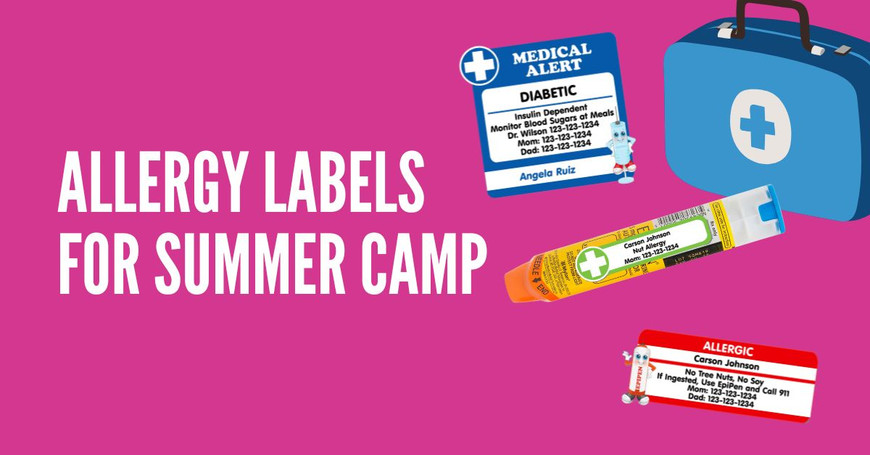
Camp is the hardest environment to manage a child's food allergy. Not because camps are careless — most are exceptionally careful — but because the physical environment creates conditions that don't exist at school. Meals happen outdoors, away from the main facility, away from the nurse's office and the medical files. Counselors rotate between cabins and activities. A child might be supervised by four different adults across a single day, none of whom know them as well as their classroom teacher does. And the distances involved mean that a reaction that is manageable at school with a nurse across the hall becomes significantly more serious when the nearest trained adult is five minutes away by golf cart.
This guide covers the specific labeling approach that works for camp — day camp, sleepaway camp, sports camp, and everything in between. What information every counselor needs before they open anything near your child, where to put it, and how to make sure it's still visible on day twelve of a two-week session.
From the founder of Sticky Monkey Labels
I'm Dodie — founder of Sticky Monkey Labels and the original creator of Peel 'n Stix® clothing labels. Two of my three boys have food allergies and both have been to summer camp. The first time I sent a child with a serious food allergy to sleepaway camp, I labeled everything and then lay awake wondering if I'd labeled enough. After fifteen years in this business and two kids through the camp system, I know what actually needs a label and what the counselors are actually looking for. That's what this guide is about.
Jump to Section
Why Camp Allergy Labeling Is Different from School
At school, your child's teacher sees them every day and knows their medical history by October. The school nurse has the file. The cafeteria staff has the list. The system is built around a consistent group of adults who know the same children all year. Camp runs on a different model. If you haven't yet built a complete labeling system for your child, our guide to how to label everything covers the full foundation before you add the camp-specific layer.
A typical camp session is one to two weeks. Counselors may change between sessions. Activities rotate daily — your child might be with their cabin counselor at breakfast and with a completely different activity leader by noon. Evening campfires involve the whole camp, managed by staff who may have no idea which children in the group have specific allergies. In this environment, the information on a label is not supplementary — it is often the only available information.
The other critical difference is physical distance from care. A child who has a reaction in a school classroom is within two minutes of the nurse's office and thirty minutes from an emergency room. A child who has a reaction at a remote camp activity site may be fifteen minutes from the nurse and forty-five minutes from a hospital. That gap in response time is why the information on a label — particularly on the EpiPen case and the child's bag — needs to be complete enough for any trained adult to act immediately without waiting for guidance from a file or a supervisor.
Before Drop-Off: Building the Information System
Labels work as the final layer of a three-part information system. Missing any layer leaves a gap.
The three-layer camp allergy information system:
- Written medical form — submitted before camp starts. Every allergen, every medication, emergency contacts, pediatrician or allergist number, and specific instructions for what to do in a reaction. Be explicit: "carries EpiPen Jr. in front pocket of blue drawstring bag — use at first sign of anaphylaxis."
- Phone confirmation — call the camp nurse or director before drop-off to confirm they received and reviewed your child's form. Ask specifically who is responsible for knowing your child's allergy information and whether all activity leaders are briefed at session start.
- Physical labels — on every container, every bag, and every piece of equipment your child brings. These are the only layer that works at the moment of contact, in the field, away from offices and files.
The written form ensures the camp's medical system has the information. The phone call ensures a human has reviewed it and knows it applies to your child. The labels ensure the information is visible at every point of contact between a counselor and your child's belongings, regardless of who that counselor is or how recently they were briefed.
What to Label at Camp for a Child with Allergies
Camp requires significantly more label coverage than school. Every item your child touches at mealtimes needs an allergy label, and every large bag or container needs one on the exterior so it's visible without opening anything.
Food & Mealtime Items
- Water bottle — body and lid
- Every food container in the snack bag
- Lunchbox exterior (day camp)
- Snack bags — label the bag itself
- Any personal food brought from home
- Reusable utensil case
Bags & Equipment (Exterior)
- Duffel bag — front exterior panel
- Trunk — lid exterior and inside lid
- Drawstring activity bag
- Sleeping bag stuff sack
- Sports equipment bag
- Backpack or daypack exterior
Also label your child's medication case, the specific compartment of their bag where the EpiPen or antihistamine is kept, and any allergen-safe snacks packed for times when camp food isn't safe for your child. A label reading "SAFE SNACK FOR [NAME] — PEANUT ALLERGY — Do not share" ensures the snack gets to the right child and doesn't end up distributed to the group.
EpiPen and Medication Labeling at Camp
The EpiPen label is the most critical single label your child takes to camp. It needs to be on the case itself and on the bag compartment where it lives. The label should include: your child's name, the word EpiPen, the allergy it treats, and one emergency contact number. If camp policy requires the EpiPen to stay with the nurse, the label on your child's bag should say where it is: "EpiPen with camp nurse, Health Center, [your child's name] — Peanut allergy — Call [number]."
This matters because in an emergency, the first adult to reach your child may not be their assigned counselor. A counselor from another cabin, a camp maintenance worker, or another camper's parent at a visiting day could be the first adult present. The label on the bag tells them immediately what the child's allergy is, that an EpiPen exists, and where to find it or who to call to get it. That fifteen-second instruction loop — reading the label, knowing the allergy, knowing the medication location — is what waterproof allergy labels are designed to make possible.
For children on daily medications in addition to emergency allergy treatment, label every medication bottle or packet with your child's name and the dosage schedule. See our full guide on back to school labels by grade for how labeling needs change from preschool through high school — many of the same labeling principles that apply at school apply at camp. Camps manage dozens of children's medications — a clear name label on every bottle ensures the right medication reaches the right child, every time.
Day Camp vs Sleepaway Camp — What Changes
| Item | Day Camp | Sleepaway Camp |
|---|---|---|
| Food containers | Label every container — goes home same day | Label every container — labels must last full session |
| Bags | Backpack or daypack exterior | Trunk lid, duffel, drawstring bags, sleeping bag sack |
| Medication | In child's bag — label case and bag compartment | May be held by nurse — label case, label bag with nurse location |
| Car seat label | Critical for carpool drop-off and pick-up | Critical for transportation to/from camp and camp outings |
| Label durability needed | One to two weeks, daily use | Two to eight weeks, outdoor conditions, daily dishwasher |
The most significant difference is transportation. At sleepaway camp, your child may travel by bus or van to off-site activities multiple times during a session. In these situations, the car seat or vehicle seat they travel in should carry their allergy and emergency contact information. Our car seat emergency labels fit this purpose exactly — they carry your child's name, allergens, medications, and emergency contacts on the seat itself, visible to any driver or adult in the vehicle.
Which Allergy Labels to Order for Camp
| Label Type | Goes On | What It Communicates |
|---|---|---|
| Waterproof Allergy Labels | All food containers, water bottle, lunchbox | Specific allergen + parent number at point of food contact |
| Medical Alert Labels | Duffel, trunk, activity bag, medication case | Complete medical information including medications and contacts |
| Car Seat Emergency Labels | Car seat or transportation seat | Full emergency information visible to any first responder |
| Safety Labels for Kids | Multiple items — complete allergy and safety pack | Full coverage across every camp scenario |
For the complete guide to allergy labeling at school and daycare, see allergy labels for kids — the complete guide. For everything else your child needs labeled for camp, including all clothing, gear, and equipment, see our complete sleepaway camp packing and labeling guide. Questions about which labels are right for your child's situation? Call us at 1-888-780-7734.
About the Author