
From the founder of Sticky Monkey Labels
I'm Dodie — mom of three boys, two with food allergies and one with special needs, and founder of Sticky Monkey Labels. I'm now in my 15th year of business, which started in 2011. Bottle labels are one of our best sellers — and also one of the most common sources of questions from new daycare parents who aren't sure what they need, what goes on the label, or why the lid needs its own. This post answers all of it.
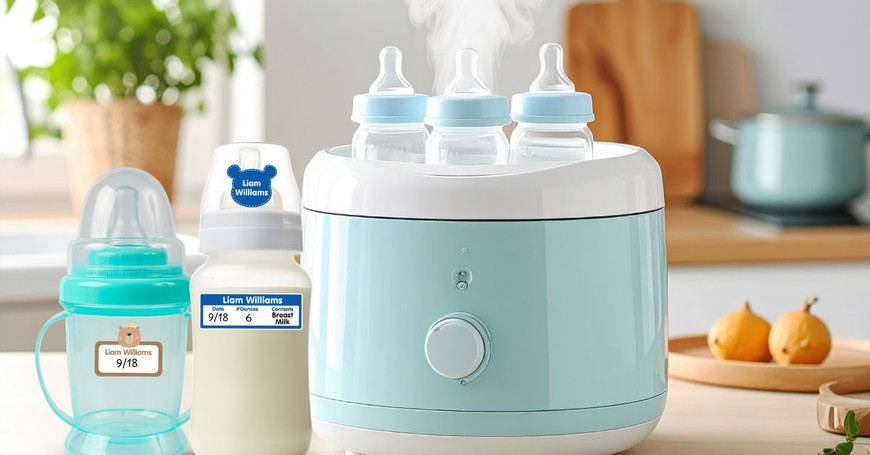
Before your child's first day of daycare, the bottles need labels. Not a name written in marker on a piece of tape. Not initials on the bottom in permanent marker. Proper waterproof labels that survive your home dishwasher and bottle sterilizer night after night, tell the daycare provider everything they need to know at a glance, and are still legible and firmly stuck at pickup.
Daycare bottle labeling has more requirements than most parents expect — and more moving parts. The label on the bottle itself isn't enough. The lid needs its own separate label. The information on the label needs to be specific. The writing tool matters. And which surface you apply to on different bottle shapes determines whether the label stays on all week or peels off in the first dishwasher cycle.
This guide covers all of it: what information every daycare bottle label needs, how to write on a label and what not to use, the lid rule that most parents learn the hard way, placement by bottle type, and what "dishwasher safe" actually means when the dishwasher is a commercial machine at a licensed childcare facility.
What's in this guide
- What daycare actually requires on a bottle label
- The lid rule — why every lid needs its own separate label
- Wax pencil vs. semi-permanent marker — which add-on to choose
- Placement guide by bottle type
- Home dishwasher and bottle sterilizer — how to make labels last
- Breast milk labels — the additional information required
- The bottles that are hardest to label correctly
- How many labels do you need?
- Frequently asked questions
1. What Daycare Actually Requires on a Bottle Label
Most licensed daycare facilities follow state childcare regulations that specify what information must appear on a labeled bottle. The exact requirements vary by state, but the core information is consistent across almost all licensed facilities:
Standard daycare bottle label information
- Child's full name — first and last. First name only is not sufficient at most facilities where multiple children may share a first name.
- Date — the date the bottle was prepared or the milk was expressed. This is how daycare staff manage rotation and identify bottles that have expired or need to be discarded.
- Contents — breast milk, formula, or the specific type of formula if the facility has multiple infants on different formulas. This matters for allergy and medical reasons, not just organization.
- Volume or ounces — how much is in the bottle. This helps staff feed the right amount and track intake accurately.
Some facilities also require the time of preparation, your contact phone number, or a designation for each feeding (morning feed, midday feed). Check your specific daycare's handbook or ask the director for their exact requirements before your first drop-off — arriving with correctly labeled bottles on day one makes an immediate impression with providers.
2. The Lid Rule: Why Every Lid Needs Its Own Separate Label
This is the detail most parents learn the hard way on day two of daycare. Label the bottle. Label the lid. Separately. Both pieces. Every time.
Here's what happens in a daycare kitchen without this rule in place: bottles come in labeled, get rinsed and washed, and the lids — which float, separate, and get stacked — lose their connection to the bottles they came with. By the time cleanup is done, the labeled bottle is sitting next to three unlabeled lids. A provider who cares will try to match them up. A provider who is managing eight infants and a feeding schedule will put the closest lid on the closest bottle.
Your child doesn't care which lid is on their bottle. Your daycare provider cares that the bottle is labeled and ready. But if the lid lands on someone else's bottle — especially in a facility with infants on different formulas, different milk types, or different feeding schedules — it matters for more than organizational reasons.
The lid label rule in practice
- Place one label on the body of the bottle — name, date, ounces, and any other required fields.
- Place one label on the top or side of the lid — name at minimum.
- Matching lid labels are included with our write-on bottle labels — the lid label has your child's name already printed, so the set works together from day one. Choose from solid shape lid labels in a range of colors to match your bottles.
- Optional add-on — animal lid labels: If you want something a little more fun on the lid, our animal bottle name labels are an adorable option. These are not included with the write-on bottle label set but can be purchased separately and used as the lid label alongside any bottle label order.
- Apply both labels before the bottle leaves your kitchen. Never label in the car or at drop-off.
3. Wax Pencil vs. Semi-Permanent Marker: Which Add-On to Choose
Our bottle labels include a printed name and can include other fixed information. But date, ounces, and contents change with every feeding — so many parents order a writing add-on to fill in the daily details directly on the label surface. There are two options, and they work completely differently.
Wax pencil — for bottles and wet surfaces
The wax pencil writes on smooth label surfaces and produces a waterproof mark. It's the right choice for anything that will go through a dishwasher or be exposed to moisture — bottles, sippy cups, and any container that gets wet.
The one rule with a wax pencil: write and go. Do not rub or smudge what you've written — wax pencil marks will smear if rubbed after writing. Write the date, ounces, and any other required fields, then set the bottle down and move on. Once set, the mark is waterproof and survives the wash.
Semi-permanent marker — for name labels, bags, folders, and school supplies
The semi-permanent marker writes on name labels, bags, folders, lunchboxes, and school supplies. It lasts significantly longer than a standard marker on label surfaces and is the right choice for anything that stays dry. Many parents also prefer it for bottle labels — it works well and holds up if that's your preference. Both options are available and both work — choose the one that fits your routine.
4. Placement Guide by Bottle Type
Different bottle shapes present different labeling challenges. The goal in every case is the same: maximum smooth flat surface for adhesion, away from areas that get gripped, dunked, or constantly handled during a feeding.
Standard straight-sided bottles (Philips Avent, Dr. Brown's wide-neck, MAM)
The easiest bottles to label. Place the label as close to the top of the bottle as possible — nearest the plastic nipple ring. This is the most visible spot for daycare staff during a feeding and keeps the label away from the base where it gets set down on wet surfaces repeatedly. Never place labels in the middle or bottom of the bottle. Clean the surface with alcohol first, apply firmly across the full label surface.
Curved or petal-shaped bottles (Comotomo, Boon Nursh)
These bottles have a soft silicone body — and silicone is a non-stick surface by nature. It's the same reason silicone bakeware releases food so easily: nothing bonds to it reliably, including label adhesive. No label will stick to the silicone body of these bottles long-term, regardless of how carefully it's prepared or applied. If you have silicone-bodied bottles, the solution is to apply the label to the plastic nipple ring at the top of the bottle — the hard plastic collar that holds the nipple in place is a smooth, stable surface that labels adhere to very well. Place the label on the outside of the plastic ring, as close to the top as possible, so it remains visible during feeding.
Narrow-neck bottles (Dr. Brown's standard, Evenflo, Playtex)
Narrow-neck bottles have a smaller surface area to work with. Use a rectangle label sized appropriately for the bottle diameter — a label that's too wide for the bottle diameter will lift at the edges immediately. Our baby bottle labels come in sizes calibrated for standard bottle diameters. Apply on the flattest section of the body, below the graduated measurement markings if possible so the label doesn't obscure the ounce lines staff use during feeding.
Angled or vented bottles (Dr. Brown's Options+, Tommee Tippee)
Bottles with an angled neck or internal venting system still have a straight-sided body section below the angle — that's where the label goes. Don't try to label across the angled portion or near the vent tube. Find the flattest straight-sided section of the lower body and apply there.
Measurement markings — label above or below, not over
On any bottle with graduated ounce markings printed on the body, place the name label either above the markings (near the neck) or below them (near the base) — not over them. Daycare providers use those markings during every feeding to track intake. A label covering the measurement lines is a label that creates problems for the people caring for your child.
5. Home Dishwasher and Bottle Sterilizer: How to Make Labels Last
Daycares do not wash bottles for you. You send clean bottles in the morning and take them home at pickup to wash each evening — in your home dishwasher, in a bottle sterilizer, or by hand. Our labels are designed and tested to survive all three methods.
One important habit to build into your evening routine: wipe off what you wrote on the label before washing. The wax pencil writing from that day's date, ounces, and contents should be removed before the bottle goes into the dishwasher or sterilizer. The label itself stays on the bottle permanently — only the daily written information comes off so you have a clean write-on surface ready for the next morning.
Application steps that determine dishwasher performance
- Clean the surface with alcohol first. Remove oils, soap residue, and any surface contamination before applying. This is the most important step and the one most often skipped.
- Apply to a completely dry surface. Any moisture under the label creates a weak point that the dishwasher will find immediately.
- Press firmly across the full label surface. Work from the center out, pressing every edge flat. Any lifted edge is where water gets in during a high-pressure cycle.
- Allow 24 hours before the first dishwasher cycle. Labels applied and immediately sent through the dishwasher have not finished curing. The first cycle is the most stressful the label will ever face — it needs to be fully set before that happens.
6. Breast Milk Labels — The Additional Information Required
Breast milk storage at daycare has stricter labeling requirements than formula, and for good reason. Breast milk is a perishable food with specific storage timelines, and daycare facilities — particularly those accredited or licensed at higher levels — are required to manage it carefully.
What a breast milk bottle label needs
- Child's full name
- Date expressed — not the date you're sending it, the date it was expressed
- Time expressed — required at many facilities for proper rotation management
- Volume in ounces
- "Breast Milk" designation — clearly identified as breast milk, not formula
- Fresh, refrigerated, or frozen — some facilities require this designation to manage storage correctly
Breast milk storage bags and freezer bags
If you're sending frozen breast milk in storage bags alongside bottles, those bags also need labels — full name, date expressed, and volume. A small waterproof label on the smooth area of the bag that isn't sealed holds well on the plastic surface of most breast milk storage bags. Some facilities require a separate sticker on each bag rather than writing directly on the bag surface — check with your provider before your first drop-off.
7. The Bottles That Are Hardest to Label Correctly
After 15 years of helping parents label bottles for daycare, there are a handful of bottle types that consistently cause problems — not because the labels are wrong, but because the bottle surface is challenging. Knowing this in advance helps you apply correctly the first time.
Silicone-bodied bottles (Comotomo, Boon Nursh, similar)
Silicone is a non-stick surface — the same property that makes silicone bakeware release food so easily means no adhesive label will bond to it reliably. This isn't a label quality issue; it's the nature of the material. The solution is the plastic nipple ring. Every silicone bottle has a hard plastic collar at the top that holds the nipple in place — that ring is smooth, stable, and bonds well to waterproof labels. Apply your label there, as close to the top as possible. Our write-on bottle labels have a version specifically designed to wrap the plastic nipple ring of silicone bottles — sized and shaped to fit that surface correctly.
Heavily textured or grip-pattern bottles
Labels cannot be placed on textured surfaces. A raised dot pattern, ridges, or grip molding means the adhesive contacts only the raised peaks — not the full label surface — creating immediate lift points that the dishwasher will find on the first cycle. If your bottle has a textured body, look for any smooth area — often just below the nipple ring near the neck — and place the label there. If the entire bottle is textured with no smooth panel anywhere on the body, use the plastic nipple ring as your label surface, the same approach as silicone-bodied bottles.
Stainless steel bottles and insulated bottles
Stainless steel is an excellent surface for waterproof labels when prepared correctly. The challenge is that stainless steel holds oils and fingerprints well — which are exactly what prevents label adhesion. Clean with alcohol and allow to fully dry before applying. Powder-coated stainless bottles (colored finishes) require the same prep. Once applied correctly on a clean dry stainless surface with the full 24-hour cure time, labels on stainless steel perform very well through repeated dishwasher cycles.
Slim or rim labels — for narrow-neck bottles and sippy cups
Very narrow bottles and sippy cups with minimal flat surface area need a label sized for that surface. Our slim rim labels are specifically designed for narrow bottle necks and sippy cup rims where a standard rectangle would wrap around the curved surface and lift at the edges. Matching label size to bottle diameter is as important as surface prep for bottles that are borderline in size.
8. How Many Labels Do You Need?
More than you think — because you're labeling the bottle and the lid, which doubles the count. A family sending three bottles to daycare each day needs six labels minimum: three for bottle bodies and three for lids. Add the daycare bag, any snack containers, clothing, and shoes, and the count grows quickly.
Estimating your bottle label count
- Number of bottles sent to daycare each day × 2 (body + lid)
- Any backup or spare bottles kept at daycare × 2
- Sippy cups or transition cups × 2 each
- Breast milk storage bags — 1 label per bag if required by your facility
- Add 20% for replacement labels over the first few months as some bottles are replaced or labels wear with heavy use
For most new daycare families, the most efficient way to cover everything before day one is to order both a bottle label set and a clothing label set separately — your daycare will almost certainly require an extra change of clothes labeled with your child's name, along with labeled shoes and any bags. Browse our daycare label packs for bottles and gear, and our clothing labels for the outfits, socks, and shoes that go with your child every day.
Frequently Asked Questions
Can I just write on the bottle with a permanent marker instead of using labels?
You can, but it won't last. A standard permanent marker on plastic, glass, or stainless steel fades or wipes off within a few dishwasher cycles or sterilizer runs — sometimes within the first wash. A proper waterproof label applied to a clean, prepared surface will outlast a marker by many months. The purpose of the label is for staff to be able to read it reliably every single day — not just on day one.
My label keeps peeling off in the dishwasher. What am I doing wrong?
Almost always one of four things: the surface wasn't cleaned with alcohol before applying (oils from your hands or soap residue prevent the adhesive from bonding fully), the surface was damp when you applied the label, the label wasn't pressed firmly enough across all edges, or the bottle went through the dishwasher before the 24-hour cure time was up. The dishwasher doesn't fail labels — insufficient preparation does. Start fresh with alcohol-cleaned, completely dry surface, firm full-coverage pressure, and 24 hours before the first cycle.
Do I need different labels for the bottle body vs. the lid?
Your lid label is included with our write-on bottle label sets — it has your child's name already printed and is sized correctly for standard bottle caps. Choose from solid shape lid labels in a range of colors, or add our animal bottle name labels as a separate add-on for something more fun on the lid. Either way, size matching is handled — the lid label fits standard caps without overhanging the edges the way a rectangle label would.
My daycare says labels must be changed daily. Is that normal?
Yes — this is a standard policy at many licensed daycare and childcare facilities, particularly infant rooms. The daily date requirement means the date information must be current, even if the name and other details stay the same. This is why write-on labels or a combination of a permanent name label and a daily date label are popular solutions. If your facility requires a fresh label each day, order a quantity that supports daily use across the full week — the wax pencil lets you write the current date each morning on a label that stays put on the bottle long-term.
Can I put bottle labels in the microwave?
We do not recommend microwaving bottles with labels attached. Even if the bottle itself is microwave safe, the label adhesive and printing are not tested for microwave use. Remove the label, or use the label only on bottles that are heated by warm water bath — which is the recommended method for breast milk anyway. Daycare facilities typically warm breast milk in warm water rather than the microwave, so this is not usually an issue for daycare-specific bottles.
What's the difference between the wax pencil and the semi-permanent marker?
The wax pencil is designed for wet environments — bottles, containers, anything going through a dishwasher regularly. Write and go — don't rub what you've written and it holds up through washing. The semi-permanent marker works on name labels, bags, folders, lunchboxes, and school supplies, and many parents prefer it for bottle labels too. If your bottles go through the dishwasher daily, the wax pencil is the more durable choice for that specific use — but both are available and both work. Add either or both to your order at checkout.
How far in advance should I label bottles before the first daycare drop-off?
Apply labels at least 24 hours before the first use — ideally before the first dishwasher or sterilizer run. The adhesive continues curing during this window, and a label that has fully set before its first wash will perform significantly better than one applied the morning of drop-off. Label your bottles the weekend before your first week of daycare — not the night before.