
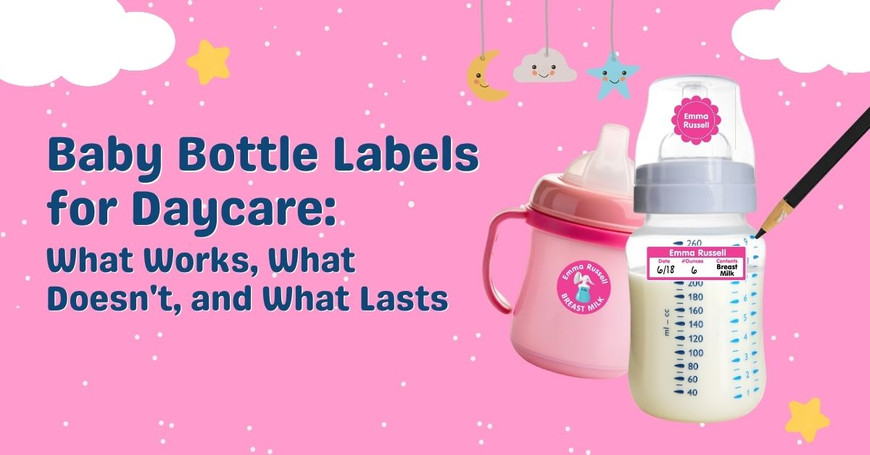
Baby bottle labels for daycare have a harder job than labels on a school water bottle — not because daycare washes them for you, but because the bottles come home and go straight into a dishwasher, bottle sterilizer, or hot water soak every single evening. Add to that the silicone components most modern baby bottles have, and the daily disassembly during rinsing at daycare, and you have a labeling situation where most labels that look fine on a casual water bottle fail on a daycare bottle within the first couple of weeks. This guide explains exactly why — and what to use instead.
Whether you're sending your baby to daycare for the first time or switching to a labeling system that actually survives the year, here's everything you need to know about baby bottle labels, sippy cup labels, labeling daycare clothes, and setting up the entire daycare bag before your first drop-off.
From the founder of Sticky Monkey Labels
I'm Dodie — mom of three boys and founder of Sticky Monkey Labels, now in my 15th year. Baby bottle labeling for daycare is one of the most specific labeling challenges I get asked about. The conditions are genuinely different from anything else we label. Here's what works.
What's Covered
- Why daycare bottle labeling is harder than school bottle labeling
- Silicone vs plastic vs glass — which surface works for labels
- How to apply baby bottle labels that actually last
- Sippy cups and training cups — same rules, different surfaces
- Beyond the bottle — labeling everything in the daycare bag
- The Baby Labels Pack — 104 labels for the full daycare setup
- The Daycare Labels Pack — 104 labels for toddlers and older babies
- Labeling daycare clothes — stick-on or iron-on?
- Frequently asked questions
Why Daycare Bottle Labeling Is Harder Than School Bottle Labeling
Three specific conditions make daycare bottles a more demanding labeling challenge than a school water bottle:
Daily home washing and sterilizing
Daycares rinse bottles — parents wash them. Every evening, daycare bottles come home and go straight into a home dishwasher, bottle sterilizer, or hot water soak. That's a daily high-heat cycle the label has to survive, every single day. Labels that look fine on a water bottle used a few days a week can fail on a baby bottle washed every evening without the right prep.
Silicone sleeves and components
Most modern baby bottles include significant silicone components — sleeves, grips, anti-colic vents, nipples and collar rings, and base boots. Nothing adheres to silicone. Families who label the silicone sleeve of a baby bottle instead of the hard plastic or glass body underneath find their label has peeled off before the second wash. The body of the bottle, where the hard surface is, is where labels belong.
Daily disassembly during rinsing at daycare
Daycare staff rinse bottles disassembled — cap, collar, nipple, and bottle body all separated. An unlabeled cap on a labeled bottle means the cap ends up in the communal rinsing area and the next family to collect grabs the wrong one. Every component needs its own label or a label that's visible on the assembled bottle from outside — so staff can sort quickly without having to disassemble to find a name.
Silicone Vs Plastic Vs Glass — Which Surface Works for Baby Bottle Labels
The surface of the bottle body determines whether a waterproof label will hold through daily daycare washing. Here's the breakdown for every bottle type currently popular in daycare settings:
✅ Label-Compatible Surfaces
- Hard plastic bottle body (BPA-free, Tritan)
- Glass bottle body (smooth exterior)
- Stainless steel bottle body
- Hard plastic collar and ring (smooth area)
- Hard plastic lid or cap (smooth surface)
❌ Labels Won't Hold
- Silicone bottle body or sleeve
- Silicone nipple and collar
- Rubber grip or silicone base
- Textured or embossed surfaces
- Any silicone component
How to Apply Baby Bottle Labels That Actually Last
The application process for baby bottle labels is the same as for any waterproof label — the prep step is what determines whether a label survives daily home dishwasher and sterilizer cycles. A label that fails in week one means re-labeling under pressure every morning at drop-off, and an unlabeled bottle at daycare is a mixed-up or lost bottle.
- Identify the smooth hard surface on the bottle body. Find the area of the bottle body that is smooth, hard, and non-silicone. For bottles with silicone sleeves, look for exposed hard plastic or glass above or below the sleeve. That's where the label goes.
- Wipe the surface with isopropyl alcohol. Apply to the specific area where the label will go and let dry completely — 30 seconds. This removes the manufacturing residue, formula residue, and skin oils that prevent adhesive bonding. At daycare temperatures, a label without this prep step typically fails within the first week.
- Make sure the surface is completely dry and at room temperature. A bottle fresh from the dishwasher or sterilizer needs to cool completely before labeling. Applying a label to a warm surface means the adhesive sets against a surface that will then cool and contract — the bond isn't as strong.
- Press the label firmly from center outward. Start at the center and smooth toward every edge. Run a thumbnail along all four edges with firm pressure — the edges are where daily dishwasher cycles lift labels first.
- Wait 24 hours before the first wash or sterilization cycle. The adhesive needs 24 hours to fully cure before being exposed to dishwasher heat or sterilizer cycles. Apply labels in the evening with plenty of time to cure overnight before morning drop-off.
Sippy Cups and Training Cups — Same Rules, Different Surfaces
Sippy cups and training cups follow the same labeling principles as baby bottles, with one additional complication: these cups often have more components than bottles — handle attachments, spout covers, straw inserts, and multiple lids — and more of those components are silicone or soft plastic.
For sippy cups going to daycare, label every hard plastic component that has a smooth flat area. The cup body gets a slim rectangle label on the smooth hard plastic surface — never on a silicone grip or handle. A small round label goes on the lid if there's a smooth hard surface area available. Straw inserts and soft spouts are silicone and won't hold a label — name stickers for water bottles of this type need to go on the cup body, not the accessories.
Name stickers for water bottles and sippy cups that survive daily home washing are the same product as all our waterproof labels — dishwasher-safe when applied correctly to hard smooth surfaces with the alcohol prep step. The label itself is the same product. The prep step is what changes whether it lasts one wash or the full daycare year. For help choosing the right sippy cup for daycare, see our guide to the best sippy cups for toddlers.
Beyond the Bottle — Labeling Everything in the Daycare Bag
Baby bottle labels are the most time-sensitive daycare labeling task — the bottle comes home and gets washed every evening, and needs a working label every day. But the bottle is not the only item in the daycare bag that needs a name on it. Here's the complete list of what daycare staff consistently ask families to label. For the full room-by-room breakdown, our complete daycare labeling checklist covers every item before drop-off.
Waterproof Labels
- Every baby bottle — body and lid
- Every sippy cup — body and lid
- Formula container or breast milk storage
- Food containers and lids
- Snack containers
- Ice packs
- Diaper bag — tag or smooth interior lining
- Sunscreen tube
- Diaper cream tube
- Pacifier case or holder
Clothing Labels
- Every garment sent to daycare
- Spare outfit — every garment and the bag
- Jacket or outerwear
- Hat and mittens
- Shoes — both shoes of every pair
- Sleep sack if used at daycare
- Comfort item if permitted
The Baby Labels Pack — 104 Waterproof Labels for the Full Baby Daycare Setup
Our Baby Labels Pack is designed specifically for the range of surfaces a baby's daycare kit requires — from the bottle body and lid down to food containers, personal care items, and shoes. 104 waterproof labels in the sizes that fit every baby and infant daycare surface.
Baby Labels Pack — 104 Waterproof Labels
- 20 Classic Rectangle labels
- 18 Slim Rectangle labels
- 14 Extra Small Rectangle labels
- 4 Medium Round labels
- 32 Small Round labels
- 8 pair Duck Shoe Labels (exclusive to this pack)
Duck Shoe Labels — exclusive to the Baby Pack
8 pair of our Duck Shoe Labels, designed for tiny infant and toddler shoes that standard shoe labels don't fit properly. The small format fits the inner sole of baby shoes, booties, and early toddler footwear. Not available in any other pack.
Best for: Infants and babies in daycare, complete baby bottle and daycare item labeling, families setting up for daycare for the first time.
The Daycare Labels Pack — 104 Labels for Toddlers and Older Babies
Our Daycare Labels Pack is designed for toddlers and older babies whose daycare kit includes more variety — sippy cups, food containers, snack bags, a fuller range of supplies, and shoes. 104 waterproof labels with the Extra Large Rectangle exclusive to this pack — the biggest label in our range for larger surfaces.
Daycare Labels Pack — 104 Waterproof Labels
- 1 Extra Large Rectangle (exclusive)
- 12 Large Rectangle labels
- 20 Slim Rectangle labels
- 19 Extra Small Rectangle labels
- 1 Large Round label
- 3 Medium Round labels
- 40 Small Round labels
- 3 pair Shoe Labels — Foot-Shape or Heel-Shape, or swap for 11 additional labels
Extra Large Rectangle — exclusive to the Daycare Pack
The largest label in our range — designed for large flat surfaces on lunch bags, daycare bags, and large containers. Not available in any other pack.
Best for: Toddlers and older babies in daycare, families who need more volume and larger label sizes for a fuller daycare kit.
Browse both packs and our complete daycare labeling range at Sticky Monkey Labels. Questions? Call us at 1-888-780-7734.
Labeling Daycare Clothes — Stick-On or Iron-On?
Bottles and containers are only half of the daycare labeling job. Labeling clothes for daycare is the other half — and the one most families underestimate until the first time a spare outfit comes home on someone else's child. Every garment that leaves the house needs a name on it. The question is which type of clothing label is right for your situation.
Stick-On Clothing Labels
Press onto the care tag inside any garment — no heat, no waiting. Stick-on clothing labels are the fastest way to get a name on every item before your first drop-off. They survive regular machine washing and are the go-to for families who need to label a full wardrobe quickly.
Best for: Quick setup, full wardrobe labeling, families who rotate hand-me-downs or want labels they can remove later.
Iron-On Clothing Labels
Heat-bonded directly into the fabric of any garment — no tag needed. Iron-on labels bond permanently to the care tag or directly to the garment fabric, surviving repeated washing and tumble drying without peeling or curling. More permanent than stick-on, and the choice for items that go through heavy use.
Best for: Long-term labeling, items without care tags, garments that get heavy daily use at daycare.
Both options are available across all our designs and are sized specifically for kids' clothing from infant to school age. If you're setting up for daycare from scratch, our daycare label packs include waterproof labels for bottles and containers — pair them with a set of clothing labels to cover both the bottles and the bag in one order.
Frequently Asked Questions
What are the best baby bottle labels for daycare?
Waterproof adhesive labels applied to the smooth hard plastic or glass body of the bottle — not to any silicone component. The prep step (isopropyl alcohol wipe before applying) and 24-hour cure before first wash are what make baby bottle labels survive daily dishwasher and sterilizer cycles. Our baby bottle labels for daycare applied correctly to an alcohol-prepped hard surface hold through daily home dishwasher and sterilizer cycles all year.
Do silicone baby bottle labels exist — and do they work?
Silicone baby bottle labels as a category — labels designed to stick to silicone bottle surfaces — do not work in any practical sense. No pressure-sensitive adhesive reliably bonds to silicone through repeated home dishwasher or sterilizer cycles. The solution for bottles with silicone sleeves is to label the hard plastic or glass body surface above or below the silicone sleeve. That's the stable, label-compatible surface. If the bottle has no exposed hard surface — it's entirely silicone — write-on labels or identification bands that physically wrap around the bottle are the only alternatives.
Are waterproof baby bottle labels safe for bottles that get sterilized?
Our waterproof name labels are designed for dishwasher-safe use on hard surfaces. For steam sterilization and bottle sterilizers — common for baby bottles — apply labels to the outside of the bottle body only, away from any surface that contacts food or liquid. Applied to the exterior hard surface with the alcohol prep step and 24-hour cure, our labels hold through daily home dishwasher and sterilizer cycles.
What is the best way to label clothes for daycare?
Stick-on clothing labels are the fastest option — press directly onto the care tag inside any garment, no heat required, and they're laundry safe through regular machine washing. Iron-on labels are more permanent, bonding directly to the care tag or garment fabric through heat — the better choice for items that get heavy daily use or for garments without a care tag. Both work for daycare labels for clothes. The most important thing is labeling every garment, including the spare outfit — that's the one daycare staff find unlabeled most often.
What is the difference between the Baby Labels Pack and the Daycare Labels Pack?
Both packs have 104 waterproof labels. The Baby Labels Pack is designed for infants — it includes our Duck Shoe Labels (8 pair, exclusive to this pack) for tiny baby shoes that standard shoe labels don't fit, and a label distribution suited to bottles and infant-specific items. The Daycare Labels Pack is designed for toddlers and older babies — it includes the Extra Large Rectangle (exclusive to this pack) for larger daycare bag surfaces and a fuller range of sizes for a more varied toddler kit, plus shoe label options or the ability to swap for additional labels. Browse both at stickymonkeylabels.com.
Why do my baby bottle labels keep peeling off at daycare?
Almost certainly one of three reasons: the label was applied to a silicone surface (nothing holds to silicone — move the label to the hard plastic or glass body), the alcohol prep step was skipped (invisible residue on bottle surfaces prevents adhesive bonding through daily dishwasher and sterilizer cycles), or the label was washed within 24 hours of application before the adhesive fully cured. All three are preventable. The alcohol prep step on a fully clean, room-temperature hard surface followed by 24 hours of cure before the first wash is the complete solution to early label failure.