
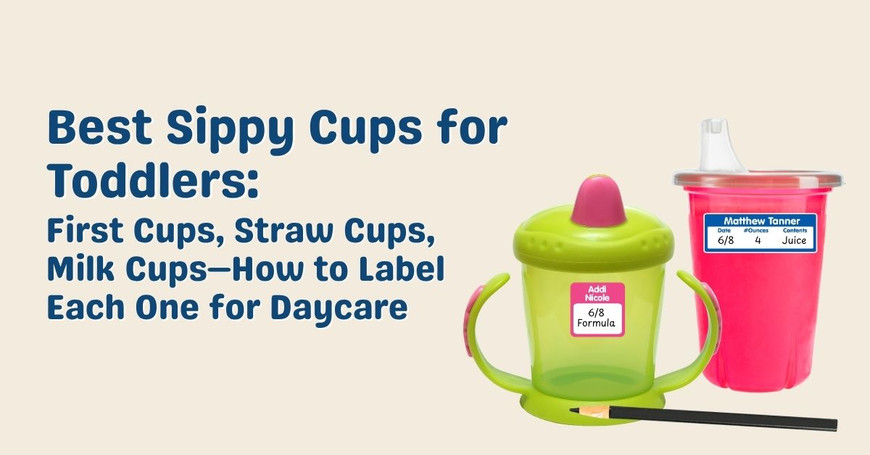
The move from bottle to sippy cup is one of the earliest transitions parents navigate — and for families with babies and toddlers in daycare, it often happens faster than expected. Caregivers encourage the transition, development milestones push it forward, and suddenly you're researching sippy cups the same way you researched bottles: which type is best, which works for milk, which handles the daycare routine, and which your toddler will actually use.
This guide covers the sippy cup types that work best at each stage — first cups for 6-month-olds, transition cups, straw cups for older toddlers, and milk-specific options — and the labeling question that every daycare family faces once they've picked a cup: how do you get a name on it so it comes home?
From the founder of Sticky Monkey Labels
I'm Dodie, founder of Sticky Monkey Labels — now in my 15th year making waterproof name labels for families. The sippy cup labeling question comes up right after the bottle labeling question for almost every daycare family. I was the first company to develop labels specifically sized and designed for the variety of bottles and cups parents are actually using — because no two cups are the same and one label does not fit all. Here's everything I know about both the cups and getting the right label on each one.
What's Covered
Sippy Cup Types — Which Works at Which Stage
Not all sippy cups are the same, and the right cup at six months is usually the wrong cup at two years. The sippy cup category covers several distinct designs that serve different developmental stages — and daycare settings often have preferences about which types they'll use with infants versus older toddlers.
First Sippy Cups — 6 Months and Up
The best first sippy cup for a 6-month-old is typically a soft-spout cup designed to ease the transition from breast or bottle. Soft silicone spouts mimic the feel of a bottle nipple and require minimal suction, making them accessible for babies just learning to drink from a cup. The body is usually hard plastic with a handle designed for small hands to grip. Most 6-month-old sippy cups are dishwasher safe and designed for breast milk, formula, and water.
At this stage, function over everything. The best sippy cups for 6 month olds are the ones a baby will actually accept — which often means experimenting with two or three styles before finding the right fit. Soft spouts, handles on both sides, and a slow-flow design are the features most parents prioritize for the earliest sippy cup introductions. Parents often shop for these as their baby's "my first sippy cup" — and starter sippy cups in this soft-spout style are the ones most likely to be accepted right away, because they feel closest to the bottle a baby already knows.
Sippy Cups for a 1-Year-Old
By the first birthday, most children are ready to move on from the earliest soft-spout starter cups. The best sippy cups for 1 year olds sit right at the crossover point — a one-year-old often has the oral motor skills for a straw or a firmer spout, but may still prefer the handles and slower flow of a transition cup. When choosing a sippy cup for one year old use, look for a leak-proof lid, a hard plastic body that stands up to daily daycare handling, and a shape wide enough to hold a waterproof name label. Many parents keep two sippy cups for one year old routines going at once — a straw cup for water and a spout or transition cup for milk — while their toddler settles on a favorite.
Toddler Sippy Cups — 12 Months to 3 Years
As toddlers develop, the best sippy cup for a 2-year-old is usually a harder spout or straw cup rather than a soft spout design. By 12 to 18 months most toddlers have the oral motor skills to use a straw, and speech therapists frequently recommend transitioning to straw cups at this stage. The best sippy cup for a 3-year-old is often less about developmental need and more about practical durability — leak-proof, easy to clean, straw-based, and tough enough to survive a daycare bag.
Best Sippy Cups for Milk
Milk is the sippy cup use case most parents research specifically because fat-containing liquids leave residue that is harder to clean than water. Whether you're looking for the best milk cups for toddlers or a toddler sippy cup for milk that survives daily daycare use, the best options share a few characteristics regardless of brand:
- Fully disassembles for cleaning. Milk residue builds up in valves, straws, and lid seams. A cup that can be taken apart completely and cleaned in every crevice stays sanitary.
- Dishwasher safe on all parts. Daily daycare use means daily dishwasher cycles. Every component needs to be top-rack dishwasher safe — not just the body.
- Slow enough flow for the age. Milk flows faster than water through the same cup. A flow appropriate for water may deliver milk too fast for a younger toddler.
- Wide enough for labeling. The best sippy cup for milk for toddlers in daycare also needs a surface wide enough for a waterproof name label. A very narrow body makes labeling difficult.
Best Sippy Cups With Straws
Straw sippy cups are the most widely recommended cup style for toddlers past 12 months. Pediatric speech therapists, occupational therapists, and dentists generally prefer straw cups over traditional spout sippy cups because the straw encourages proper oral motor development. The best sippy cups with straws for daycare share a few practical qualities beyond developmental benefit:
Look For
- Weighted straw (follows liquid in any position)
- Leak-proof lid with silicone seal
- Straw that removes for cleaning
- Hard plastic body for easy labeling
- Dishwasher safe on all parts
Watch Out For
- Straws that can't be cleaned with a brush
- Silicone-body cups (labeling challenge)
- Valves that trap milk residue
- Very narrow bodies (limited label surface)
- Components that only hand-wash safely
For daycare specifically, the best sippy cup with a straw is a hard plastic body with a simple lid that any caregiver can open, clean, and reassemble. Complex lid systems create problems when multiple caregivers handle each cup throughout the day.
Best Transition Sippy Cups — Bottle to Cup
The best transition sippy cups bridge the gap between bottle and open cup — typically for the 6 to 12 month age range. They work by mimicking features of a bottle (soft flexible spout, easy suction) while introducing the cup-drinking skill. Successful transition sippy cups require minimal suction change from what the baby already knows, don't require tilting, and have handles that accommodate an early grip.
For daycare families, the transition sippy cup phase is when the labeling question becomes urgent. Babies using transition cups at daycare need every cup and every lid labeled. Your daycare may also require contents to be marked — especially when breast milk, formula, or cow's milk go into the same style cup. The labeling section below covers the right product for every scenario.
What Daycare Requires for Sippy Cups
Daycare centers vary significantly in what they require on sippy cup labels. Before you choose a label, ask your specific center what information they need. The most common requirements fall into a few categories:
Name only
The simplest requirement — the child's first name, or first and last name, on the cup and lid. Most common for toddler rooms where contents are typically just water or milk and are less variable.
Name and contents
Common when different children receive different contents — one child has breast milk, another has formula, another has cow's milk. Caregivers need to know what's in each cup without opening it. A content label or write-on label with space for both name and contents handles this clearly.
Name, date, and contents
Common in infant rooms where breast milk and formula are strictly tracked. State licensing may require the date expressed or prepared on every breast milk container. Write-on labels with space for name and date handle this requirement cleanly.
Name, date, contents, and ounces
The most detailed requirement — all four fields. Some infant rooms track exactly how many ounces a baby took at each feeding. A write-on label surface gives caregivers a place to mark the amount alongside the other required information.
How to Label Every Sippy Cup Type for Daycare
Choosing the right label for a sippy cup depends on two things: the cup material (what will stick) and what information your daycare requires (name only, name and contents, name and date, or all four). Here is the complete guide to both.
Step One — Know Your Cup Surface
Hard plastic body cups
The most straightforward. Wipe the smooth body with isopropyl alcohol, apply a waterproof name label, press every edge firmly with a thumbnail, and allow 24 hours before the first dishwasher cycle. Apply a small round label to the lid using the same steps. Hard plastic accepts labels reliably and holds them through daily dishwasher use.
Cups with silicone sleeves or soft bodies
Nothing adheres to silicone. If the cup has a silicone sleeve or soft body, find the hard plastic sections — the body above the sleeve, or the plastic ring collar on a soft spout lid — and label those. For cups with a plastic nipple ring collar similar to a bottle, our slim labels and curved labels sized for bottle nipple rings work equally well on similar cup collar surfaces.
Straw cup lids
Always label the lid separately. Straw cup lids separate from bodies constantly in daycare bags, dishwashers, and refrigerators. A labeled cup with an unlabeled lid is a lid that doesn't come home. Apply a small round label to the flattest smooth surface on the lid with the same alcohol prep and 24-hour cure.
Step Two — Match the Label to What Your Daycare Requires
Name only — personalized waterproof labels
If your daycare only requires a name, our small baby bottle labels are sized for smaller sippy cup bodies and are waterproof, bottle warmer safe, and sterilizer safe. Personalized with your child's name and ready to apply.
Name and contents — content labels
When your daycare requires contents to be marked alongside the name, our content labels for daycare are designed for exactly this. Available in breast milk, formula, milk, and water designs — personalized with your child's name and the content pre-printed so there's no writing required at drop-off. These work on both bottles and sippy cups.
Name and date — write-on labels
For daycares that require the date (common in infant rooms tracking breast milk), our name and date write-on labels include a space to write the date fresh each day. Personalized with your child's name already on the label — you just fill in the date at home before drop-off. Waterproof, dishwasher safe, and sterilizer safe.
Fun design with write-on space
For a label that feels less clinical and more personal — particularly for toddlers who love seeing their cup look fun — our animal character write-on labels combine a cute design with a write-on space for name and any daily information your daycare requires. Waterproof, sterilizer safe, and freezer safe.
Frequently Asked Questions
What is the best sippy cup for a 6 month old?
The best sippy cups for 6 month olds are soft-spout transition cups that require minimal suction change from bottle feeding. Look for a soft silicone spout, handles on both sides for small-hand grip, slow flow appropriate for a 6-month-old's swallowing speed, and a hard plastic body that can be labeled for daycare. At this stage the goal is introducing the cup-drinking skill gradually rather than replacing the bottle immediately.
What is the best sippy cup for a 1 year old?
The best sippy cups for 1 year olds sit at the crossover point between soft-spout starter cups and straw cups. By their first birthday, many children have the oral motor skills for a straw or firmer spout but still benefit from handles and a slower flow. When choosing a sippy cup for one year old use, prioritize a leak-proof lid, a hard plastic body that survives daily daycare handling, and a shape wide enough for a waterproof name label. It's common to run two sippy cups for one year old routines at once — a straw cup for water and a spout or transition cup for milk.
What is the best sippy cup for milk?
The best sippy cup for milk is one that fully disassembles for cleaning, is dishwasher safe on all parts, and has age-appropriate flow rate. Milk leaves residue in valves and straws that builds up if cups can't be fully cleaned. When comparing the best milk cups for toddlers, a good toddler sippy cup for milk also needs a hard plastic body wide enough for a waterproof name label that survives daily dishwasher cycles.
What information goes on a sippy cup label for daycare?
It depends entirely on your daycare center and the room your child is in. Some centers require name only. Many require name and contents — especially when children in the same room have different liquids (breast milk, formula, cow's milk, water). Infant rooms commonly require name plus date to track breast milk freshness. Some centers require name, date, contents, and ounces. Always ask your specific center before labeling — requirements vary by center, room, and state licensing regulations.
Are straw sippy cups better than spout sippy cups?
Pediatric speech therapists generally prefer straw cups for toddlers past 12 months. Straw cups promote oral motor development and tongue positioning consistent with mature swallowing. For the 6 to 12 month transition period, soft spout cups are the common starting point — best sippy cups with straws become the better choice as children develop through the toddler stage.
What is the best transition sippy cup from bottle to cup?
The best transition sippy cup is the one that requires the smallest skill change from bottle feeding. Many parents start with a "my first sippy cup" style soft-spout cup from the same brand as the baby's bottle. Look for familiar suction requirements, handles for grip development, and a slow flow that matches the baby's current feeding pace — the qualities that make starter sippy cups easy for a baby to accept.
How do you label a sippy cup for daycare?
Wipe the smooth hard plastic body with isopropyl alcohol, apply a waterproof name label, press every edge firmly with a thumbnail, and allow 24 hours before the first dishwasher cycle. Apply a small round label to the lid with the same prep steps. For cups with silicone sleeves or bodies, label only the hard plastic sections — nothing adheres to silicone. Choose your label type based on what information your daycare requires — name only, name and contents, or name and date write-on.
What sippy cup labels survive the dishwasher and sterilizer?
Waterproof name labels applied correctly to an alcohol-prepped hard plastic surface with 24 hours of cure time survive daily top-rack dishwashing and bottle sterilizer use. The prep step is the most important factor — a label applied without the alcohol wipe is bonded to surface residue rather than the cup itself and will lift in the first few cycles regardless of label quality.
When should I start using a sippy cup?
The American Academy of Pediatrics recommends introducing an open cup around 6 months alongside solid food introduction, with most children fully transitioning away from bottles by 12 to 18 months. In practice, most daycare families begin introducing a sippy or transition cup around 6 months as daycare begins, with the full transition happening over the following 6 to 12 months.