Hey there, first-time daycare parent —
Someone handed you a supply list and said "label everything." But what does that actually mean? What's everything? And why can't you just write their name with a Sharpie like your older sister did? I have answers — and a few war stories that will save you from learning this the hard way.
I'm Dodie King — mom of three boys (two with food allergies, one with special needs) and founder of Sticky Monkey Labels. When my first son started daycare 15 years ago, I was completely in the dark about daycare labeling. The daycare handed me a supply list and said "everything needs to be labeled" — but nobody explained what that actually meant, what kind of labels survive real daycare conditions, or why a Sharpie was going to let me down in about four days.
This guide covers everything I wish someone had told me — plus 15 years of hearing from parents, daycare providers, and teachers about what actually works.
What's Covered in This Guide
- My epic daycare labeling fail (so you don't have to)
- What waterproof labels for daycare actually are
- What "label everything" actually means
- The items parents consistently forget to label
- How to label pacifiers for daycare
- Clothing labels — and the mouth-safety rule
- Why waterproof labels matter — real examples
- How long waterproof daycare labels actually last
- The money talk
- Age-by-age daycare labeling guide
- How to label daycare items step by step
- Baby Pack vs Daycare Pack — and everything else
- Allergy and medical labels for daycare
- My biggest labeling mistakes
- Your action plan
- Frequently asked questions
My Epic Daycare Labeling Fail (So You Don't Have To)
With my first son, I thought I was being smart. I wrote his name on his diaper pack with a Sharpie. The Sharpie transferred all over my hands and shirt while I was carrying it — and I was headed to work. I looked like I'd been finger painting with a toddler.
As I kept sending more items to daycare, I realized I wanted his name to actually stand out among all the other kids' stuff — something easier to apply and something that would last longer than three days and a rainstorm.
That's when I discovered waterproof daycare labels — and honestly, it changed everything. The labels on the market at the time were boring and plain, so eventually I started making better ones. But that's a story for another post.
What Are Waterproof Labels for Daycare?
Waterproof labels for daycare are made from vinyl with special adhesive and printed with fade-resistant ink that doesn't smudge or run. Here's what makes them different from everything else you might try:
- ✓ Made from vinyl that repels liquids, dirt, and whatever mysterious substances daycare kids generate
- ✓ Special adhesive that bonds to smooth surfaces and stays bonded
- ✓ Fade-resistant ink that stays readable through months of daily washing
- ✓ Designed to survive daycare's commercial dishwashers — which run far hotter than your home machine
- ✓ Won't leave sticky residue when you eventually remove them
What nobody tells you: Daycare isn't like home. There are 10–20 kids using similar bottles, wearing similar clothes, and everything gets mixed up constantly. Without proper daycare labels, your stuff gets sent home with the wrong family or sits in the lost-and-found permanently.
The reality: You send clean bottles in the morning, they come home dirty at pickup. You send your kid in a cute outfit, they come home covered in food, paint, and playground dirt. Everything that goes to daycare comes back home for you to wash — and your labels need to survive both daycare and your washing machine.
Ask your daycare before you label anything: What name format do they require? What information goes on bottles and breast milk? Do clothing items need first and last name or just first? Some require name, date, ounces, and contents on every bottle. Getting this right before you start saves redoing it later.
What "Label Everything" Actually Means
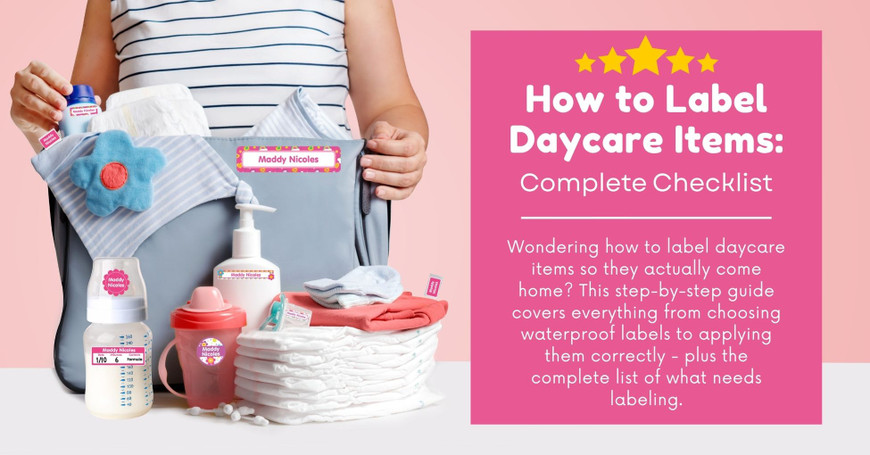
When daycare says "label everything," they mean EVERYTHING that could possibly get mixed up with another child's belongings.
Baby Bottles and Feeding Items (Priority #1)
- Every single baby bottle body
- Every bottle cap or lid — separately from the bottle
- Pacifiers (label the flat plastic base or the clip)
- Sippy cups and lids when they transition
- Food containers and snack cups — body and lid each
- Breast milk storage bags — every individual bag
- Bibs, spoons, forks, burp cloths
- Ice packs
Clothing (The Biggest Mix-Up Zone)
- Every piece of clothing including underwear and undershirts
- The spare outfit stored in the cubby — every garment in it
- Both shoes — kids take them off for nap time
- Every sock — these vanish into thin air
- Jackets, hats, mittens
- Sleep sacks or blankets for nap time
- Loveys and comfort items
Personal Care Items
- Diaper cream tubes
- Sunscreen bottles
- Any medications — super important for safety
- Wipes containers
- Nap mat or changing pad
- Cloth diapers and wet bag if applicable
Bags and Storage
- The diaper bag — exterior label and interior contact label
- The lunchbox exterior
- Ice packs (separate from the bag)
- Breastfeeding supplies and pump parts
- Insulated carriers and pouches
The Items Parents Consistently Forget to Label
After 15 years of helping daycare families, these are the items that show up unlabeled most often:
Bottle caps and sippy cup lids
The bottle gets a label. The cap doesn't. The cap ends up in a communal drawer by week two. Label both parts every time — the cap as a separate item with its own small round label.
The spare outfit in the cubby
Parents label the clothes their baby wears to daycare but forget the spare set stored in the cubby. That spare outfit is the one used after accidents. An unlabeled shirt from it comes home with the wrong child. Label every garment in the spare set and the bag it's stored in before day one.
Ice packs
Ice packs are identical across every family in the room. A small round label on the flat surface takes 30 seconds and solves this permanently.
Individual containers inside the lunchbox
The lunchbox gets labeled. The four containers inside it don't. Those containers come off the table at snack time and get mixed with other children's. Label every container and every lid that separates from its base.
Loveys and comfort items
A lovey that travels to daycare is a lovey that will eventually need to be found in a hurry at nap time. If it has a tag, use a clothing label. If it has a plastic attachment, use a small round waterproof label. A labeled lovey is a lovey that comes home.
Diaper cream and personal care items
These go into a communal personal care area in many daycare rooms. An unlabeled tube of cream gets used on the wrong child or simply doesn't come home.
Socks
Infant and toddler socks are tiny, identical, and lost constantly. Iron-on labels inside the cuff of each sock are the most durable solution. Label every pair.
How to Label Pacifiers for Daycare
Pacifiers are one of the hardest daycare items to label because the surfaces are almost entirely silicone or rubber, neither of which accepts standard adhesive labels. The labelable surface on most pacifiers is the flat plastic base disc or the plastic handle area, depending on the brand.
- Find the flattest plastic surface — the base disc or handle depending on the brand
- Apply a very small round waterproof label to that surface
- Press every edge firmly with a thumbnail
- Allow 24 hours before the pacifier goes to daycare
Some daycare centers ask parents to label the pacifier clip rather than the pacifier itself — check with your center first. A small round label on the flat plastic section of a pacifier clip is more durable than a label on the pacifier because the clip surface is larger and more stable for adhesion. Our small round labels are sized for this.
Clothing Labels — and the Mouth-Safety Rule Most Parents Miss
For most daycare clothing, stick-on clothing labels applied to the care tag are the fastest option — machine washable all year, removable for hand-me-downs, no equipment needed. For items you never want to re-label, iron-on clothing labels adhere permanently to iron-safe garments: cotton setting, no steam, 60–90 seconds firm press-and-lift, 24-hour cure before first wash.
The mouth-safety rule: bibs, loveys, and anything baby chews
There is one situation where iron-on labels are the correct choice regardless of convenience: any item your baby or toddler is likely to mouth, suck on, or chew. Bibs, comfort blankets, jacket collars, anything that ends up near a child's mouth. Iron-on labels sit completely flat once applied with no corners or edges that can be picked at or pulled off. Stick-on labels on care tags are safe for standard clothing, but for mouth items, iron-on is the right call.
Quick guide: which clothing label for which item
- Shirts, pants, jackets, shoes, spare clothes — stick-on clothing labels on the care tag
- Bibs, comfort blankets, anything baby mouths — iron-on labels on iron-safe garments only
- Non-iron-safe items, sleep sacks, outerwear — stick-on clothing labels only
- Socks — iron-on inside the cuff, most durable placement
Why Waterproof Daycare Labels Actually Matter
The milk spill reality
Regular labels turn into a soggy mess when milk sits on them all day. Masking tape starts peeling before you even get to daycare, leaving sticky residue everywhere. Paper labels dissolve. None of this is theoretical — it will happen on day two.
The playground dirt factor
When your kid comes home looking like they wrestled in a mud pit, you need daycare labels that are still readable under all that grime — and that survive the washing machine you immediately run everything through.
The commercial dishwasher test
Daycare centers run commercial dishwashers at 180°F or more — far hotter than your home machine. Most standard labels fail within a week. You need labels specifically rated for commercial dishwasher temperatures.
The allergy safety issue
For children with food allergies, unlabeled items don't just get lost — they get used by another child. A clear allergy label on every food container means any adult handling your child's food sees the restriction before they open a single container.
How Long Do Waterproof Daycare Labels Actually Last?
From my real experience with three kids:
Baby bottles and sippy cups: Years of daily dishwasher cycles — these outlast the bottles themselves
Clothing labels: Hundreds of wash cycles — your child will outgrow the clothes before the labels wear out
Outdoor gear: Multiple seasons of playground abuse and still going strong
Lunch containers: Years of daily use — we're talking elementary school and beyond
Your child will outgrow the design long before you need to replace the label.
The Money Talk
What I Lost in Year 1 Without Labels:
- 2 bottles at $8 each = $16
- 3 sippy cups at $7 each = $21
- Socks, shirts, and one jacket = $35
- Total lost: $72
What I Spent on Waterproof Labels:
$35
for the whole year and beyond
Quality daycare labels pay for themselves after preventing the loss of just one bottle and a couple of sippy cups.
Age-by-Age Daycare Labeling Reality Check
Infants (0–12 months) — Bottles, Bottles, Bottles
Focus: Baby bottles and feeding items above everything else. Most daycares require name, date, ounces, and contents on every bottle. Our write-on baby bottle labels cover all required fields — no more masking tape scraps at 6am. For which label fits your specific bottle brand, see our complete bottle labeling guide.
What surprised me: Even newborn socks need labels. I don't know how, but they disappear.
Allergy note: If your infant has dietary restrictions, allergy labels on the exterior of the bag are non-negotiable from day one — not just a note in the file.
Toddlers (1–3 years) — The Chaos Years
Focus: Everything they can drop, throw, share, or hide needs a label.
Reality check: Toddlers are generous. They'll share their sippy cup with three friends, and suddenly nobody knows whose is whose. Three days later, the whole household has a virus.
Sanity saver: Picture labels work great for toddlers who can't read yet. My youngest could spot his monkey design from across the room before he knew a single letter.
Preschoolers (3–5 years) — Almost Independent
Focus: They're more responsible but also bring more stuff that can get lost.
Sweet spot: Let them help choose their label design. When kids feel ownership over their belongings, they're genuinely more careful with them.
Transition moment: This is when snack and lunch labels become more important — labeled AM snack, lunch, and PM snack containers mean providers always know what's for when.
How to Label Daycare Items: Step by Step
For Baby Bottles and Containers
- Clean the surface with isopropyl alcohol — removes residue that prevents adhesion
- Peel the waterproof label carefully from the backing
- Press firmly from center outward, thumbnail along every edge
- Wait 24 hours before first wash — the adhesive cures during this window
For Clothing
Iron-on clothing labels:
- Cotton setting, no steam
- Cover with parchment paper
- Press firmly for 60–90 seconds, press-and-lift (don't slide)
- 24 hours before first wash
Stick-on clothing labels:
Press firmly onto the care tag. 24 hours before first laundry cycle. Avoid bleach or essential oil detergents.
For Small Items
Our small round labels and extra small rectangle labels are designed for pacifiers, bottle caps, utensils, and tiny gear. Same prep: clean surface, firm press, thumbnail along every edge, 24-hour cure.
For pacifiers specifically, apply to the flat plastic base or clip — not the silicone nipple.
Baby Pack vs Daycare Pack — and Everything Else
Both packs include 104 waterproof labels, but they're designed for different stages:
For infants in daycare
- 20 Classic Rectangle
- 18 Slim Rectangle
- 14 Extra Small Rectangle
- 4 Medium Round
- 32 Small Round
- 8 pair Duck Shoe Labels (exclusive) — sized for infant and toddler footwear
Daycare Labels Pack — 104 Labels
For toddlers and older babies
- 1 Extra Large Rectangle (exclusive) — for bigger bag and container surfaces
- 12 Large Rectangle
- 20 Slim Rectangle
- 19 Extra Small Rectangle
- 4 Round labels (assorted)
- 40 Small Round
- 3 pair Shoe Labels
Bottle Labels
Write-On Baby Bottle Labels — Large waterproof labels with space for name, date, ounces, and contents. Dishwasher safe, designed for the daily bottle routine.
Write-On Date Labels
Write-On Date Labels — Apply once, write date and contents each morning, wipe clean in the dishwasher. Required by most centers for breast milk and all perishables.
Clothing Labels
Iron-On for shirts, pants, and anything worn against skin. Stick-On for jackets and hand-me-downs. Both ordered separately from the label packs.
Snack and Lunch Labels
Snack and Lunch Labels — Pre-marked for morning snack, lunch, and afternoon snack. One label per container and daycare providers always know what's for when.
Allergy and Medical Labels for Daycare
For children with food allergies or medical conditions, daycare labels carry safety stakes beyond the organizational requirement. I have two sons with food allergies. Allergy labels on every food item that goes to daycare are non-negotiable in our household.
The label is there for the regular caregiver and equally for the substitute or volunteer who has never been briefed on your child's needs. "PEANUT ALLERGY" on every food container is more useful to a staff member at snack time than "ALLERGY" with no detail — and far more useful than a note in a file in the office.
Three-layer allergy labeling for daycare:
- Formal documentation — allergy action plan on file with daycare administration
- Allergy labels — specific allergen named on every food container, bottle, and the daycare bag exterior
- Emergency contact labels — parent contact and medical information on the bag itself, visible to any adult
For the complete guide to allergy labeling across daycare, school, and camp, see our allergy and medical alert labels guide.
My Biggest Labeling Mistakes (So You Don't Make Them)
Waiting until the last minute
Order at least one week before daycare starts. Labels need 24 hours to cure before they go through the dishwasher or washing machine. Labels applied the morning of the first day haven't finished curing and are significantly more likely to peel.
Only labeling the expensive stuff
That $3 sippy cup is just as likely to vanish as the $25 one, and replacing "cheap" items adds up fast. Label everything equally.
Hiding labels so they wouldn't show
I put labels inside clothing where they wouldn't be visible externally. Labels on the exterior or visible interior are what actually helps providers at pickup time.
Not involving my kids
My middle son was noticeably more careful with items he helped label. Let kids choose their design. A label they chose is one they'll actually look for.
Forgetting the backup items
I labeled his daily bottles but forgot the emergency bottles stored in his cubby. Every item in that building that belongs to your child needs a label — not just the ones you pack each morning.
Your Action Plan: Getting Started
Two Weeks Before Daycare Starts
- ✓ Ask your daycare exactly what information they require on labels
- ✓ Order waterproof labels, clothing labels, and any write-on bottle labels
- ✓ Gather everything in one place for one labeling session
One Week Before
- ✓ Set aside 30 minutes for one labeling session
- ✓ Bottles and caps first, then clothing, then everything else
- ✓ Label the spare outfit kit in the cubby and every item in it
After the First Week
- ✓ Check what came home unlabeled and fix it
- ✓ Note any caps or lids that got separated from their bottle
- ✓ Marvel at the time and money you're saving
Common Questions from First-Time Daycare Parents
"Why can't I just use a Sharpie?"
Sharpie fades fast, smudges when wet, and bleeds onto everything it touches. Daycare runs commercial dishwashers at 180°F or higher. A label that survives your home dishwasher for months may fail at daycare within a week. Waterproof labels use vinyl with adhesive specifically rated for those conditions.
"Do I really need to label socks?"
Yes. Socks are the number one lost item at daycare. Kids take shoes off for nap time, socks get mixed up in the pile, and you'll never see them again. Iron-on labels inside the cuff of every pair. This is not a debate I'm willing to have after losing approximately 40 socks across three children.
"How many labels do I need for daycare?"
For an infant starting daycare, plan on 50–80 labels as a starting point — bottles and caps, pacifiers, clothing, food containers, ice packs, and personal care items. Our Baby Labels Pack and Daycare Labels Pack each include 104 labels in multiple sizes to cover every surface in one order.
"What if my child outgrows their bottles?"
The same waterproof labels work on sippy cups, lunch boxes, water bottles, and school supplies. Think of the label pack as a long-term investment — not just a daycare purchase.
"How do I label for food allergies at daycare?"
Two layers: formal allergy action plan on file with the daycare, plus physical allergy labels naming the specific allergen on every food container and the bag exterior. "PEANUT ALLERGY" is more useful to a caregiver at snack time than "ALLERGY" with no detail. The label does what the file in the office cannot.
The Bottom Line
Waterproof labels aren't a luxury — they're a necessity. Your labels need to survive spit up, spilled milk, playground adventures, art projects gone wrong, commercial dishwashers, and your washing machine at home. Apply them once before daycare starts. Then forget about them for the rest of the year.
New to daycare labels entirely? Our starter label pack guide explains every label type from the beginning. For the complete back-to-school transition when daycare ends, see our back to school labels by grade checklist.
| Daycare Label Packs | Clothing Labels | Baby Bottle Labels |
About Dodie King
Mom of three boys (including two with food allergies and one with special needs), founder of Sticky Monkey Labels and the original creator of Peel 'n Stix® clothing labels. In business since 2011, based in Little Rock, Arkansas.
Every product we make is tested in my own home before it reaches yours. Questions? Call 1-888-780-7734. Verified by the Better Business Bureau.