
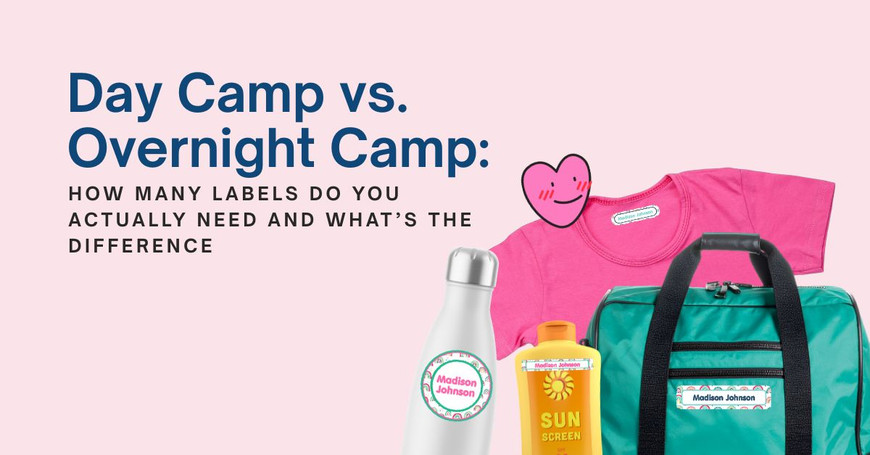
Day camp and overnight camp are not the same labeling problem. They look similar from the outside — your child goes to a camp, they're around other kids, things could get mixed up — but the conditions that cause items to go missing are fundamentally different, and so is the labeling strategy that prevents it.
Day camp parents often over-prepare on labeling — spending hours on iron-on labels for clothing that comes home every single day and is washed at home every night. Overnight camp parents consistently under-prepare — labeling the obvious items, skipping the socks, forgetting the bedding entirely, and sending unlabeled toiletry bottles into a shared bathroom for a month.
This guide breaks down the actual labeling requirements for each camp type: what you need, how many of each label, where to focus your effort, and where you can reasonably simplify. The goal is accurate preparation — not the maximum possible preparation, and not a shortcut that costs you items at the end of session.
From the founder of Sticky Monkey Labels
I'm Dodie — founder of Sticky Monkey Labels, boy mom of three sons, and 15 years in business since 2011 in Little Rock, Arkansas. I hear from camp families at the end of session every summer. The day camp families worry about the same things as overnight camp families — but the actual losses are completely different. This guide shows you where to put your energy for each situation.
What's in this guide
- The key difference between day camp and overnight camp for labeling
- Day camp labeling — what you actually need
- Overnight camp labeling — the full picture
- How many labels — quantities by camp type and session length
- Which label type for which camp environment
- Priority order — where to focus if time is short
- Frequently asked questions
1. The Key Difference Between Day Camp and Overnight Camp for Labeling
The variable that changes everything is whether items come home each day. That single factor determines which label type you need, how many you need, and which items matter most.
Day camp — daily return
Clothing, shoes, water bottles, and lunchboxes come home every single day. If something gets mixed up during the day it has a good chance of being sorted at pickup. Your child participates in sorting their own things at the end of each day. The label's job is to handle the situations where your child isn't there to claim something — a jacket left at an activity station, a water bottle set down at the pool, a lunchbox in the wrong cubby. Home laundry every night means stick-on clothing labels work fine for most items.
Overnight camp — extended stay
Nothing comes home until the session ends. Clothing goes through communal high-heat institutional laundry multiple times during the session. Items get mixed up in cabin bathrooms, activity areas, and dining halls over days and weeks with no daily sorting opportunity. Your child cannot easily retrieve something that's ended up in the wrong cabin or the lost-and-found pile mid-session. Iron-on labels for all clothing. Labels on every individual sock and both shoes of every pair. Bedding labeled. Toiletry bottles labeled with clear overlays on sunscreen and bug spray. The full system.
2. Day Camp Labeling — What You Actually Need
Day camp labeling is simpler than overnight camp labeling — but it's not nothing. The items that go missing at day camp do so during shared activities: pool and swim sessions, PE and sports areas, shared lunch spots, and the general end-of-day chaos. Labels on the right items prevent those specific losses.
Day camp — essential labels
- Water bottle — body and lid separately. The most consistently lost item at any camp. Label before the first day.
- Lunchbox — exterior front and interior both.
- Food containers and snack containers — body and lid separately. Every container.
- Shoes — both shoes of every pair. Pool and water activities are where day camp shoes most often go missing.
- Swim bag / pool bag — exterior on smooth hardware.
- Sunscreen bottle — waterproof label plus clear overlay for any session longer than one week.
- Jackets and outer layers — the most common left-behind item at day camp. Stick-on on care tag.
Day camp — useful but not critical
- Everyday clothing — clothing comes home daily so individual item mixing during the day is usually sorted at pickup. Label if you want to, but it's not the priority it is for overnight camp.
- Socks — for a pool or splash program where socks come off, labeling all socks is worthwhile. For a standard day camp without extensive water activities, daily return makes individual sock labeling lower priority.
- Swimsuit — useful at pool programs. Label inside the back with iron-on.
3. Overnight Camp Labeling — The Full Picture
Overnight camp requires a labeling system, not just individual labels. Everything goes. Everything gets lost without a name on it. And the conditions — communal laundry, shared bathrooms, outdoor activities, weeks without a daily sorting opportunity — create mixing problems that only a comprehensive labeling approach prevents.
Overnight camp — non-negotiable labels
- Every individual clothing item — iron-on for all fabric going through communal laundry
- Every individual sock — iron-on, inside cuff, one per sock (not one per pair)
- Both shoes of every pair — shoe labels, inside heel, clear overlay required
- Every piece of bedding — fitted sheet, flat sheet, pillowcase, pillow, blanket, sleeping bag. Iron-on on outside hem edge where visible without unfolding.
- Water bottle and lid — separately. Large die-cut label for Stanley/Hydro Flask.
- Every toiletry bottle — waterproof label, plus clear overlay on sunscreen and bug spray
- Shower caddy — smooth plastic or metal frame
- Lunchbox and food containers — body and lid separately
- The trunk or duffel itself — exterior and interior lid
- Any activity-specific gear — sports equipment, instrument cases, specialty bags
4. How Many Labels — Quantities by Camp Type and Session Length
The honest answer to "how many labels do I need?" is always more than you think — because lids count separately, socks count individually, and shoes count per shoe. Here are realistic estimates for each situation.
| Camp Type / Session | Iron-on labels | Waterproof labels | Shoe labels | Clear overlays |
|---|---|---|---|---|
| Day camp — 1 week | 5–10 | 10–15 | 2–4 pairs (4–8 labels) | 2–4 (sunscreen, bug spray) |
| Day camp — full summer | 10–20 | 15–25 | 3–5 pairs (6–10 labels) | 4–6 |
| Overnight camp — 1–2 weeks | 40–60 | 20–30 | 3–5 pairs (6–10 labels) | 6–10 |
| Overnight camp — 3–4 weeks | 60–90 | 25–40 | 4–6 pairs (8–12 labels) | 8–12 |
| Overnight camp — full summer (6–8 weeks) | 80–120 | 35–50 | 5–7 pairs (10–14 labels) | 10–16 |
5. Which Label Type for Which Camp Environment
| Item | Day Camp | Overnight Camp | Reason for Difference |
|---|---|---|---|
| Clothing with care tag | Stick-on | Iron-on | Home laundry vs communal institutional washing |
| Socks | Iron-on (pool programs) | Iron-on — every individual sock | No care tag. Iron-on only on sock fabric regardless of camp type. |
| Shoes | Shoe labels — both shoes | Shoe labels — both shoes | Same regardless of camp type. Shoes always separate. |
| Water bottle | Waterproof + lid | Waterproof + lid | Same — most commonly lost item at both camp types. |
| Bedding | Not needed | Iron-on — every piece | Day camp doesn't send bedding. Overnight camp bedding goes through communal laundry. |
| Sunscreen / bug spray | Waterproof (overlay optional for 1 week) | Waterproof + clear overlay always | Cumulative chemical degradation over weeks requires overlay for longer sessions. |
| Toiletry bottles | Waterproof | Waterproof | Shared bathrooms at both types but more mixing risk over weeks at overnight camp. |
| The trunk or bag itself | Useful — bag exterior | Essential — exterior and interior lid | At overnight camp a trunk without a name is a sorting problem at end of session. Label it. |
6. Priority Order — Where to Focus if Time Is Short
If you're working with limited time and need to triage, here's the order that protects the most valuable and most commonly lost items first.
Day camp — priority order
- Water bottle and lid
- Lunchbox and food containers (body and lid)
- Shoes — both shoes of every pair
- Jackets and outer layers (care tag stick-on)
- Swim bag and pool gear
- Sunscreen and bug spray (with overlay for sessions over one week)
- Swimsuit (iron-on inside back)
- All remaining clothing
- Socks (if pool or water program)
Overnight camp — priority order
- Water bottle and lid
- Shoes — both shoes of every pair
- Every individual sock
- All clothing — iron-on on every item
- Bedding — every piece, outside hem edge
- Sunscreen and bug spray — waterproof label plus clear overlay
- All remaining toiletry bottles
- Lunchbox and food containers (body and lid)
- Shower caddy
- The trunk or duffel — exterior and interior lid
Browse our camp label packs and our iron-on name labels at Sticky Monkey Labels — we ship within 1–2 business days. Need help estimating quantities for your specific camp and session length? Call us at 1-888-780-7734.
Frequently Asked Questions
My child went to day camp last year without labels and everything came home. Do I really need labels?
Day camp is lower risk than overnight camp because clothing and gear come home daily. If your child is good at tracking their belongings and nothing important was lost, you may be able to get away with labeling only the highest-risk items — water bottle, lunchbox, shoes. The items that most consistently don't come home from day camp are jackets left at activity stations, water bottles set down at the pool, and shoes mixed up at swim time. Label those at minimum. Label everything if you'd rather not think about it.
My child is going to overnight camp for the first time. Is labeling really as extensive as this guide describes?
Yes — for a multi-week overnight camp session, the full labeling approach described here reflects what actually prevents losses. The parents who tell me at the end of session what didn't come home almost always sent their child without labels on socks, bedding, or both shoes of every pair. The labeling session takes 3–4 hours spread across a few days before drop-off. That time prevents a much longer frustration at the end of session and a replacement cost that adds up quickly. For the full week-before timeline, see our first-time camp parent guide.
Can I use stick-on labels for overnight camp clothing to save time?
Not for the clothing — stick-on labels are designed for home laundry and are not intended for commercial washers or dryers. Overnight camp clothing goes through communal institutional washing at higher temperatures. Iron-on labels bonded into fabric fibers are what survive those conditions through a full session. Stick-on labels on care tags may hold for the first wash or two and then begin to lift as the institutional laundry conditions stress the adhesive. For hard-surface items (water bottles, food containers, toiletries) the same waterproof labels work for both camp types.
My child is going to a specialty overnight camp (music, art, sports) for one week. Does the full overnight camp labeling approach still apply?
A one-week overnight session has reduced labeling risk compared to a month-long session — there are fewer communal laundry cycles, less time for items to migrate, and less accumulated mixing in shared spaces. For a one-week overnight session, focus on iron-on for all clothing (communal laundry still happens), labels on both shoes of every pair, water bottle and lid, and any specialty gear (instrument case, sports bag). Bedding labeling is still worth doing even for one week — it takes 30 minutes and prevents end-of-session confusion. You can scale back on the full toiletry labeling system for a single week.
Is there any item that doesn't need a label regardless of camp type?
Items that are highly distinctive in appearance and only ever used by your child don't carry the same loss risk as identical-looking items in a shared space. A very unusual piece of equipment with a distinctive color or design may not need a label in the same way a white athletic sock does. But the honest answer is that the cost of a label is so low — in time and money — compared to the cost of losing any individual item that the practical advice is always to label everything that leaves your house going to camp. The question "does this really need a label?" almost always resolves to yes when weighed against the alternative.
My child goes to both day camp in June and overnight camp in August. Do I need two separate labeling setups?
Not exactly — but you'll want to think through the label type choice at the start of summer. If you use stick-on labels on care tags for June day camp with the intention of using the same clothing for August overnight camp, you'll need to either re-label with iron-on before overnight camp or use iron-on from the start on the items that will make both trips. Iron-on labels work equally well in home laundry and institutional laundry — so labeling everything with iron-on at the start of summer is the simplest approach if your child's clothing will go to both environments. Stick-on for day camp only items that won't go to overnight camp is fine.