
From the founder of Sticky Monkey Labels
As a mom of three boys and the founder of Sticky Monkey Labels, the most common question I get is some version of: "I need labels — but which ones?" The answer depends entirely on the surface. Here's the complete guide.
"Name labels" sounds like one product. It isn't. A label that works perfectly on a water bottle will fail on a piece of clothing. A label designed for care tags won't perform on a lunchbox. The reason labels peel off, fade, or stop adhering isn't always label quality — it's often label type mismatch. Using the right label for the right surface is what makes them last.
This guide covers every label type we make, what each one is designed for, what makes it different from the others, and the specific items it works best on. By the end you'll know exactly which labels to order — and you won't buy the wrong ones.
Quick Decision Table — Find Your Item, Find Your Label
| Item | Label Type | Why |
|---|---|---|
| Water bottle, lunchbox, food containers | Waterproof labels | Dishwasher-safe, adheres to hard surfaces |
| School uniforms, PE kit, jackets | Iron-on labels (iron-safe fabrics only) | Permanent bond, flat, survives weekly washing |
| Any clothing — care tag or tagless imprint | Stick-on clothing labels | No iron needed, laundry-safe, any fabric |
| Shoes and boots | Shoe labels | Designed for curved inner sole, washer/dryer safe |
| Baby bottles — daily date and content tracking | Write-on bottle labels | Rewritable daily, warmer/sterilizer/dishwasher safe |
| Pantry bins, freezer containers, home storage | Write-on labels | Contents change — wipe and rewrite as needed |
| Pencils and narrow items | Pencil labels | Designed for narrow surfaces where standard labels won't fit |
| Attic clothing storage bins | Clothing storage labels | Size pre-printed, season and disposition checkboxes |
| Lunchbox/bag for child with allergies | Allergy labels | Visible allergy information for any adult at a glance |
| Young child's shoes — teaching left from right | MatchUP Shoe Labels | Two-part puzzle that self-corrects when shoes are on the right feet |
Waterproof Name Labels — For Hard Surfaces
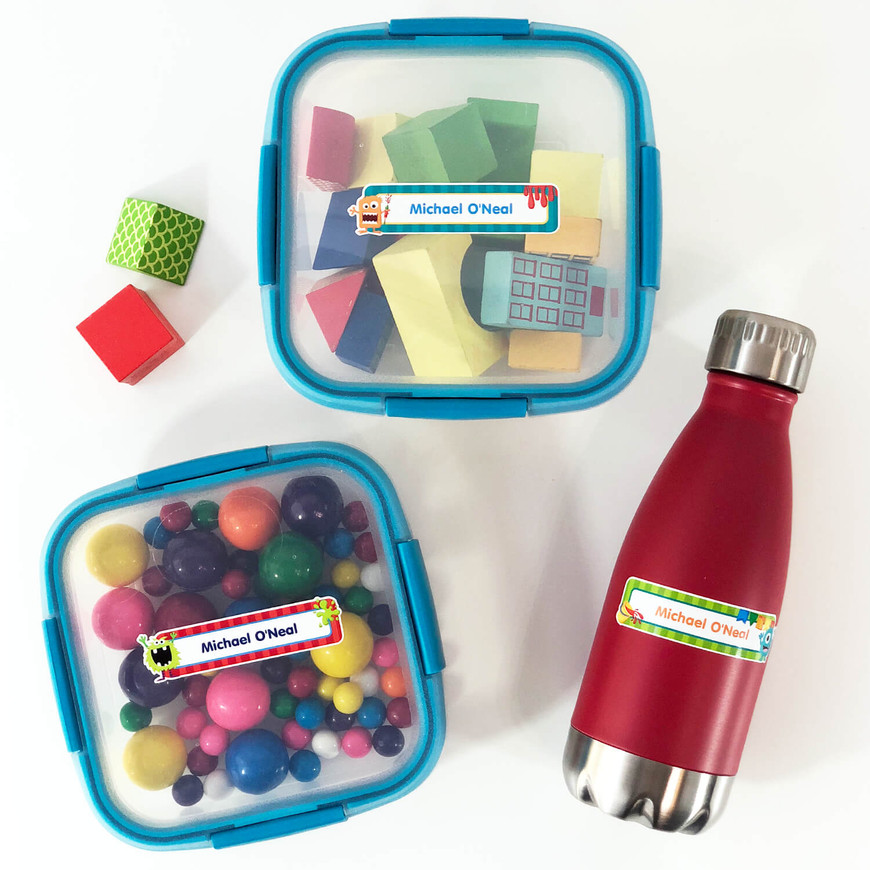
Our most versatile label type. Waterproof labels adhere to plastic, glass, metal, paper, and cardboard — covering the full range of water bottles, lunchboxes, food containers, backpacks, sports equipment, and hard-surface school supplies.
What makes them different: explicitly dishwasher-safe (top rack), microwave-safe, weatherproof, and tear-resistant. They survive the daily cycle of school use — washed, refilled, tossed in bags, back again — without peeling or fading.
What they don't do: they don't adhere to silicone surfaces, and they're not designed for direct fabric application. For clothing, use a clothing-specific label type.
Iron-On Clothing Labels — Permanent Bond for Iron-Safe Fabrics
Iron-on labels bond directly into iron-safe fabric using a standard household iron. Once applied, they're permanently part of the garment — completely flat, completely soft, with no bulk, no corners, and nothing that can be felt against skin during wear or sport.
What makes them different: the bond is permanent and lives in the fabric weave rather than sitting on top of it. They're the most durable long-term clothing label, particularly for items washed frequently — uniforms, PE kits, sports jerseys that go through the wash multiple times a week.
What they don't do: they can't be applied to fabrics that aren't iron-safe (always check the garment care label first), and they can't be removed once applied. If removability matters (for hand-me-downs), use stick-on clothing labels instead.
Stick-On Clothing Labels — Fast, Flexible, Any Fabric
Stick-on clothing labels apply to the garment care tag inside the collar or neckline, or to the tagless imprint area — the largest flat section printed inside the garment. No iron, no tools, no waiting. Peel and press.
What makes them different: they work on any garment regardless of whether it's iron-safe, they're laundry-safe through regular machine washing and drying, and they're removable when needed. They're made from a different material than waterproof labels — specifically designed for clothing applications rather than hard surfaces.
Important clarification: stick-on clothing labels go on the care tag or tagless imprint area, not directly on fabric. This is the most common application mistake — applying to fabric rather than the tag produces much shorter label life.
Shoe Labels — Designed for the Inner Sole
Standard waterproof labels don't perform well on the curved inner sole surface inside a shoe — the curve and the material are different from a flat hard surface, and labels applied there typically peel within weeks. Our shoe labels are specifically designed for this surface: the right adhesive, the right dimensions, the right shape to sit flat on the curved heel area.
What makes them different: washer and dryer safe (shoes go through both), designed to stay for the life of the shoe, only removable with intent. Applied at the heel of the inner sole — the most stable and readable position inside a shoe.
For children just starting school who are still developing left-right awareness, our MatchUP Shoe Labels are a specific version worth knowing about — two halves of a picture that only form correctly when shoes are on the right feet, turning the daily shoe routine into a self-correcting left-right learning exercise.
Write-On Labels — When the Information Needs to Change
Write-on labels are for situations where the label stays but the information on it changes. The label is applied once and stays permanently adhered to the surface. The writing is added and removed repeatedly — semi-permanent marker wipes off with water, wax pencil wipes off with a dry cloth.
What makes them different: they're the only label type where the information is genuinely variable. This makes them the right choice for baby bottles (daily date and content updates), food storage containers (different contents, different dates), pantry organization (rotating contents), and any home storage situation where what's in a container changes regularly.
Our write-on labels come with our tested semi-permanent marker and wax-based pencil — the writing tools we've specifically designed and tested for use on our labels. They're available as add-ons when purchasing write-on labels or write-on bottle labels.
The Three Most Common Label Mistakes — and How to Avoid Them
- Using waterproof labels on clothing. Waterproof labels are designed for hard surfaces — they won't adhere reliably to fabric and will peel quickly. For clothing, always use a clothing-specific label (stick-on to the care tag, or iron-on for iron-safe fabrics).
- Applying labels without surface preparation. Even brand-new items have invisible residue — manufacturing film, skin oils, cleaning product traces — that prevents labels from bonding properly. A thirty-second wipe with isopropyl alcohol before applying waterproof labels to hard surfaces makes a significant difference to how long they last.
- Washing before the adhesive sets. All label types need time to fully bond before their first wash cycle. Allow 24 hours after applying any label before the first dishwasher run or laundry cycle. Applying labels the morning of the first school day and sending them straight through the dishwasher that afternoon is the fastest way to lose a label.
Browse our full range at Sticky Monkey Labels — including school label packs that combine multiple label types in one order. Questions about which label fits a specific item? Call us at 1-888-780-7734 — we're always happy to help.
Frequently Asked Questions
What's the difference between iron-on and stick-on clothing labels?
Iron-on labels bond permanently to iron-safe fabrics using a household iron — the most durable option for clothing washed frequently. Stick-on clothing labels apply to care tags or tagless imprint areas with no heat required — suitable for any fabric and removable when needed. Both are laundry-safe; the right choice depends on whether the fabric is iron-safe and whether permanent bonding or removability is more important for your situation.
Can I use the same label on both clothing and water bottles?
No — you need different label types for fabric and hard surfaces. Waterproof labels are designed for hard surfaces (bottles, lunchboxes, equipment) and won't perform reliably on fabric. Clothing labels (stick-on or iron-on) are designed for garment care tags and tagless imprint areas and are made from a different material. Using the right label for the right surface is what makes both types last.
Why do my labels keep peeling off?
The most common reasons: using the wrong label type for the surface, not preparing the surface with isopropyl alcohol before applying, or washing before the adhesive has had 24 hours to fully set. If you're using the right label type, have prepared the surface, and allowed proper setting time and labels are still peeling — call us at 1-888-780-7734 and we'll help troubleshoot.
Are waterproof labels safe for the dishwasher?
Yes — our waterproof labels are dishwasher-safe on the top rack through regular daily cycles. Avoid sanitary dishwasher cycles (extreme heat degrades adhesive faster) and detergents containing bleach or essential oil additives. Standard detergent and top rack placement handles daily use reliably.
Which label pack should I order for back to school?
Our School Label Pack (138 labels) covers younger children with a full range of sizes for comprehensive labeling. The School Essentials Pack (64 labels) is sized for older students who need fewer labels but still want the key items covered. Both can be customized with clothing labels and shoe labels added at checkout, and any pack can be split across multiple children's names at no extra charge.