
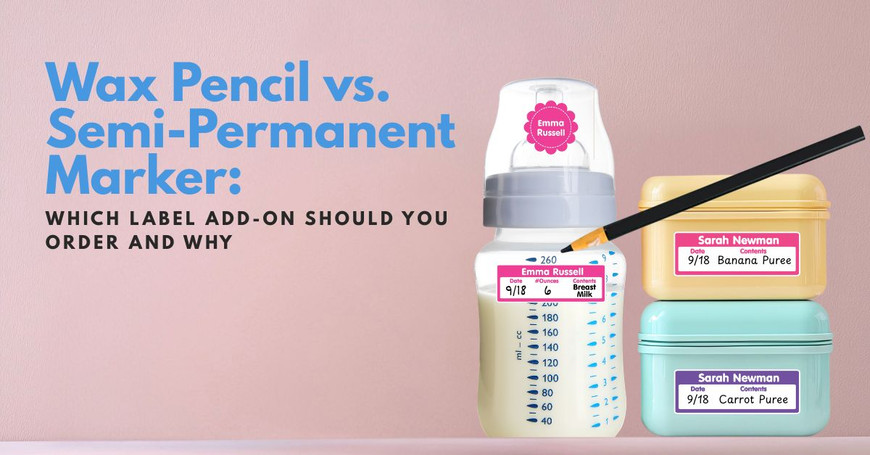
When parents order write-on bottle labels from us, two add-on tools show up at checkout: a wax pencil and a semi-permanent marker. Most parents pick one, assume it works for everything, and find out somewhere around week three of daycare that they picked the wrong one for at least some of what they're labeling.
These are two different tools for two different environments. The wax pencil is designed for wet environments — items that go through the dishwasher or sterilizer nightly, or anything exposed to condensation and moisture throughout the day. The semi-permanent marker is for dry environments — label surfaces, bags, folders, and school supplies where moisture isn't a regular factor. It writes cleanly and lasts well in dry conditions, though heavy condensation can affect it over time.
This post explains exactly what each tool does, which items each one is for, the one rule about the wax pencil that almost every parent gets wrong the first time, and whether you actually need both or just one.
From the founder of Sticky Monkey Labels
Dodie here — founder of Sticky Monkey Labels, boy mom of three sons, two with food allergies and one with special needs, 15 years in business since 2011 in Little Rock, Arkansas. The wax pencil question comes up constantly — mostly from parents who've already had one go wrong. This is the post that prevents that.
What's in this guide
- The wax pencil — what it does, how to use it, and how to expose more wax
- The one rule most parents get wrong
- The semi-permanent marker — what it does and how to use it
- Which tool for which items — the complete guide
- Do you need both or just one?
- The daily routine with write-on labels
- Frequently asked questions
1. The Wax Pencil — What It Does, How to Use It, and How to Expose More Wax
A wax pencil — also called a china marker or grease pencil — writes using a wax-based pigment rather than liquid ink. This is a meaningful distinction: liquid ink can be compromised by moisture before it sets, and conventional ink on a wet surface bleeds, smears, or simply washes away. Wax pigment doesn't have the same vulnerability to moisture. Once the wax sets against the label surface, it's waterproof.
What the wax pencil is designed for
- Write-on fields on bottle labels — date, ounces, contents, and any other daily fields your daycare requires
- Any label surface on items that go through the dishwasher or bottle sterilizer nightly
- Items exposed to condensation, moisture, or wet handling throughout the day
- Write-on fields that need to be wiped clean and rewritten daily — the wax comes off cleanly with a dry cloth or fingernail before washing, leaving the label surface fresh for the next morning
Important: keep writing away from direct heat and steam
Both the wax pencil and semi-permanent marker have been tested and found not to set permanently when exposed to heat — which is exactly what makes them the right writing tools for labels that go through the dishwasher or sterilizer. However, the written information on the label should not be directly exposed to extended steam or concentrated heat. Always place the label as close to the top of the container or bottle as possible — nearest the nipple ring or spout — where it is furthest from the heat source and steam exposure at the base during washing.
Removing wax build-up
If wax residue builds up on the label surface over time and a dry cloth doesn't remove it completely, a small amount of cooking oil on a cloth will dissolve the wax build-up cleanly without harming the label. Wipe off the oil residue afterward with a dry cloth before rewriting.
How to expose more wax when the tip wears down
Our wax pencil is a paper-wrapped china marker. As the tip wears down, look for the small string near the tip of the pencil. Grip the string between your thumb and forefinger and pull it slowly downward — this peels away one coil of the paper wrapper at a time, exposing fresh wax underneath. Tear the coil off, leave the string approximately 2cm long for next time, and the pencil is ready to write again. No sharpener needed. Never pull too aggressively or remove more than one coil at a time — overexposing the wax core can cause it to break during writing.
How to use it
Write the date, ounces, contents, or other required fields in the designated write-on area. Write and go — set the bottle down and move on. Before washing each evening, wipe the written information off with a dry cloth or your fingernail so the write-on area is clean for the next morning. The label stays. The wax mark comes off. The label surface is ready to write on again the following morning.
2. The One Rule Most Parents Get Wrong
Write and go. Do not rub what you've written.
This is the rule almost every parent gets wrong the first time — not because it's counterintuitive, but because it feels natural to smooth or blend what you've just written, especially when the wax goes down a little thicker than expected. The instinct is to rub it in. That's the wrong move.
Why rubbing causes smearing
Wax pigment sits on the label surface and sets through contact and time, not through absorption the way ink does. When you write with the wax pencil and immediately rub the mark, you're dragging the wax across the surface before it's set — which smears the date, ounces, or name into an unreadable blur. Once set, wax is waterproof and durable. Rubbed before it sets, it's a smear. The correct technique: write clearly, set the bottle down, walk away. The mark is set and waterproof once you come back to it.
3. The Semi-Permanent Marker — What It Does and How to Use It
A semi-permanent marker uses a specialized ink formulated to bond strongly to label surfaces and smooth non-porous materials. It writes more like a permanent marker than a standard washable marker — the ink grips the label surface and dries to a durable finish that lasts significantly longer than a regular marker on label material.
What the semi-permanent marker is for
- Name labels on school supplies — bags, folders, pencil cases, binders
- Write-on areas on labels going to school or any dry environment
- Smooth non-porous surfaces — label material, hard plastic, smooth folder covers
- Many parents also prefer it for bottle labels — it works well and holds up in those conditions too
- Any environment where moisture and condensation are not a regular factor
The difference from a standard permanent marker — and why permanent marker is not recommended
A standard permanent marker is not a substitute for either of these tools. On label surfaces, permanent marker sets into the material and is not fully removable — which means if you use it on a write-on bottle label field that you need to wipe clean each evening, the ink stays behind and builds up over time. It also fades faster than the semi-permanent marker on label surfaces, typically within weeks of regular handling and washing. The semi-permanent marker is specifically formulated for label material — the ink bonds more aggressively to the surface and lasts significantly longer, while still behaving as intended for its environment. For labeling school supplies that will be handled daily for a full school year, the difference is noticeable within the first month.
4. Which Tool for Which Items — The Complete Guide
| Item | Recommended Tool | Reason |
|---|---|---|
| Bottle write-on fields (date, ounces, contents) | Wax pencil — or marker | The wax pencil is designed for wet environments — dishwashers, sterilizers, condensation. The semi-permanent marker also works well on bottles for many parents, unless there is significant condensation on the bottle throughout the day. |
| Sippy cup and toddler container write-on fields | Wax pencil | Same nightly dishwasher cycle as bottles. Same daily wipe-and-rewrite routine. Wax pencil is the right tool for any write-on field on items washed nightly. |
| School supply labels (bags, folders, pencil cases) | Semi-permanent marker | These items stay dry. The semi-permanent marker bonds strongly to label surfaces and smooth plastic, lasting through a school year of daily handling. |
| Waterproof labels on water bottles and lunchboxes | Semi-permanent marker | Water bottles and lunchboxes have fixed names — not daily write-on fields. Semi-permanent marker on the label surface lasts well. For write-on date/contents fields on these items, use the wax pencil. |
| Binders and folders | Semi-permanent marker | Dry environment, handled daily. Semi-permanent marker on the label surface or directly on smooth folder material lasts through the school year. |
| Camp gear with write-on fields | Wax pencil | Anything written at camp that will be exposed to outdoor conditions, water, or daily activity benefits from wax pencil's waterproof-once-set property. |
| Snack container and food jar write-on fields | Wax pencil | Food containers go through the dishwasher nightly alongside bottles. Same daily wipe-and-rewrite routine. Same wax pencil. |
5. Do You Need Both or Just One?
It depends on what you're labeling and where those items are going. Most families end up using both because most families have both wet-environment items (bottles, containers, camp gear) and dry-environment items (bags, folders, school supplies) that need writing on.
You need the wax pencil if
- Your child is in a daycare or childcare program that requires daily date and contents on bottles and food containers
- You have write-on bottle labels or snack container labels with daily fields
- You're sending items to camp that need information written on them in outdoor conditions
You need the semi-permanent marker if
- You're labeling school supplies — bags, folders, pencil cases, binders — and want the writing to last through the school year
- You want to write on name labels on any dry-environment item where the information doesn't change
- You're labeling items that won't be washed regularly and don't need daily wiping and rewriting
You need both if
- You have a child at daycare (wax pencil for the daily bottle and container routine) and a school-age child (semi-permanent marker for bags, folders, and supplies)
- You're doing a back to school labeling session that covers both hard-surface gear with write-on fields and school supplies
- You're packing for camp and labeling both toiletry bottles and school-year supplies in the same session
6. The Daily Routine With Write-On Labels
Once write-on labels are applied and the first application has cured, the daily routine is fast. The setup work is done once. The morning and evening work is a few seconds per bottle.
Morning — takes 30 seconds per bottle
- Fill the bottle
- Write today's date in the date field with the wax pencil
- Write the ounces in the ounces field
- Write the contents if your daycare requires it and it's not pre-filled
- Write and go — set the bottle down, don't rub what you've written
Evening — before the dishwasher
- Wipe the write-on area with a dry cloth or your fingernail — the wax mark from the morning comes off cleanly
- Wash as normal — dishwasher or sterilizer
- Dry and set aside. Write-on area is clean and ready for tomorrow morning.
Both the wax pencil and semi-permanent marker are optional add-ons at checkout when ordering from Sticky Monkey Labels — neither is included automatically with a label order. Add the one you need or both if your situation calls for it. Questions about which is right for your specific setup? Call us at 1-888-780-7734.
Frequently Asked Questions
I used the wax pencil and the mark smeared completely. What did I do wrong?
You rubbed it. This is the most common wax pencil mistake — writing and then smoothing or blending the mark before it's set. The wax needs a moment on the label surface before it's stable. Write and go. Don't touch what you've written until you're wiping it off before washing that evening. If a mark has smeared, wipe the area completely clean and start fresh — a smeared wax mark can't be corrected, only removed and rewritten.
Can I use the semi-permanent marker on bottle labels instead of the wax pencil?
Yes — many parents prefer the semi-permanent marker for bottle labels and it works well. It's easy to write with and holds up in dry conditions. The practical consideration is condensation: if your bottle consistently builds up heavy condensation throughout the day, the wax pencil is the more reliable choice since it's specifically designed for wet environments. For bottles that stay relatively dry on the outside, the marker is a perfectly good option. Use whichever fits your routine.
Is the wax pencil included with my label order automatically?
No — both the wax pencil and the semi-permanent marker are add-ons you select at checkout. Neither is included automatically with a standard label order. If you're ordering write-on bottle labels and you need to write daily information on them, add the wax pencil to your order. If you're labeling school supplies and bags, add the marker. Both add-ons are available on the product pages.
How long does the wax pencil mark last before it needs to be wiped off?
Once set, the wax mark is waterproof and holds through handling and moisture exposure — it's designed to stay readable through the full daycare day even on a bottle that gets wet or handled repeatedly. The wax mark stays until you intentionally wipe it off before washing each evening. It won't wash off on its own in the dishwasher if you forget to wipe it — which is by design, since you don't want the date disappearing mid-day. Wipe before washing each evening to keep the write-on surface clean.
Can I use a regular permanent marker on write-on label fields?
Not recommended — and specifically not for write-on bottle label fields. A standard permanent marker sets into label material and is not fully removable, which means the write-on area you need to wipe clean each evening before washing won't come clean. The ink stays behind and builds up. On school supply labels and dry-surface items, permanent marker also fades significantly faster than the semi-permanent marker — typically within weeks of regular handling. The wax pencil is specifically designed for wet-environment write-on fields and wipes clean easily. The semi-permanent marker is designed for dry-environment label surfaces and lasts far longer than a standard permanent marker on the same material. Either add-on tool is the right choice for its environment. A standard permanent marker is not the right choice for either.
Does the wax pencil work on any surface or only on our specific labels?
The wax pencil works on any smooth non-porous surface — glass, plastic, metal, and label material all accept wax pencil marks well. It doesn't work well on paper, fabric, or any porous surface where the wax can't set cleanly. For the write-on label fields specifically, the label surface is designed to accept wax cleanly and release it cleanly — which is part of why the daily wipe-and-rewrite routine works so well.