
Staying organized sounds great in theory. In practice, with kids, work, school runs, and the general chaos of daily family life, organization often gets pushed to the back of the list. I understand this completely — because I live it.
What I've learned after years of trial and error is that a few well-placed labels do more to keep a household functional than any elaborate organization system. Not because labels are magic, but because a labeled container communicates its contents to everyone in the house — not just the person who organized it. When everyone knows where things are and where they belong, the daily friction of "where is the—" and "where does this go?" mostly disappears. Here's how I use labels in every area of the house.
Areas Covered
- The kitchen — freezer meals and fridge organization
- The pantry — snack containers and dry goods
- Art and craft supplies
- The home office
- Attic clothing storage — the system that makes hand-me-downs easy
From the founder of Sticky Monkey Labels
I'm a mom of three boys, founder of Sticky Monkey Labels, and I live with four boys, two dogs, and a cat — all male, every single one of them. That's seven males in this house. I have learned a few things about household organization.
The Kitchen — Freezer Meals and Fridge Organization
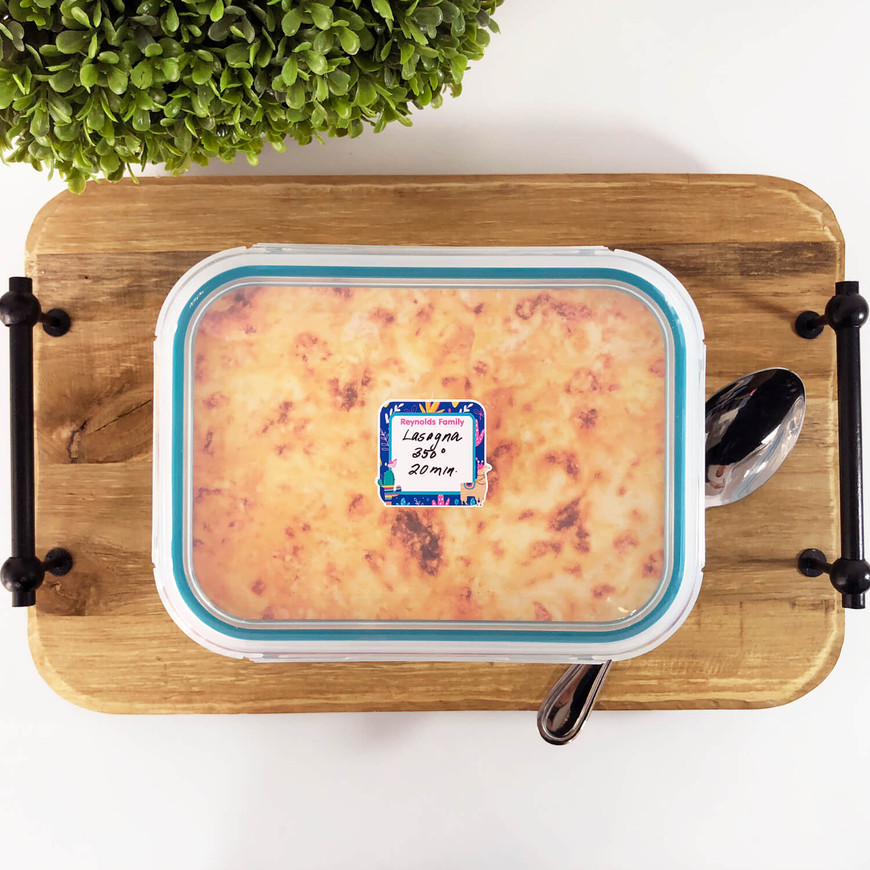
This is where our write-on labels earn their place most clearly. Any time I make lasagna, spaghetti sauce, enchiladas, or really any recipe that scales easily, I make a little extra and freeze it. A freezer stocked with labeled meals means there's always something on hand for the nights when cooking from scratch isn't happening — which, with three kids and a business, happens regularly.
The key to this system actually working is the label. An unlabeled container in the freezer is a mystery that nobody touches. A labeled container with the contents and the date prepared is something the whole family can use without asking. I use write-on labels on freezer-safe glass casserole dishes — write the contents and date with the semi-permanent marker, which wipes off with water when the dish is washed and ready for the next batch.
The same approach works in the fridge for leftovers, prepped ingredients, and anything that needs a date on it. Our write-on labels are refrigerator and freezer safe, dishwasher safe, and microwave safe — they handle the full cycle from freezer to microwave to dishwasher without peeling or fading.
The Pantry — Snack Containers and Dry Goods
The pantry is where a labeled container system pays back immediately and consistently. All the kids' snacks go into clear containers with easy-to-open lids — each labeled with the contents and a date where relevant. Clear containers mean everyone can see what's available at a glance; the label confirms exactly what it is and when it was transferred in.
Why this matters with kids specifically: a labeled container is a container a child can access and use independently, without asking you what's in it or whether they can have it. Autonomy in the snack area means fewer interruptions to whatever you're doing, and a clear system means less food gets forgotten and wasted.
For containers with rotating contents — anything that gets refilled with different items seasonally or when you run out — write-on labels are the practical choice. Wipe off the old content name with a damp cloth, write the new one, done. The container stays in place; only the label information changes.
Art and Craft Supplies — Including the Light Sabers
With three boys, the art and craft supply situation is genuinely significant. And the dress-up and toy situation is even more so — at one point we had more light sabers in this house than any reasonable family could justify. Everything gets a container and a label.
The system that works: see-through containers with easy-open lids for smaller supplies, so even the youngest can manage independently. Labels on every container — art label for markers, crayons, colored pencils, glue, scissors. Larger items like dress-up costumes and yes, the light sabers, go in pull-out bins with see-through fronts and a label on the outside. You can see what's in them before you pull them out, and the label confirms it.
The independence factor matters here as much as the organization. A child who can find what they need, use it, and put it back without adult involvement is building genuine self-sufficiency — and the labeled container system is what makes that possible. Without labels, "put it back where it belongs" is an instruction that requires the adult to define where that is every single time.
The Home Office — Shelves and Shared Spaces
Most office supplies live in drawers where labels aren't necessary — you know what's in the drawer you chose for pens. But anything that goes on open shelving, into shared bins, or into a space other family members might access benefits from a label.
The write-on label works particularly well here because home office contents shift — the supplies in a bin change over time, projects move in and out, seasonal items rotate. Rather than replacing labels every time something changes, the write-on approach means you just update the information. The container stays; the label information evolves with the actual contents.
Attic Clothing Storage — The System That Makes Hand-Me-Downs Easy
This is the labeling application I'm most proud of, and the one I recommend to every parent of multiple children without hesitation. All the boys' outgrown clothing goes into large plastic storage bins in the attic, labeled with our clothing storage labels.
Here's what makes this system genuinely excellent: our clothing storage labels have the clothing size pre-printed on the label, with areas to mark the season (Fall/Winter or Spring/Summer) and checkboxes for whether the contents are for resale, donate, or other. So each bin is immediately identified by size, season, and disposition — no opening required.
I buy the same size bins specifically so they stack uniformly. The attic stays organized because everything has a consistent home, and the labels mean I never have to open three bins to find the one I want. When I need to pull down 4T fall/winter clothes for a younger child, I go straight to that bin. When it's garage sale time, I pull the bins marked for resale — and here's the garage sale tip that genuinely works: put a price tag on the front of the bin and let people sort through it themselves. People are happy to dig through a bin of children's clothing if it's all in the size they're looking for. It sells better than hanging individual items.
Which Labels for Which Area
- Write-On Labels — kitchen, pantry, freezer, fridge, art supplies, home office, any area where contents change regularly. Rewritable with our tested semi-permanent marker and wax pencil. Refrigerator, freezer, microwave, and dishwasher safe.
- Clothing Storage Labels — attic storage bins, seasonal storage, any clothing that's being stored rather than actively used. Size pre-printed, season and disposition checkboxes included.
- Waterproof Name Labels — any hard surface container where the information is permanent (specific toy bins, designated storage areas) and won't need to be updated.
Browse our full range at Sticky Monkey Labels. Now put "buy containers and labels" on this weekend's to-do list. There's a child-free bubble bath in your future.
Frequently Asked Questions
What labels are best for kitchen and pantry organization?
Write-on labels are the most practical choice for the kitchen and pantry because contents change — different freezer meals, different snacks, different dates. The ability to wipe off the information and rewrite it means you never need to replace the label, just update it. They're refrigerator, freezer, microwave, and dishwasher safe, making them compatible with the full cycle of kitchen container use.
How do I organize children's clothing by size for storage?
Our clothing storage labels are designed specifically for this. The clothing size is pre-printed on the label, with fields for season and disposition (resale, donate, or other). Use same-size bins so they stack uniformly. Once the system is set up, outgrown clothes go directly into the correct labeled bin — it takes seconds and keeps the storage area organized without periodic reorganization.
How do write-on labels work — can you really write and erase them?
Yes — our write-on labels have a special surface designed for repeated rewriting. Using our semi-permanent marker, the writing wipes off with water. Using the wax pencil, the writing wipes off with a clean dry cloth. The label stays adhered to the container; only the written information changes. Make sure the surface is completely dry before rewriting for best results.
What's the quickest way to start labeling the house?
Pick one area — start with the pantry or the freezer since those pay back immediately in daily convenience. Spend one afternoon buying containers and applying write-on labels. Once that area is working well and you see the difference it makes, expanding to other areas of the house feels much more achievable than tackling everything at once.