
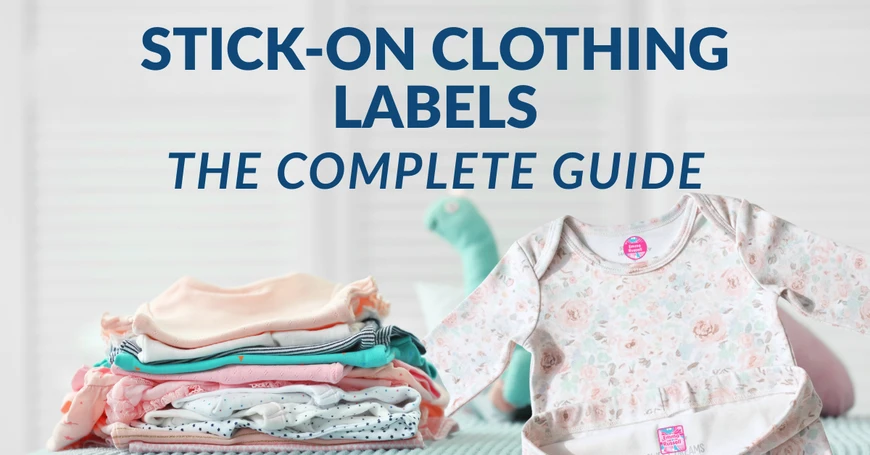
Stick-on clothing labels are the fastest way to label kids' clothes — peel, press, done. No iron, no parchment sheet, no waiting for things to cool. For the right surfaces, they hold through the laundry reliably and last and last. For the wrong surfaces, they peel off in days.
The difference between a stick-on label that holds for years and one that peels after the first wash comes down to one thing: where you put it. Stick-on clothing labels bond to smooth, stable surfaces — care tags and the flat area of tagless imprints. They do not bond to raw fabric, knit, stretch material, or any surface that flexes and moves. That's not a quality issue. It's how pressure-sensitive adhesive works.
This guide covers everything parents need to know about stick-on clothing labels — where they go, where they don't, how to apply them correctly, which situations call for iron-on instead, and why stick-on is genuinely the better choice in several specific situations that most parents don't think about.
From the founder of Sticky Monkey Labels
I'm Dodie — mom of three boys, two with food allergies and one with special needs, and founder of Sticky Monkey Labels. I'm now in my 15th year of business, which started in 2011. I make both stick-on and iron-on clothing labels and use both in my own house. This is the honest guide to which one goes where — written by someone who has seen every application mistake and knows exactly what causes labels to fail.
What's in this guide
- How stick-on clothing labels work
- The right surfaces — care tags and tagless imprints
- The wrong surfaces — and why they fail
- How to apply stick-on labels correctly
- Item-by-item guide — stick-on or iron-on?
- When stick-on is genuinely the better choice
- Stick-on labels on hard surfaces — bottles, gear, and school supplies
- Stick-on labels for daycare clothing
- Frequently asked questions
1. How Stick-On Clothing Labels Work
Stick-on clothing labels use a pressure-sensitive adhesive — the same technology used in high-quality waterproof stickers and professional labeling applications. Pressure-sensitive adhesive bonds through contact and downward pressure with a smooth, stable surface. When you press the label firmly onto a care tag or tagless imprint, the adhesive flows into the microscopic texture of that surface and creates a bond that holds through repeated wash and dry cycles.
The key word in that description is smooth. Pressure-sensitive adhesive needs continuous surface contact to create a complete bond. On a smooth, flat surface like a care tag, it makes full contact across the entire adhesive area. On a textured surface like raw knit fabric, it contacts only the raised fiber tips — not the full surface — which means a partial bond that the washing machine quickly identifies and exploits.
2. The Right Surfaces — Care Tags and Tagless Imprints
There are two correct surfaces for stick-on clothing labels. Everything else is the wrong surface.
Care tags
The sewn-in fabric tag at the inside back collar or inner side seam of a garment — the one with the washing instructions and size information on it. Care tags are typically made from a smooth woven material that gives stick-on adhesive an excellent bonding surface. The tag doesn't stretch or flex independently from the garment during wear and washing the way fabric does, which means the adhesive bond stays intact. Apply the stick-on label to the flat face of the care tag, pressing firmly across the full label surface. This is the most reliable placement for stick-on clothing labels.
Tagless imprints
Many modern children's clothing brands have replaced traditional sewn-in care tags with a tagless imprint — a small printed area directly on the inside of the garment, usually at the back collar or inner side seam. The imprint area is typically smooth relative to the surrounding fabric and gives stick-on adhesive more to grip than raw knit. Apply to the largest flat area of the tagless imprint — the smooth printed section, not the surrounding fabric. If the imprint area is very small, a smaller label size will perform better than a standard-sized label that extends beyond the imprint onto raw fabric. Our stick-on clothing labels are not for commercial washers, dryers, or dry cleaning — they're designed for home laundry where they hold up for years on care tags and tagless imprints when applied correctly.
3. The Wrong Surfaces — And Why They Fail
Knowing where stick-on labels don't work saves you from the frustration of labels that peel within days and the assumption that the label quality is the problem when it isn't.
Raw fabric — any type
Never apply a stick-on clothing label directly to fabric. It doesn't matter whether the fabric is cotton, polyester, fleece, or jersey — fabric moves, stretches, and compresses in ways that break adhesive bonds quickly. A label applied to raw fabric may look fine when first applied but will lift at the edges and peel completely within a few washes. This is physics, not a label quality problem.
Knit fabric — including sock fabric, t-shirt fabric, and jersey
Knit fabric has the additional problem of textured surface loops that prevent full adhesive contact. Even if a knit item has a care tag, don't apply a stick-on label to any knit area — only to the care tag itself.
Stretchy elastic waistbands and cuffs
Elastic expands and contracts constantly during wear and washing. Any adhesive bond on an elastic surface is repeatedly stressed with every movement. Even care tags sewn into an elastic waistband can be partially elastic themselves — check that the tag itself is a smooth flat woven material before applying.
Fuzzy or textured surfaces — fleece, terry, ribbed knit
Any surface with texture — fleece lining, terrycloth, ribbed cuffs — gives the adhesive incomplete contact and an immediate tendency to lift. If a garment's care tag is attached to the inside of a fleece collar or terrycloth area, the tag itself may still be smooth enough to use. The key is whether the tag surface is smooth and woven — not the surrounding fabric.
4. How to Apply Stick-On Clothing Labels Correctly
The application is simple — peel, position, press — but the pressing step is where most parents underdeliver. A label pressed for two seconds with light pressure will peel far sooner than the same label pressed firmly for ten seconds with full hand pressure across every edge.
Step 1 — Identify the correct surface
Find the care tag or the tagless imprint. Confirm it's a smooth, flat, woven surface — not elastic, not fuzzy, not raw fabric. If the garment has no care tag and the tagless imprint area is very small, consider whether iron-on is the better choice for this specific item.
Step 2 — Peel and position the label
Peel the label from its backing and position it on the care tag or tagless imprint surface before pressing. Make sure the label sits fully within the bounds of the smooth area — no part of the label should extend onto raw fabric. A label that partially overlaps from the tag onto raw fabric will lift at the fabric-side edge immediately.
Step 3 — Press firmly from the center outward
Press the label down starting from the center and working outward toward each edge. This pushes any air bubbles out from under the label rather than trapping them in the middle. Use firm, consistent pressure — your thumbnail works well for running along each edge to ensure full contact. Every part of the label surface should make complete contact with the tag surface beneath it.
Step 4 — Allow 24 hours before the first wash
The adhesive continues setting after application. A label applied and immediately tossed in the laundry has not finished bonding. 24 hours at room temperature before the first wash gives the adhesive time to fully set against the care tag surface. Label clothes the night before a school week starts or well before camp drop-off — not the morning of.
5. Item-by-Item Guide: Stick-On or Iron-On?
Apply the surface rule to each item and the answer is consistent every time.
| Item | Label Type | Surface | Notes |
|---|---|---|---|
| T-shirts with care tag | Stick-on | Care tag | Fast, reliable, and lasts for years on care tags with home laundry. Not for commercial washers, dryers, or dry cleaning. |
| Tagless t-shirts | Iron-on preferred | Tagless imprint too small | Stick-on on the largest flat area of the tagless imprint works well with home laundry. Iron-on is the right choice when there is no suitable tagless imprint surface. |
| Hoodies and jackets | Stick-on | Care tag | Usually has a large accessible care tag. Removable for hand-me-downs — a key advantage over iron-on for outerwear. |
| Socks | Iron-on only | No care tag | No care tag exists. Knit fabric gives stick-on nothing to bond to. Iron-on only. |
| Underwear | Iron-on only | No usable tag | Waistband is elastic fabric. No suitable smooth surface for stick-on. Iron-on into the flat waistband fabric only. |
| School uniforms | Iron-on or Stick-on | Care tag or fabric | Stick-on works well with home laundry. Use iron-on if uniforms go through a commercial school laundry service. Not for dry cleaning. |
| Shorts and pants with care tag | Stick-on | Care tag | Care tag only — not the waistband elastic or fabric. |
| Swimsuits | Iron-on preferred | Care tag | Swimwear stretches constantly during wear and washing. The stretch stresses any adhesive bond on a care tag. Iron-on bonded into the fabric handles swimwear movement better than stick-on on a tag. |
| Pajamas with care tag | Stick-on | Care tag | Works well for home laundry. Label top and bottom separately — they separate in the wash. |
| Daycare outfits | Stick-on | Care tag or tagless imprint | Fast for daily volume labeling. Washed at home nightly. Use iron-on for any tagless daycare items. |
| Items for hand-me-downs | Stick-on | Care tag | Peels cleanly for relabeling. Iron-on is permanent — plan ahead and use stick-on from the start for items that will pass between siblings. |
6. When Stick-On Is Genuinely the Better Choice
Stick-on isn't a compromise version of iron-on. For several specific situations it's the genuinely better tool — faster, more practical, or more appropriate for the specific need.
Speed and volume labeling sessions
When you have thirty items to label in one evening — the night before school starts or a few days before camp — stick-on on care tags is fast enough to actually get done. Peel and press, item after item, no equipment setup, no waiting for things to cool. For everything with a care tag, stick-on gets through the pile. Iron-on gets saved for socks, underwear, and tagless items where there's no choice.
Hand-me-down planning
If clothing is going to move from your oldest to your youngest, stick-on labels on care tags are the right choice from the start. They peel cleanly off the care tag without residue and without damaging the tag — ready to be relabeled with the next child's name. Iron-on is permanent. Plan for hand-me-downs before you label, not after.
Rapidly changing sizes in the early years
Infants and toddlers change clothing sizes frequently — sometimes every few months. Iron-on permanent labels on items that will be outgrown in eight weeks don't make practical sense. Stick-on on care tags is the right approach for the early years when size turnover is high. As children get older and stay in sizes longer, iron-on becomes more practical for items that will be worn for a full year.
Versatility across clothing and hard surfaces
Stick-on clothing labels also work on smooth hard surfaces — plastic containers, metal water bottles, lunchboxes, and school supplies. This makes them genuinely versatile for a labeling session that covers both tagged clothing and gear at the same time. One label type, multiple surfaces, one sitting. Iron-on is fabric only.
7. Stick-On Labels on Hard Surfaces: Bottles, Gear, and School Supplies
Stick-on clothing labels and waterproof stick-on labels share the same application principle — pressure-sensitive adhesive on smooth surfaces — but they are different products for different surfaces. Waterproof labels are specifically formulated for hard surfaces like plastic, metal, and glass and are rated for dishwasher and sterilizer use. Clothing labels are formulated for the smooth surface of care tags and tagless imprints.
For bottles, containers, water bottles, lunchboxes, and school supplies, use our waterproof name labels rather than clothing labels. They're designed and tested for those surfaces and washing conditions. The same alcohol-prep, firm-press, 24-hour-cure sequence applies.
8. Stick-On Labels for Daycare Clothing
Daycare requires labeled clothing — typically a full outfit plus a change of clothes in the bag every day. Stick-on labels on care tags work well for the daily daycare outfit, especially in the early years when sizes change frequently and you don't want permanent labels on items that will be outgrown in a few months.
When stick-on works well for daycare clothing
- Items with accessible care tags — everyday outfits, shirts, pants, jackets
- Rapidly changing sizes — infant and toddler clothing where size turnover is fast
- Items you plan to pass to a younger sibling
- A quick labeling session that covers a full week's worth of daycare outfits at once
When iron-on is needed for daycare clothing
- Socks — iron-on only, always
- Tagless onesies and sleepers — iron-on into the fabric is more reliable than stick-on on a small tagless imprint for items washed daily
- Underwear — iron-on only
- Any item that goes through the daycare facility's own laundry rather than coming home each night
Browse our stick-on clothing labels and our full range of clothing name labels at Sticky Monkey Labels. Questions about which type is right for a specific item? Call us at 1-888-780-7734 — after 15 years of helping families label everything from newborn onesies to camp trunks, I can usually answer in two minutes.
Frequently Asked Questions
My stick-on label peeled after the first wash. What went wrong?
Almost certainly one of three things: the label was applied directly to fabric rather than a care tag or tagless imprint, the label was washed before the 24-hour cure time, or the label extended beyond the smooth area of the tag onto raw fabric. Check which applies and reapply correctly. A stick-on label applied to the smooth face of a care tag with firm pressure and 24 hours before first washing should not peel after one wash.
How long do stick-on clothing labels last?
On a care tag with correct application, stick-on clothing labels last and last — many parents report labels holding up through years of regular washing. The care tag surface is stable and the label bond stays intact through repeated home laundry cycles. Labels on tagless imprints may show more wear over time since the imprint surface is slightly less stable than a woven care tag. In both cases, correct application — firm full-surface pressure, 24 hours before first wash — is what determines longevity.
Can I use stick-on labels for camp clothing?
For day camp — yes, stick-on on care tags works well and lasts for years with home laundry. For overnight camp clothing that goes through a commercial washer or dryer — use iron-on, as our stick-on clothing labels are not designed for commercial laundry equipment. For socks and underwear at any camp, iron-on is the only option — there's no care tag or tagless imprint surface for stick-on to bond to.
Do stick-on clothing labels work on all care tags?
They work on care tags made of smooth woven material — which is most care tags. Occasionally a care tag is made of a softer, slightly fuzzy material that doesn't give the adhesive as strong a surface to grip. In those cases, a firm pressing with your thumbnail along every edge is especially important, and allow the full 24-hour cure time. If a care tag is very small, use a smaller label that stays entirely within the smooth tag surface rather than extending onto surrounding fabric.
Can I use stick-on labels on a care tag that already has a school or camp name tape on it?
If the existing tape is smooth and firmly adhered, a stick-on label can go on top of it — but the bond will only be as strong as the existing tape's bond to the tag. It's more reliable to place the stick-on label on a different section of the care tag that isn't already covered, or on the back of the tag if the front is full. Never layer labels on fabric — only on smooth tag surfaces.
Is there a benefit to using both stick-on and iron-on labels for the same child?
Yes — most families who label thoroughly use both. Stick-on for everything with an accessible care tag, iron-on for socks, underwear, and tagless items. The two types cover different surfaces and situations and work together rather than competing. A complete labeling session for a camp trunk or a school wardrobe almost always uses both. The question isn't which one to choose — it's which one goes on which item. That answer comes from the surface, not the preference.