
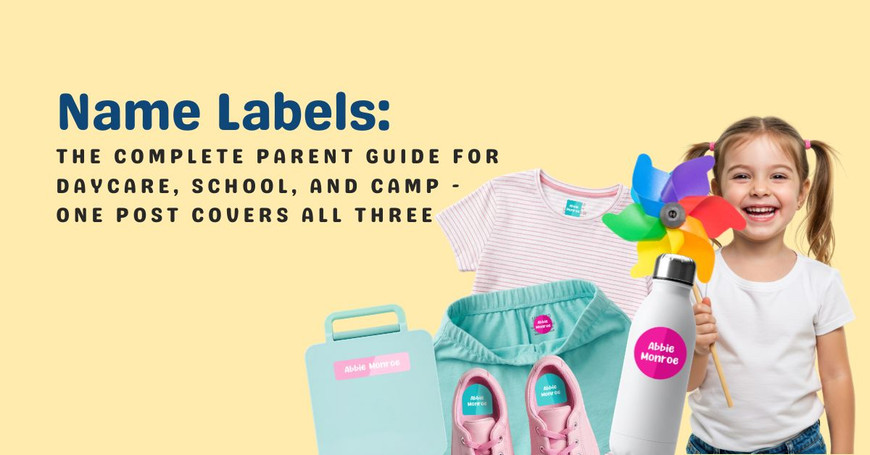
Name labels for kids have one job: make sure everything your child takes out the door comes back. That's the whole point. A name on a jacket means the jacket comes home from the lost-and-found. A name on a bottle means the bottle gets returned at daycare. A name on a sock means one less thing disappearing in communal laundry at camp.
The challenge isn't understanding why name labels matter — it's figuring out which name label to use on which item. There are four distinct types, each designed for a specific surface, each with specific limitations. Using the wrong one on the wrong surface is the reason labels fail — not label quality, not washing conditions, not bad luck. The surface mismatch is the problem in almost every case.
This is the complete parent guide to name labels for kids: every type explained, every surface matched to the right label, every situation — school, daycare, camp, the first day of anything — covered in one place so you don't have to figure it out from scratch every August.
From the founder of Sticky Monkey Labels
Dodie here — founder of Sticky Monkey Labels, boy mom of three sons, two with food allergies and one with special needs, 15 years in business since 2011. Name labels are the foundation of everything we make. This guide is what I'd hand every new customer before they ordered anything.
What's in this guide
- The four types of name labels for kids
- Iron-on name labels — permanent, flat, sensory-safe
- Stick-on clothing labels — fast, flexible, removable
- Waterproof name labels — for everything hard-surface
- Shoe labels — the specialist
- The complete surface-to-label guide
- Name labels by situation — school, daycare, and camp
- How to make name labels last
- Frequently asked questions
1. The Four Types of Name Labels for Kids
Every name labeling mistake comes from one of two sources: wrong label type for the surface, or wrong application for the correct label type. The surface always determines the label type. Before buying anything, identify the surfaces you're labeling and match the label to them.
| Label Type | Surface | Application | Key Feature |
|---|---|---|---|
| Iron-on | Fabric fibers — socks, underwear, tagless clothing | Household iron, cotton setting, no steam | Permanent. No raised edge. Sensory-safe when correctly applied. |
| Stick-on clothing | Care tags and tagless imprints (if large enough). Also hard surfaces. | Peel and press | Fast. Removable. Super-sticky adhesive. Home laundry only — not commercial. |
| Waterproof | Smooth hard surfaces — plastic, steel, glass, metal | Peel and press after alcohol prep | Dishwasher safe. Lasts years. Write-on format available for daycare bottles — name pre-printed, daily date/ounces/contents written with wax pencil and wiped clean each evening. Die-cut shapes available. |
| Shoe labels | Inside heel of shoes only | Peel and press, then clear overlay over the top | Rated for sweat and friction. Clear overlay included — required. Laundry safe. |
2. Iron-On Name Labels — Permanent, Flat, Sensory-Safe
Iron-on labels use heat-activated adhesive that melts at the correct iron temperature and flows into the fabric fibers beneath. As it cools it resolidifies — not on the surface of the fabric but inside it. The bond is at the fiber level, which is why iron-on labels are permanent, have no raised edge that can be felt against skin, and survive conditions that would lift any surface-level adhesive.
When iron-on is the right choice
- Socks — no care tag exists, knit fabric gives stick-on nothing to bond to. Iron-on only.
- Underwear — elastic waistband, no stable smooth surface for stick-on. Iron-on on the flat waistband fabric.
- Tagless clothing where the imprint is too small — if the tagless imprint isn't large enough for a stick-on label, iron-on directly into the fabric.
- Camp clothing going through communal laundry — iron-on survives institutional washing conditions that stick-on is not designed for.
- Sensory-sensitive children — correctly applied iron-on has no raised edge. The only labeling option that completely eliminates the sensation that triggers distress.
- Items that won't be passed down — iron-on is permanent. If the garment will be relabeled for a younger sibling, use stick-on instead.
3. Stick-On Clothing Labels — Fast, Flexible, Removable
Stick-on clothing labels use a specially formulated super-sticky adhesive that bonds to the smooth, stable surface of a care tag or the largest flat area of a tagless imprint. Peel and press — no iron, no equipment, no waiting. Last for years with home laundry when applied correctly.
When stick-on is the right choice
- Anything with an accessible care tag — t-shirts, hoodies, jackets, trousers, school uniforms
- Tagless clothing with a large enough imprint — the label must sit fully within the smooth imprint area; if the imprint is too small, use iron-on instead
- Items being passed to a younger sibling — peels cleanly from care tags for relabeling
- Rapid size turnover in early years — infant and toddler clothing changes sizes quickly; stick-on is practical when permanence isn't needed
- A mixed labeling session covering clothing and gear — stick-on also works on smooth hard surfaces, making it versatile for covering both in one session
What stick-on cannot do
- Bond directly to fabric — any kind of fabric
- Survive commercial washers, dryers, or dry cleaning — home laundry only
- Work on socks or underwear — no suitable smooth surface exists on these items
- Bond to a tagless imprint that's smaller than the label
4. Waterproof Name Labels — For Everything Hard-Surface
Our waterproof name labels go on every smooth hard-surface item your child takes out the door — water bottles, lunchboxes, food containers, school supplies, daycare bottles, toiletries, and camp gear. Pressure-sensitive adhesive on a durable synthetic material. Dishwasher safe. Rated to last years when applied to a properly prepped surface.
For daycare and childcare settings, our write-on bottle labels are a specific format within the waterproof label family — your child's name is pre-printed on the label permanently, and a designated write-on area lets you fill in daily information (date, ounces, contents) each morning with the wax pencil add-on. The wax wipes off cleanly before nightly washing, leaving a fresh write-on surface for the next morning. The label itself stays on the bottle for years. These are purchased alongside matching lid labels — your child's name already printed, sized correctly for standard bottle caps.
For large insulated bottles — Stanley, Hydro Flask, YETI — our large die-cut name labels are sized for the wider diameter and come in fun cutout shapes that kids spot immediately in a lineup of identical bottles. The same waterproof adhesive, a size and shape that fits the surface, and a design older kids actually want on their things.
Where waterproof labels don't work
- Fabric — not for clothing of any kind
- Silicone surfaces — non-stick by nature; nothing bonds to silicone. Use the plastic nipple ring, hard plastic cap, or other hard plastic component instead.
- Textured surfaces — raised dots, ridges, or grip patterns. Labels cannot be applied to textured surfaces — find the smooth area.
- Rubber surfaces — labels will not stick to rubber
5. Shoe Labels — The Specialist
Our shoe labels are specifically designed for the inside heel — a more demanding environment than any other labeling surface because of the combination of sweat, friction, heat, and flex that the heel interior experiences during daily wear.
Key rules for shoe labels
- Inside the heel only — not the sole, tongue, or exterior
- Both shoes of every pair — shoes separate; one labeled shoe doesn't bring home the other
- For shoes with a material insole: clean of loose fibers and ensure completely dry before applying
- Clear overlay included with every order — apply over the name label after pressing. Required, not optional. The overlay protects the print from heel friction.
- Shoe labels are laundry safe for household machines
- Standard waterproof labels are not recommended for shoes — use shoe labels specifically
- Labels will not stick to rubber soles or exterior rubber surfaces
- Crocs are made from a proprietary non-stick foam — nothing adheres to them. Use permanent marker on the interior strap instead.
- 24 hours before first wear after applying
6. The Complete Surface-to-Label Guide
| Item / Surface | Label Type | Placement / Notes |
|---|---|---|
| T-shirts / tops with care tag | Stick-on | Flat face of the care tag |
| Tagless tops | Stick-on or Iron-on | Stick-on on the largest flat area of the tagless imprint if large enough. Iron-on if imprint is too small. |
| Hoodies, jackets, coats | Stick-on | Care tag. Removable for hand-me-downs. |
| Socks | Iron-on only | Inside cuff. Every individual sock. Single flat layer on firm ironing board section. |
| Underwear | Iron-on only | Flat fabric of inner waistband. Not on elastic. Back center placement. |
| Trousers / skirts with care tag | Stick-on | Care tag inside waistband. Not the elastic or fabric directly. |
| Camp clothing (communal laundry) | Iron-on | All fabric items going through institutional washing. Stick-on not for commercial laundry. |
| Shoes | Shoe labels | Inside heel. Both shoes. Clear overlay required. |
| Water bottle — standard | Waterproof | Upper smooth body. Lid separately. Alcohol prep. |
| Water bottle — Stanley / Hydro Flask / YETI | Large die-cut | Powder-coated body above silicone base boot. Lid separately. Fun shapes kids identify instantly. |
| Lunchbox | Waterproof | Exterior front and interior. Both. |
| Daycare bottles and sippy cups | Waterproof write-on | Top of bottle nearest nipple ring. Lid separately with matching lid label. Name pre-printed. Daily date, ounces, and contents written in write-on field with wax pencil — wiped clean before nightly washing. Wax pencil write and go — do not rub. |
| Food and snack containers | Waterproof | Body and lid separately. Every container. |
| Backpack / school bag | Waterproof | Smooth plastic or metal exterior hardware. Not fabric or mesh. |
| Sunscreen / bug spray (camp) | Waterproof + overlay | Clear overlay applied over the name label protects ink from chemical degradation over a full camp session. |
| Camp bedding | Iron-on | Outside hem edge — visible without unfolding. Every piece separately. If care tag is accessible, stick-on on the tag is valid for sheets. |
7. Name Labels by Situation
School — back to school labeling
Waterproof labels for water bottles, lunchboxes, and school supplies. Stick-on clothing labels for everything with an accessible care tag. Iron-on for socks, underwear, and tagless items. Shoe labels for both shoes of every pair. Die-cut large labels for any middle or high schooler with an insulated water bottle they actually want a label on. For the full session-by-session approach, see our complete back to school labeling guide.
Daycare — first drop-off labeling
Write-on waterproof labels for bottles and food containers — name pre-printed permanently on the label, with a designated write-on area for the daily information your daycare requires: date, ounces, and contents. Each morning, fill in the write-on fields with the wax pencil add-on — write and go, don't rub. Before nightly washing, wipe the written fields clean with a dry cloth so the write-on surface is fresh for the next morning. The label itself stays on the bottle for years. Matching lid labels are included with bottle label sets — body and lid both need their own label, always. Stick-on clothing labels for the daily outfit and the change of clothes your daycare requires. Iron-on for socks. Shoe labels for both shoes of every pair.
Camp — the most comprehensive version
Everything goes, everything needs a label, and labels need to hold through weeks of outdoor conditions and communal laundry. Iron-on for all clothing and bedding. Waterproof for all hard-surface gear. Die-cut large labels for the water bottle. Clear overlays on sunscreen and bug spray. Shoe labels for every pair. Label the trunk exterior and interior lid. Every individual sock. Every individual shoe. Every container body and lid. Browse our camp label packs for the full setup.
8. How to Make Name Labels Last
The label quality determines the ceiling. The application determines the result. The same rules apply regardless of label type or surface — prepare, apply correctly, allow cure time.
Waterproof labels on hard surfaces
- Clean with alcohol first — every surface, every time, including new items
- Apply immediately after the alcohol dries — don't touch the cleaned area with your hands first
- Press firmly from center outward — thumbnail along every edge
- Allow 24 hours before the first dishwasher cycle
Stick-on clothing labels on care tags
- Label must sit fully within the smooth face of the care tag — no overlap onto fabric
- Press firmly from center outward — thumbnail along every edge
- Allow 24 hours before the first wash
Iron-on labels on fabric
- Cotton setting, steam completely off
- Press-and-lift technique — never slide the iron. 60–90 seconds total across the label.
- Cool completely before touching — at least two minutes
- Thumbnail check after cool-down — every edge must feel flush. Re-press any edge that lifts.
- Allow 24 hours before the first wash
Browse our full range of clothing name labels, waterproof name labels, large die-cut name labels, and shoe labels at Sticky Monkey Labels. Questions about your specific situation? Call us at 1-888-780-7734.
Frequently Asked Questions
How long do name labels for kids last?
Iron-on labels are permanent for the life of the garment when correctly applied. Stick-on clothing labels last for years with home laundry on care tags. Waterproof labels last for years on correctly prepped hard surfaces — through testing with my own kids and parents regularly tell us labels are still holding after many years of daily dishwasher use. Shoe labels last through the life of the shoe when applied correctly with the clear overlay. The answer in every case is: correct application to the correct surface determines longevity, not a time limit on the label itself.
Are name labels safe for young children?
Yes. Our labels are non-toxic. Iron-on labels specifically are made to be super soft with no rough edges — no raised surface that a child wearing them against skin would feel when correctly applied. Waterproof labels go on the exterior of containers, not inside where they contact food or liquid. For sensory-sensitive children, correctly applied iron-on labels are the only labeling option that completely eliminates the physical sensation of a label edge.
Do I need to order different label sets for school, daycare, and camp, or can I use one set for everything?
You need both clothing labels and waterproof labels regardless of the situation — the surface variety across clothing, bottles, and gear always requires both types. Within each type, the same product covers all situations: the same iron-on label that goes on a school uniform sock goes on a camp sock. The same waterproof label that goes on a school lunchbox goes on a camp water bottle. The situation determines which items to label — the label products themselves are consistent across school, daycare, and camp.
My name labels keep failing within the first week. What is the problem?
Almost always the surface mismatch or application error — rarely the label itself. For waterproof labels peeling from hard surfaces: was the surface cleaned with alcohol? Was 24 hours allowed before the first wash? Is the surface silicone, textured, or rubber where nothing bonds? For stick-on clothing labels peeling: was it applied to fabric rather than the care tag? For iron-on labels lifting: was pressing time less than 60–90 seconds? Was the label touched before it cooled? Identify which applies and reapply correctly — the same label applied correctly will hold.
Can I remove name labels if I need to?
Stick-on clothing labels peel cleanly from care tags for relabeling — no residue, no damage to the tag. Waterproof labels can often be peeled from hard surfaces, especially if removed promptly, though some residue may remain on the surface. Iron-on labels are permanent — they cannot be removed from fabric. Plan your label type choice before applying: if any item will need relabeling for a different child, use stick-on rather than iron-on from the start.
How many name labels do I need for a typical school year setup?
A typical back to school setup for one child needs approximately 15–25 waterproof labels for hard-surface items (water bottle, lunchbox, food containers, school supplies — counting lids separately), 20–30 stick-on clothing labels for the school wardrobe (including every individual clothing piece), iron-on labels for socks and underwear (one per individual sock, one per underwear piece), and shoe labels for every pair going to school. Add 20% across all types for mid-year replacements and new items. Our label sets are priced for full coverage rather than single items — ordering by the set is more economical for a full school year.