
From the founder of Sticky Monkey Labels
Our family is constantly on the go with three busy boys. Meal prepping has saved us so much time and frustration — it's kept our grocery bill lower and reduced the number of times I get asked "what's for dinner?" We've also noticed we spend much more time together in the evenings. I hope your family benefits from it the same way ours has.
Meal prepping works. The research is clear, the anecdotal evidence is overwhelming, and most parents who try it stick with it. The problem isn't the concept — it's the execution. Specifically: prepared food that isn't properly labeled and organized is food that gets forgotten, wasted, or eaten by the wrong person. The system that makes meal prep sustainable is an organizational one as much as a cooking one.
Here's the labeling and organization system that makes meal prep actually function for a busy family — week after week, not just the first enthusiastic Sunday.
In This Article
Why Meal Prep Fails — and What the Labeling System Fixes
The most common meal prep failure mode isn't a lack of cooking ambition. It's standing in front of an organized-looking fridge on Wednesday evening and genuinely not knowing what any of the containers hold, how old they are, or whether what you're looking at is dinner or tomorrow's lunches. Unlabeled meal prep turns into a guessing game — and eventually, food waste.
A labeling system solves this by making every container self-explanatory. The contents, the date prepared, who it's for, and when it should be used — all visible at a glance, without opening anything. That's the difference between a fridge that functions as a meal prep system and one that's just a collection of containers.
The secondary benefit is family functionality. When containers are clearly labeled with who they belong to and what's in them, other family members can retrieve their own food independently. This is particularly meaningful with children — a labeled lunchbox that a child can pack themselves in the morning is time and decision-making returned to the parent who would otherwise be doing it.
Container Choices That Make the System Work
The container is the foundation of the labeling system — the label goes on the container, and the container determines whether the label stays readable and the food stays fresh.
- Clear containers wherever possible. Transparency is a feature, not an aesthetic preference. A clear container lets you see the contents before opening — combined with a label, it provides complete information at a glance. Opaque containers require opening to identify contents, which defeats part of the organizational purpose.
- Airtight seals for fridge and freezer items. Properly sealed containers extend the usable life of prepped food significantly, which is what makes the investment of prep time worthwhile. Good seals also prevent freezer burn on batch-cooked items.
- Stackable designs to maximize fridge space. A meal-prepped fridge fills up quickly. Stackable containers — the same brand, the same dimensions — make efficient use of shelf space and keep things findable. Mixed container shapes create the Tetris problem: nothing fits properly and things get pushed to the back.
- Portion-appropriate sizes. Separate containers for individual servings rather than one large container makes portioning straightforward and prevents the "I'll just have a bit more" that undermines meal planning intentions. Small containers for dressings and sauces stored separately from main components keep everything fresher.
Which Labels for Which Meal Prep Use
Our write-on labels are the right tool for meal prep organization — and here's why:
Write-On Labels — For Fridge, Freezer & Food Storage
The workhorse of meal prep organization. Apply to food containers once — the label stays adhered to the container permanently. Write the contents, the date prepared, and any relevant notes with the semi-permanent marker. When the container is washed and repurposed, the writing wipes off with water and you rewrite for the next use.
- Refrigerator and freezer safe
- Dishwasher safe (top rack)
- Microwave safe
- Rewritable with our tested semi-permanent marker — wipes off with water
Packing School Lunches — Labeled Lunchboxes That Come Home
School lunch packing is one of the highest-frequency meal prep tasks in a family's week — five days a week, for years. A system that makes this fast and largely automatic has an outsized impact on morning routines.
With a meal-prepped fridge, lunch assembly becomes a matter of filling compartments from labeled containers rather than cooking anything from scratch. Five minutes in the morning rather than twenty. The labeling system that makes this work:
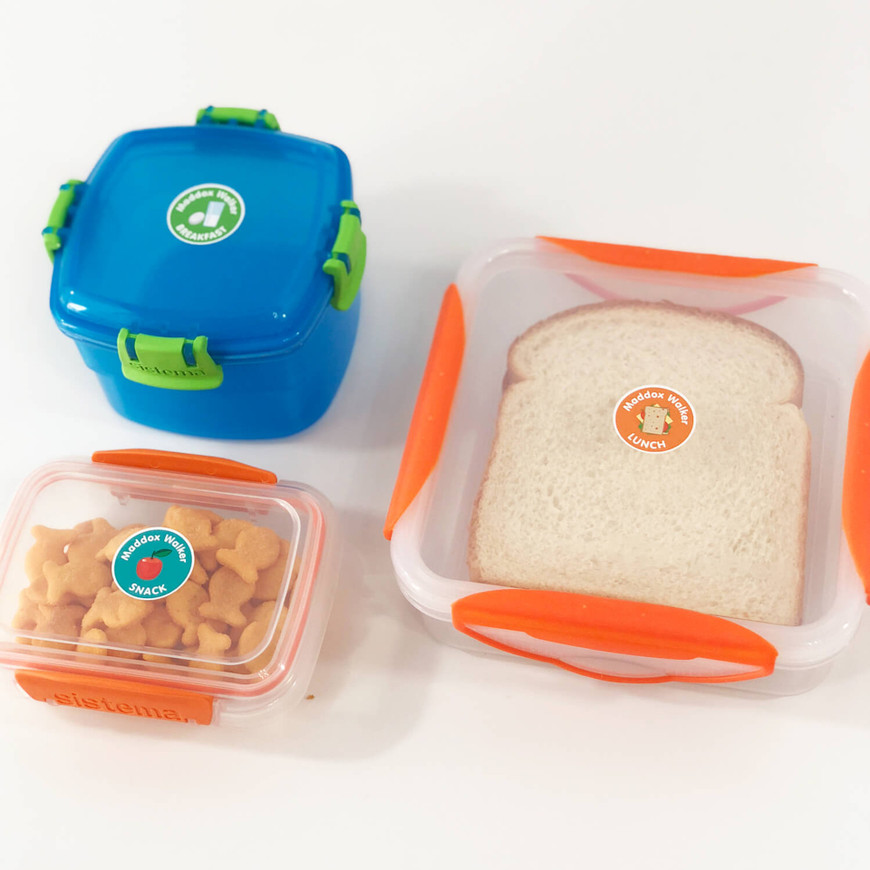
- Label the lunchbox with your child's name — a waterproof name label on the outside and a contact label inside the lid. Labeled lunchboxes come home. Unlabeled ones end up in the school lost and found.
- Label individual containers inside the lunchbox — write-on labels on reusable food containers identify the contents at a glance, which matters especially for children who want to know exactly what they're eating.
- For families with multiple children — label each lunchbox clearly with the individual child's name. Identical-looking lunchboxes with similar contents reaching the wrong child is an inconvenience for most families and a safety issue for a child with food allergies.
The Weekly Meal Prep Process
The system works best when prep is batched into one or two dedicated sessions rather than spread across the week. Sunday afternoon is the most common time for families — close enough to the week ahead to be useful, and typically a lower-demand time of day.
- Plan the week's meals first. Fifteen minutes planning on Saturday means Sunday prep is efficient rather than improvised. Note what requires cooking, what can be assembled from components, and what can be grabbed from the freezer.
- Batch cook the foundations. Grains, proteins, and roasted vegetables are the building blocks that become different meals throughout the week. A batch of cooked rice or quinoa, grilled chicken, roasted vegetables, and a pot of soup covers most of a family's week and takes two to three hours to prepare in parallel.
- Portion and container immediately. Food goes directly from cooking into portioned, labeled containers — not into a large pot that gets dipped into all week. Individual portions are what make mid-week grab-and-go work.
- Label immediately after packing. This is the step most commonly skipped and the one that causes the most waste. Label every container before it goes in the fridge — contents, date, and whose it is if relevant. Our write-on labels take five seconds per container.
- Freeze extras immediately. Anything not needed in the next three to four days goes straight to the freezer, labeled with contents and date. A well-labeled freezer is a resource; an unlabeled one is a mystery that gets avoided.
What to Actually Prep — Balanced Lunch Building Blocks
The organizational system works for any food you choose to prep. For school and family lunches specifically, prepping by component rather than complete meals gives the most flexibility across the week:
Proteins (batch cook)
- Grilled or roasted chicken
- Hard-boiled eggs
- Cooked beans or lentils
- Turkey slices
Grains (batch cook)
- Brown rice or quinoa
- Whole-grain pasta
- Whole-grain crackers (store)
Vegetables (prep ahead)
- Pre-chopped raw veggies
- Roasted vegetables
- Washed salad greens
- Cherry tomatoes (store)
Quick additions
- Fruit (most needs no prep)
- Hummus (portioned)
- Cheese
- Nuts and seeds
With these components prepped and labeled in the fridge, assembling a school lunch or family dinner takes five minutes of combining rather than thirty minutes of cooking. The variety comes from different combinations of the same building blocks — not from cooking something entirely new every day.
Browse our full range of write-on labels at Sticky Monkey Labels.
Frequently Asked Questions
What labels are best for meal prep containers?
Write-on labels are the most practical — apply once and update the written information each time the container is repurposed. They're refrigerator and freezer safe, dishwasher safe (top rack), and microwave safe. The writing wipes off cleanly with water when the container is washed, and you write the new contents and date for the next use.
How do I keep meal-prepped food organized in the fridge?
Label every container immediately after packing — contents, date, and whose it is if relevant. Use clear containers so contents are visible without opening. Stack uniform-sized containers to maximize space. Keep the most perishable and shortest-use items at eye level at the front so they get used first.
How long does meal-prepped food keep in the fridge?
Most cooked proteins and grains keep for three to four days in an airtight container in the fridge. Prepped raw vegetables keep three to five days depending on the vegetable. Clearly labeling preparation dates lets you track freshness without guessing — which is why labeling immediately after prep, not after a few days, is the habit that prevents food waste.
How should I label school lunchboxes for meal-prepped lunches?
A waterproof name label on the outside of the lunchbox ensures it comes home reliably. A contact label inside the lid — with your child's name and your contact information — provides the backup. For reusable food containers inside the lunchbox, write-on labels that can be updated daily are the most practical choice: write the contents before packing, wipe clean when the container is washed, repeat. For families with multiple children, each child's lunchbox should be clearly labeled with their individual name to prevent mix-ups.