
From the founder of Sticky Monkey Labels
As a mom of three boys and the founder of Sticky Monkey Labels, I've spent years figuring out what actually gets children to clean up — not just when you're watching, but as a genuine habit. The answer is almost always about removing barriers and creating the right conditions, not about willpower or punishment.
Most parents do their children's tidying themselves — not because they want to, but because it's faster and because they know it'll be done right. The problem with this approach is that it doesn't stay faster as children get older. And it deprives children of something genuinely valuable.
Research from the University of Minnesota found that children assigned household chores at an early age were more likely to succeed academically, maintain better relationships, and develop greater self-sufficiency as adults. The chores themselves mattered less than the habits of responsibility they built. Here's how to start building those habits — in a way that actually works, without constant battles.
Strategies Covered
- Remove the barriers — make cleaning accessible
- Start with small, specific tasks
- Never use cleaning as punishment
- Explain the why in age-appropriate terms
- Use rewards and consequences consistently
1. Remove the Barriers — Make Cleaning Physically Accessible
The most common reason children don't clean up isn't laziness or defiance — it's that the system requires adult knowledge or physical capability they don't have. A child who can't reach the hanging rod can't hang up their clothes. A child who doesn't know which bin their toys go in will put them anywhere or nowhere. Remove those barriers and the behavior changes.
Practical changes that make a real difference:
- Label storage at child height. Bins, shelves, and drawers labeled clearly — with words for readers, pictures for pre-readers — let children put things away independently without asking where things go. When the answer is visible rather than stored in an adult's head, children act on it. Our write-on labels are ideal for storage bins that change contents as children grow — update the label without replacing it.
- Give each child their own clearly labeled catch-all bin. Rather than requiring perfect categorization, a personal catch-all for toys, art supplies, and small items gives children a single destination that's always correct. Label each bin with the child's name so ownership is unambiguous.
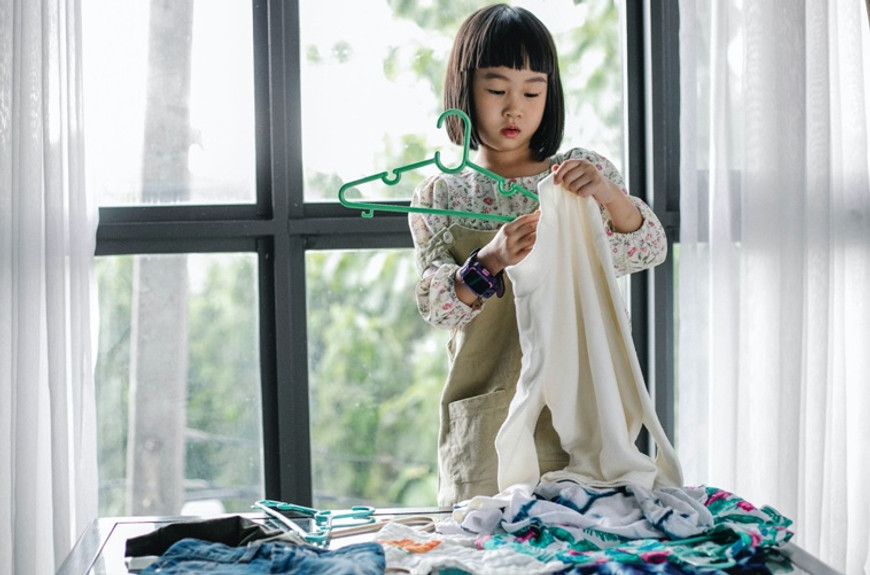
- Use iron-on clothing labels for laundry independence. Sorting clean laundry is a genuinely achievable task for children from around age five — but only if they can identify whose clothes are whose. Our iron-on clothing labels bond permanently to iron-safe fabrics using a household iron, lying completely flat with no bulk or irritating edges. They're compatible with cotton, polyester, and poly-cotton blends — and once applied, they're laundry-safe through the full school year and beyond.
- Adjust storage to be physically reachable. A double hang system in a child's closet — a lower rod within their reach — means they can actually hang up their own clothes. Cleaning supplies stored at child height in a small caddy means they can start tasks without needing to ask you for supplies first.
- Provide child-friendly cleaning tools. A small caddy with age-appropriate supplies — a simple spray bottle, a duster, soap, a scrub brush — gives children everything they need for basic cleaning tasks without searching through adult supplies. When everything is in one accessible place, starting is immediate rather than a process.
2. Start With Small, Specific Tasks
Adults get overwhelmed by a messy room and feel a sense of defeat before they've even started. Children experience this even more intensely. "Clean your room" is an instruction that encompasses dozens of individual tasks and no clear starting point — it's genuinely hard to act on.
"Put your shoes in the shoe bin" or "put your books on your shelf" is actionable. Specific, completable, immediately verifiable. Starting with tasks at this level builds the habit of responding to cleaning instructions — and builds the confidence that comes from completing things successfully.
Two approaches that work well in practice:
- The scheduled task approach. Specific tasks on specific days, written on a visible chart. Monday is vacuum day, Tuesday is laundry sort day. When it's on a schedule, it stops being a negotiation — it's just what happens on that day. The predictability is actually helpful for children; they resist surprises more than routines.
- The Ten Minute Rule. If a task can be completed in ten minutes, it's best done now rather than later. This is a principle you can teach directly to children from around age six or seven — and it applies to a surprising number of household cleaning tasks. A room that gets ten-minute maintenance regularly never becomes the overwhelming mess that requires a two-hour clean.
3. Never Use Cleaning as Punishment
This is one of the most important principles in building cleaning habits that last. Using tidying as a punishment — "since you did that, you have to clean the bathroom" — creates a direct negative association between cleaning and being in trouble. The outcome is predictable: children who learn to associate cleaning with punishment become adults who avoid cleaning.
Cleaning needs to be framed as a normal, neutral part of daily life — not a consequence, not a burden, just something that happens in a functioning household. The way to do this is to model it as normal yourself, to include it in routines rather than reactive responses, and to use entirely separate systems for consequences and rewards.
When children do avoid cleaning or create additional mess, address the behavior directly — but keep the consequence separate from the chore. Taking away screen time or a planned outing is a consequence. Assigning extra cleaning is a punishment that corrupts the habit you're trying to build.
4. Explain the Why in Age-Appropriate Terms
Children who understand why something matters are more likely to do it than children who are simply told to. This applies to cleaning as much as anything else — and the explanation doesn't need to be complicated.
For young children, concrete and immediate reasons work best: "When toys are left on the floor, people trip and get hurt." "When food is left out, it attracts bugs." These are cause-and-effect relationships children can understand and verify from their own experience.
For older children, you can add more nuance: "A clean space is easier to work and relax in." "When everyone contributes to keeping the house tidy, no one person has to do all the work." "These are skills you'll need when you're living independently."
The key is age-appropriate specificity. A vague "because it's important to be tidy" gives a child nothing to work with. A concrete reason that connects to their experience gives them something they can actually internalize.
5. Use Rewards and Consequences Consistently
Positive incentives for completing chores work significantly better than negative consequences for not doing them — especially for younger children who are still building the intrinsic motivation that makes habits self-sustaining. The reward doesn't need to be large or expensive; it needs to be consistent and connected clearly to the completed task.
Reward approaches that work well in practice:
- An allowance or points system. Financial incentives scaled to age and task difficulty teach children that effort has tangible value — a lesson with applications well beyond household chores.
- Activity-based rewards. A trip to the park, a movie night, a chosen family activity. These work especially well for younger children who respond more to experiences than to money.
- Earned autonomy. For teenagers especially, connecting completed responsibilities to increased privileges — later bedtimes, more screen time, greater freedom — is a powerful motivator that also models the real-world relationship between responsibility and independence.
On the consequence side: when a child leaves a mess or fails to complete a task, a proportional reduction in whatever rewards or privileges are on offer is appropriate. Consistency matters more than severity — a small, reliable consequence is more effective than an occasional large one.
Setting up a labeled, accessible organizational system at home is one of the most effective ways to reduce cleaning friction for children. Browse our range of write-on labels for storage, iron-on clothing labels for laundry independence, and our full range of kids name labels at Sticky Monkey Labels.
Frequently Asked Questions
At what age should children start doing chores?
Children can begin contributing to household tasks from around age two or three with very simple, supervised activities — putting toys in a bin, placing dirty clothes in a hamper. By age five or six, most children are capable of completing simple chores independently when the system is set up to support them. The University of Minnesota research suggests starting early matters more than the specific tasks — the habit of contribution is what builds the long-term benefits.
Why won't my child clean up even when I ask them to?
The most common reasons are: the task is too large and undefined ("clean your room" covers too many subtasks), the system requires knowledge or physical access they don't have (unlabeled storage, unreachable rods), or cleaning has negative associations from being used as punishment. Identify which barrier applies and address that specifically — usually the solution is making the task smaller and more specific, or removing a physical barrier that makes independent completion impossible.
Does giving children chores actually benefit them?
Yes — research consistently supports this. The University of Minnesota study found children assigned household chores at an early age were more likely to succeed academically and maintain better relationships as adults. The mechanism is the development of responsibility, self-reliance, and the understanding that effort produces outcomes — habits that transfer well beyond household tasks.
Should I pay my children for doing chores?
This is a genuine parenting debate with reasonable perspectives on both sides. An allowance tied to chores teaches the connection between effort and reward — a valuable real-world lesson. Some parents prefer to separate allowance from chores to convey that household contribution is an expectation, not a transaction. Both approaches can work; the most important factor is consistency. An inconsistent reward system — sometimes paid, sometimes not — is less effective than either consistent payment or consistent expectation.
How do labels help children stay organized and clean up?
Labels reduce the decision-making required to put things away correctly — which is one of the main friction points that leads to things not being put away at all. A labeled bin with a picture or word makes the correct destination immediately obvious, removing the need to ask where things go. For laundry specifically, iron-on or stick-on clothing labels that identify whose clothes are whose make sorting an independent task children can complete without adult involvement.