
From the founder of Sticky Monkey Labels
As a mom of three boys and the founder of Sticky Monkey Labels, I've watched all three of my kids work through the left-right challenge at different ages and in different ways. The methods that worked best weren't the most complicated — they were the ones that made it tangible, physical, and fun. These are them.
Left and right is one of those concepts that seems like it should be simple — and then you watch a child confidently put both shoes on the wrong feet for the fourteenth morning in a row and realize it genuinely isn't. Directional awareness is a spatial reasoning skill that develops differently in every child, and for many kids it doesn't click until ages five, six, or even seven.
The good news is that the right approach makes a real difference. Children learn left and right fastest when it's physical, visual, and repeated in contexts that matter to them — not through abstract instruction. Here are six methods that work, including one that turns getting dressed in the morning into a puzzle your child actually wants to solve.
6 Methods Covered
- MatchUP Shoe Labels — the visual cue that works every morning
- Storytelling and imaginative play
- Body awareness games (Simon Says, dance)
- Outdoor exploration and obstacle courses
- Tech-assisted learning
- Everyday routines and role modeling
1. MatchUP Shoe Labels — The Daily Visual Cue That Makes It Click
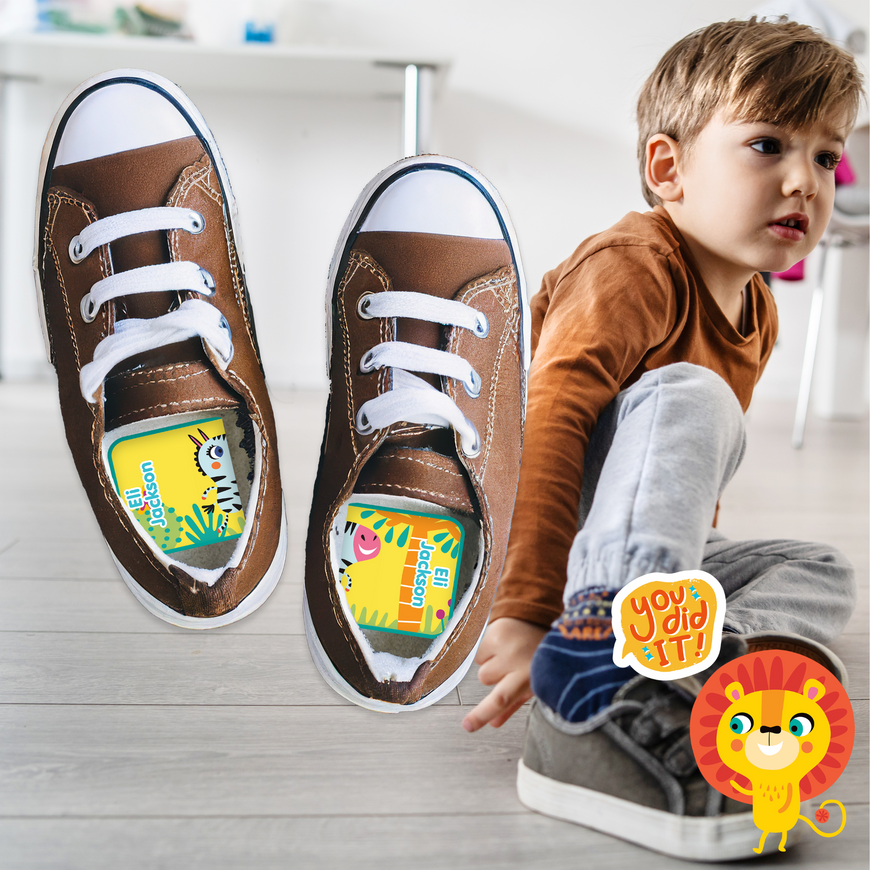
Of all the methods for teaching left and right, this is the one that works passively — every single morning, without any extra effort from you. The concept is simple and genuinely clever: two halves of a fun graphic, one inside each shoe. When the shoes are placed on the correct feet, the two halves form a complete picture. When they're on the wrong feet, the image is split and obviously wrong — even to a three-year-old.
That self-correcting visual feedback is what makes MatchUP Shoe Labels so effective. Your child doesn't need you to tell them the shoes are on the wrong feet — they can see it themselves, and they can fix it themselves. That independence is what builds the spatial awareness that eventually becomes automatic.
Our MatchUP labels are customizable with your child's name, an optional phone number, or simply "Left" and "Right" if you prefer the direct approach. They're waterproof, washer and dryer safe, and designed for the curved inner sole of children's shoes — applied at the heel where they stay put and stay readable.
2. Storytelling and Imaginative Play
Young children learn through narrative — which makes storytelling one of the most natural ways to introduce directional concepts. Create simple adventure stories where characters have to make left and right choices: "The explorer turned left at the big oak tree," "the bunny hopped right to find the carrot patch." As you tell the story, have your child act out the movements.
You can extend this with simple props — drawing a map together, laying out a path with cushions or tape, or following directions through the house. The physical movement reinforces the concept in a way that listening alone doesn't. When a child turns their own body left and right in the context of a story, it begins to build the muscle memory and spatial awareness that eventually makes the distinction automatic.
- Narrative exploration — tell stories with directional choices baked in, and have your child act out the movements as the story unfolds.
- Map-making — draw simple maps together with left and right directions marked clearly. Following their own hand-drawn map gives children an immediate, satisfying way to apply what they're learning.
3. Body Awareness Games
Games that require physical responses to left-right commands are among the most effective teaching tools available — and children don't experience them as learning at all. They experience them as playing.
- Simon Says — the classic format works perfectly for directional learning. "Simon says touch your left knee," "Simon says wave your right hand," "Simon says jump on your left foot." The game format creates just enough stakes (don't get out!) to keep children focused and attentive in a way that regular instruction doesn't.
- Dance parties — put on music and lead simple routines that incorporate left and right movements. "Stomp your left foot, clap your right hand, spin to the left." The rhythm helps reinforce the sequence, and the movement makes it physical and memorable. Many children who struggle with verbal instruction pick up directional concepts quickly through movement.
4. Outdoor Exploration and Obstacle Courses
Taking left-right learning outside combines movement, fresh air, and real-world context — which is particularly effective for children who learn best when they're active and engaged with their environment.
- Nature scavenger hunts — give directional clues as part of the hunt. "Walk to the big tree, then turn right," "find something red to the left of the bench." Following real directions to reach real things makes left and right feel purposeful rather than abstract.
- Obstacle courses — set up simple courses with left and right turns built in. Cones to zigzag, stepping stones, a path with marked turning points. As children navigate the course repeatedly, left-right responses start to become instinctive rather than deliberate.
5. Tech-Assisted Learning
For children who are drawn to screens, educational apps and videos can be a genuinely useful supplement to the physical methods above. The key word is supplement — screen-based learning works best when it reinforces concepts the child has already begun to develop through physical activity, not as a replacement for it.
- Educational apps — many well-designed apps use games and puzzles to reinforce left and right through interactive play. Look for ones with colorful visuals, clear feedback, and activities that require the child to make choices rather than just watch.
- Songs and videos — catchy directional songs with accompanying movements are effective for younger children especially. The combination of melody, repetition, and physical action hits multiple learning pathways at once.
6. Everyday Routines and Role Modeling
Consistent, low-pressure repetition in daily life is what ultimately cements left and right into long-term memory. The games and activities above create the initial understanding — daily reinforcement is what makes it automatic.
- Daily routines — weave left and right language naturally into everyday tasks. "Hand me your left foot so I can put your sock on." "Which hand do you hold your spoon with? That's your right hand." "We're turning left at the corner." Casual, consistent exposure in real contexts is more effective than dedicated practice sessions for most children.
- Role modeling — use directional language consistently in your own speech, especially when giving instructions or navigating together. Children absorb the language of the adults around them — the more naturally left and right come up in conversation, the more familiar they become.
The Easiest Daily Reinforcement Tool: MatchUP Shoe Labels
Of all the tools on this list, MatchUP Shoe Labels are the one that works without any extra effort from you — because they're built into your child's morning routine. Every time your child puts on their shoes, the puzzle either works or it doesn't, and they know immediately which way to fix it.
Customizable with your child's name, available in a range of fun designs, waterproof, and built to last through the full school year. Browse MatchUP Shoe Labels at Sticky Monkey Labels — and while you're there, explore our full range of shoe labels for kids of all ages.
Frequently Asked Questions
At what age should kids know left from right?
Most children develop a reliable understanding of left and right between ages five and seven, though there's significant variation. Some children grasp it earlier with consistent exposure; others — particularly left-handed children — may take longer. It's a spatial reasoning skill that develops gradually, and mild confusion well into early elementary school is completely normal.
What is the easiest way to teach a child left from right?
Physical, visual cues that children encounter in their daily routine work best. MatchUP Shoe Labels — which create a puzzle that only works when shoes are on the correct feet — are one of the most effective tools because they reinforce the concept every morning without requiring any additional instruction. Body-based games like Simon Says and dance routines are also highly effective for young children.
What are MatchUP Shoe Labels?
MatchUP Shoe Labels are a two-part label — one half inside the left shoe, one half inside the right. Together they form a complete graphic image, but only when the shoes are on the correct feet. This self-correcting visual cue helps young children independently identify which shoe goes on which foot, building left-right awareness as a natural part of getting dressed. They're customizable with your child's name, waterproof, and washer and dryer safe.
Why do left-handed children often struggle more with left and right?
Many of the common memory cues for left and right are designed around right-handed children — "the left hand makes an L shape when you hold up your fingers" works for a right-handed child looking at their hands, but can feel counterintuitive for a left-handed child. Visual tools like MatchUP Shoe Labels are especially helpful for left-handed children because they don't rely on hand-based memory cues at all — the visual feedback is immediate and unambiguous.
How long does it take to teach a child left and right?
There's no single timeline — it varies significantly by child. With consistent daily exposure through games, visual cues, and routine reinforcement, most children make noticeable progress within a few weeks and develop reliable awareness within a few months. The key is making left-right language a natural part of daily interaction rather than a separate teaching exercise.