
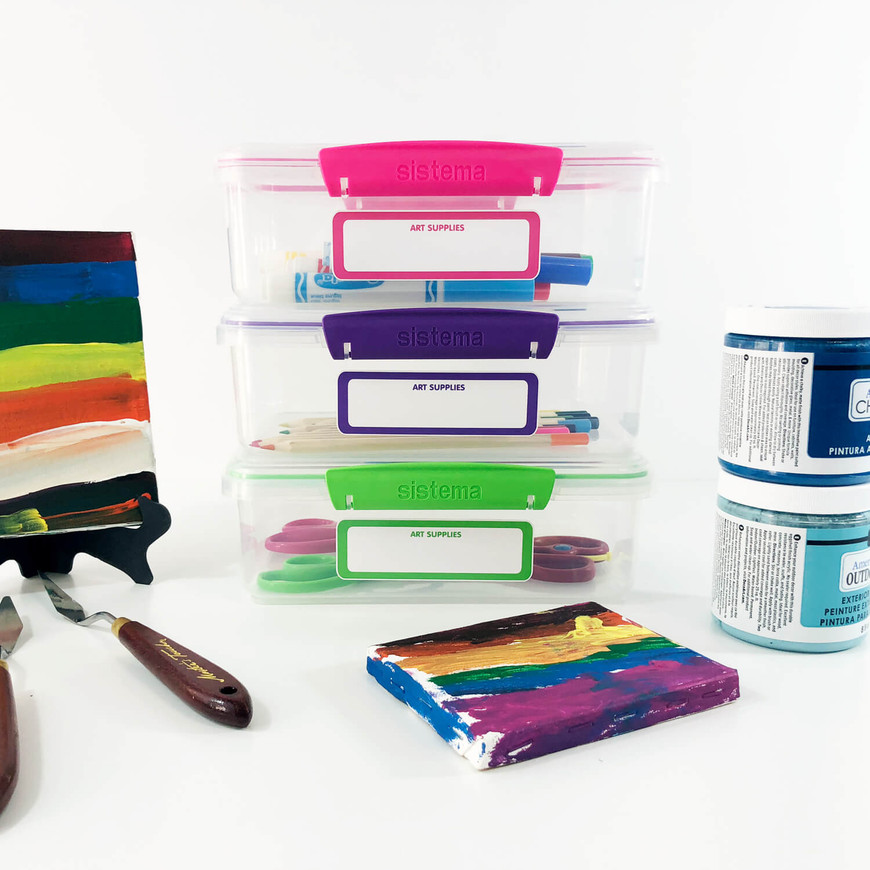
A well-organized craft space does something that seems almost paradoxical: it produces more creativity, not less. When children can find what they need instantly, start projects independently, and return supplies without adult direction, crafting becomes something they initiate themselves rather than something that requires a parent to set up and supervise.
The key to getting there is a labeled storage system built around how children actually use supplies — not an aspirational system that looks good in photos but collapses within a week. Here's the step-by-step approach that actually holds up.
Steps Covered
- Take inventory — get it all in one place first
- Evaluate, cull, and handle the UFOs
- Contain and label by category
- Set up a dedicated craft space that invites use
- Choose the right labels for craft storage
- Get children involved and keep the system running
From the founder of Sticky Monkey Labels
As a mom of three boys and the founder of Sticky Monkey Labels, I live with a craft supply situation that requires active management. Clear plastic shoeboxes and write-on labels are genuinely the foundation of our system — here's the full approach.
Step 1: Take Inventory — Get It All in One Place First
Before any organizing can happen, you need to know what you're organizing. This means pulling every craft supply in the house — yes, including the ones in three different drawers, the ones under the bed, and the broken crayons at the bottom of the art box — onto one surface at the same time.
This step feels like it makes things worse before it makes them better. It does. That's the point. Seeing the full scope of what you have is what makes genuine organization decisions possible, rather than just tidying the visible surfaces while chaos continues underneath.
Have your containers ready before you start, along with your write-on labels and marker — you'll be labeling as you sort rather than doubling back to do it separately. Clear plastic shoeboxes are my favorite container for this because they're stackable, uniform, and you can see what's inside without opening them.
Step 2: Evaluate, Cull, and Handle the UFOs
With everything in front of you, the evaluation process becomes straightforward. Work through each category and make decisions:
- Is it still usable? Dried-out paint, dead markers, glue that no longer sticks, torn paper beyond use — these go. There's no organizational system that makes unusable supplies useful. The broken crayons get the most judgment here, but honestly: if they're too short or too broken to use comfortably, they go.
- Are there duplicates? Multiple pairs of the same scissors, more glitter than a family could use in a decade, twelve nearly identical shades of blue — consolidate. Keep the best, donate or discard the rest.
- Handle the UFOs and WIPs. Every craft collection has them — UFOs (unfinished objects) and WIPs (works in progress) that have been sitting untouched for months. Be honest: is this going to be completed? If yes, it gets a dedicated "current projects" space. If realistically no, let it go. Half-finished projects that live in the craft storage indefinitely become clutter that makes the whole system feel overwhelming.
Step 3: Contain and Label by Category
With the culled and usable supplies sorted, the organization itself is relatively straightforward: group by category, contain each group, label each container.
Category groupings that work well for most children's craft collections:
- Drawing tools — pencils, markers, crayons, colored pencils
- Paint and brushes
- Paper — construction paper, cardstock, tissue paper
- Adhesives — glue sticks, tape, double-sided tape
- Cutting tools — scissors, shaped punches
- Embellishments — stickers, stamps, stencils, glitter, beads, ribbons
- Fabric and yarn
- Seasonal/holiday craft supplies — stored separately and rotated in when relevant
- Current projects — one dedicated space for everything in active use
Keep categories broad enough that a child can return an item without needing to make a complicated decision about subcategory. "Drawing tools" is more sustainable than separate bins for markers, pencils, crayons, and colored pencils — at least for younger children. The system that gets used is better than the system that's perfectly precise.
Step 4: Set Up a Dedicated Craft Space That Invites Use
The organizational system works best when paired with a designated physical space — even a small one. A craft corner, a dedicated table, a section of a bedroom — what matters is that it's consistent, that supplies live there and return there, and that the space signals "this is where creating happens."
What makes a craft space work for children specifically:
- Everything at child height and reachable independently. If a child needs to ask an adult to get them supplies, the creative impulse is already interrupted. Shelves, hooks, and containers positioned at the child's level mean they can start projects without waiting for help.
- A "go-to" caddy on the workspace. Keep the most-used supplies — scissors, glue, markers, pencils — in a small caddy directly on the craft surface so they're always accessible without going to the storage area. Replenish from main storage as needed.
- Lightweight, portable containers where practical. Baskets with handles, lightweight bins, craft caddies that children can carry — these let supplies move between rooms while remaining organized. A child who can transport their own supplies independently is a child who crafts more.
- Vertical storage for larger items. Pegboards for scissors, jars for brushes, wall-mounted shelves — vertical storage makes use of space that often goes unused and keeps the craft surface itself clear.
Step 5: Choose the Right Labels for Craft Storage
The label type that works best for craft storage is specifically write-on labels — and the reason is the same reason they work well for pantry and home storage: craft supply categories change. A bin that holds regular markers this year might need to hold specialty markers and watercolor pencils next year. A seasonal supply bin's contents change entirely between seasons. A "current projects" bin is by definition always changing.
Our write-on labels apply to bins, jars, baskets, boxes, and any hard surface once and stay permanently adhered. The written information wipes off cleanly — semi-permanent marker with water, wax pencil with a dry cloth — and you rewrite when the contents change. No peeling old labels, no sticky residue, no labels that need replacing every time you reorganize.
For color coding by child (when multiple children share a craft space), our solid color labels in each child's designated color work well — and our write-on labels are available in a variety of colors and designs so the labels themselves can be part of the visual organization system.
Step 6: Get Children Involved and Keep the System Running
An organizational system that children helped design and operate is one that stays organized. One that was done to them by an adult while they watched is one that lasts two weeks.
- Include them in the sorting decisions. What stays, what goes, which items belong in which category — these are decisions children can and should participate in. Not all decisions, and with appropriate guidance, but genuine participation creates genuine investment.
- Let them apply the labels. For children old enough to peel and write (or trace), the labeling session itself is an activity. They write the category name on the label, they apply it to the bin. That bin is now theirs in a meaningful sense.
- Teach and reinforce the return habit. The "five-minute clean-up" at the end of each craft session — everything back to its labeled home — is the routine that maintains the system. It doesn't need to be perfect. It needs to be consistent. Acknowledge it when they do it well; over time it becomes automatic.
- Update labels as supplies and interests change. Review the system every few months — what still works, what categories have shifted, what's missing. Wipe and rewrite labels that are no longer accurate. This quarterly review takes fifteen minutes and keeps the system honest rather than letting it drift into irrelevance.
Browse our full range of write-on labels — available with our tested semi-permanent marker and wax pencil — at Sticky Monkey Labels.
Frequently Asked Questions
What is the best way to organize children's craft supplies?
Start with a full inventory — everything in one place. Cull unusable items and duplicates. Sort into broad categories that children can actually navigate. Contain each category in a labeled clear container at child height. The labeled, visible, child-accessible system is what produces independence — which is the real goal, not a tidy room for its own sake.
What labels work best for craft storage bins?
Write-on labels are the most practical for craft storage because the contents of bins change over time — different seasons, different projects, evolving interests. Apply the label once and update the written information when the bin's purpose changes. This is more sustainable than printed labels that need replacing every time you reorganize.
How do I organize craft supplies in a small space?
Use vertical storage — pegboards, wall shelves, stacked bins — to make use of space that's often unused. Lightweight portable containers let supplies move without the space becoming a fixed craft room. Keep only actively used supplies accessible; store seasonal and rarely used supplies in labeled bins elsewhere. Culling duplicates and unusable supplies before organizing frees up more space than any storage solution.
How do I get kids to put craft supplies back where they belong?
Make the return process as easy as possible — labeled, visible, child-height storage with broad enough categories that the decision about where something goes is obvious rather than requiring thought. Establish a consistent clean-up routine at the end of each craft session and reinforce it positively. Systems children helped design and personalize are maintained much more consistently than those imposed on them.
What should I do with unfinished craft projects?
Create a dedicated "current projects" space — a labeled bin or tray specifically for works in progress. Items that are actively being worked on live there. Items that haven't been touched in months are probably not going to be finished; let them go rather than letting them occupy permanent space in the craft storage. Be honest: an unfinished project that's been sitting for six months is clutter with sentimental attachment, not an active creative endeavor.