
From the founder of Sticky Monkey Labels
I'm Dodie — mom of three boys, two with food allergies, and founder of Sticky Monkey Labels since 2011. When my first son started daycare, nobody explained what "label everything" actually meant for bottles — what information was required, which labels survived commercial dishwashers, or why silicone bottles were a completely different problem. This guide covers everything I had to learn the hard way, plus 14 years of feedback from daycare providers across the country.
The moment your daycare registration packet arrives, you realize one thing fast: every bottle that leaves the house needs a label — and not just any label. Most daycares require specific information on each bottle, have preferences about placement, and run commercial dishwashers that destroy standard stickers within days. Getting this right from the start protects your child, meets state licensing requirements, and saves you from relabeling every single week.
Here's everything working parents need to know — the right label for every bottle type, what your daycare actually requires, the wax pencil vs. marker question, how to apply labels so they last, and what a complete daycare labeling system looks like beyond just the bottles.
What's Covered in This Guide
Why Proper Bottle Labeling Is Non-Negotiable
In a room of 8–15 infants, every baby has multiple bottles that look nearly identical. Without clear, readable labels that survive real daycare conditions, the consequences go well beyond inconvenience.
What's actually at stake:
- Prevents dangerous bottle mix-ups. The wrong milk reaching the wrong baby is a genuine health and allergy risk. In a room where multiple babies are being fed simultaneously, an unlabeled bottle cannot be reliably traced to the right child.
- Ensures your baby receives the correct milk or formula. This is especially critical for infants with dietary restrictions, allergies, or specific formula requirements. A labeled bottle is the only guarantee that the right contents reach the right baby.
- Helps daycare staff maintain precise tracking. Providers need to know date prepared, ounces, and milk type at a glance — not after hunting for information on a smeared or missing label. Their ability to track feeding accurately depends on labels being readable throughout the full daycare day.
- Required by most state licensing regulations. Most daycare centers are required by state health codes to track bottle contents and preparation dates. An unlabeled or illegibly labeled bottle cannot legally be served in many states — which means your child goes without if the label fails.
What Information Your Daycare Actually Requires
Before you buy labels, call your daycare and ask specifically what they require on each bottle. Requirements vary by state regulation and individual center policy. Knowing upfront means you choose a label with enough write-on space for everything — rather than discovering after delivery that you need a larger size.
Most daycare centers require some combination of the following:
- Child's full name — first and last, not initials. In a room with two babies named Emma, initials don't help.
- Date of bottle preparation — the date the milk or formula was made or expressed, not the date you're sending it.
- Milk type — breast milk or formula, and which formula if relevant to your child's dietary needs.
- Total ounces in the bottle.
- For breast milk specifically: the date expressed and the date thawed if the milk was previously frozen. Many states require both dates by law.
- Warming instructions — some centers require this, particularly where different babies receive different warming protocols.
Label Sizing and Placement: The Complete Guide
This is the detail most parents miss: not all bottles work with the same label. Bottle material, shape, and construction determine which label size and style will actually adhere and stay readable. Buying labels without measuring your specific bottle first is the most common — and most costly — labeling mistake new daycare parents make.
Silicone baby bottles — labels go on the nipple ring, not the bottle body
If your bottles are made of silicone, labels cannot go on the bottle body. Nothing adheres reliably to silicone or rubber surfaces — this is a material science reality, not a label quality issue. For silicone bottles, labels must be placed on the plastic nipple ring, which is the only part of the bottle with a surface labels will bond to.
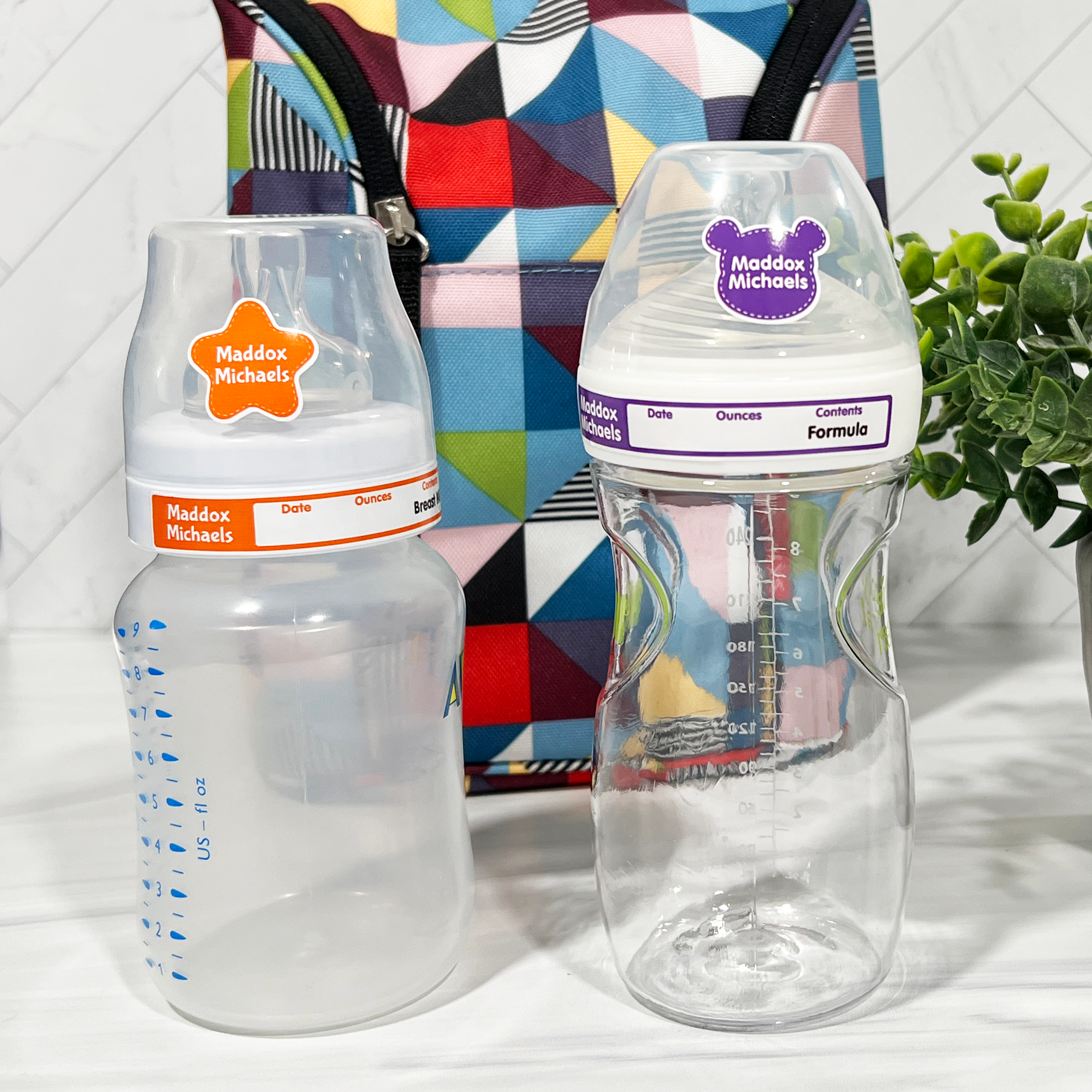
- Use our slim rim baby bottle labels or curved rim baby bottle labels — designed specifically for nipple ring placement
- Measure the height of your nipple ring before ordering — nipple ring heights vary significantly by bottle brand, and the wrong size won't adhere correctly
- Nothing will adhere to rubber or silicone surfaces regardless of label brand or adhesive type
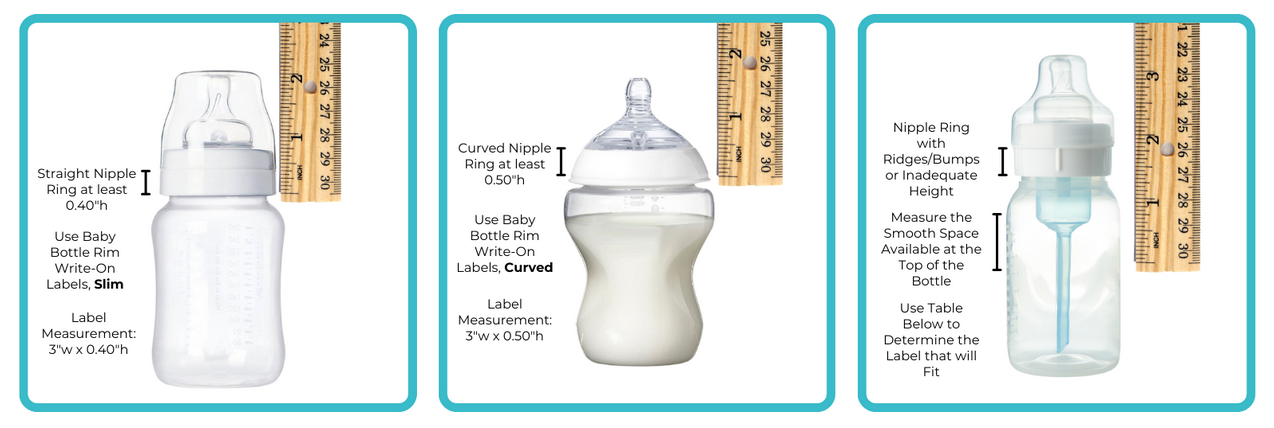
Slim Rim Labels |
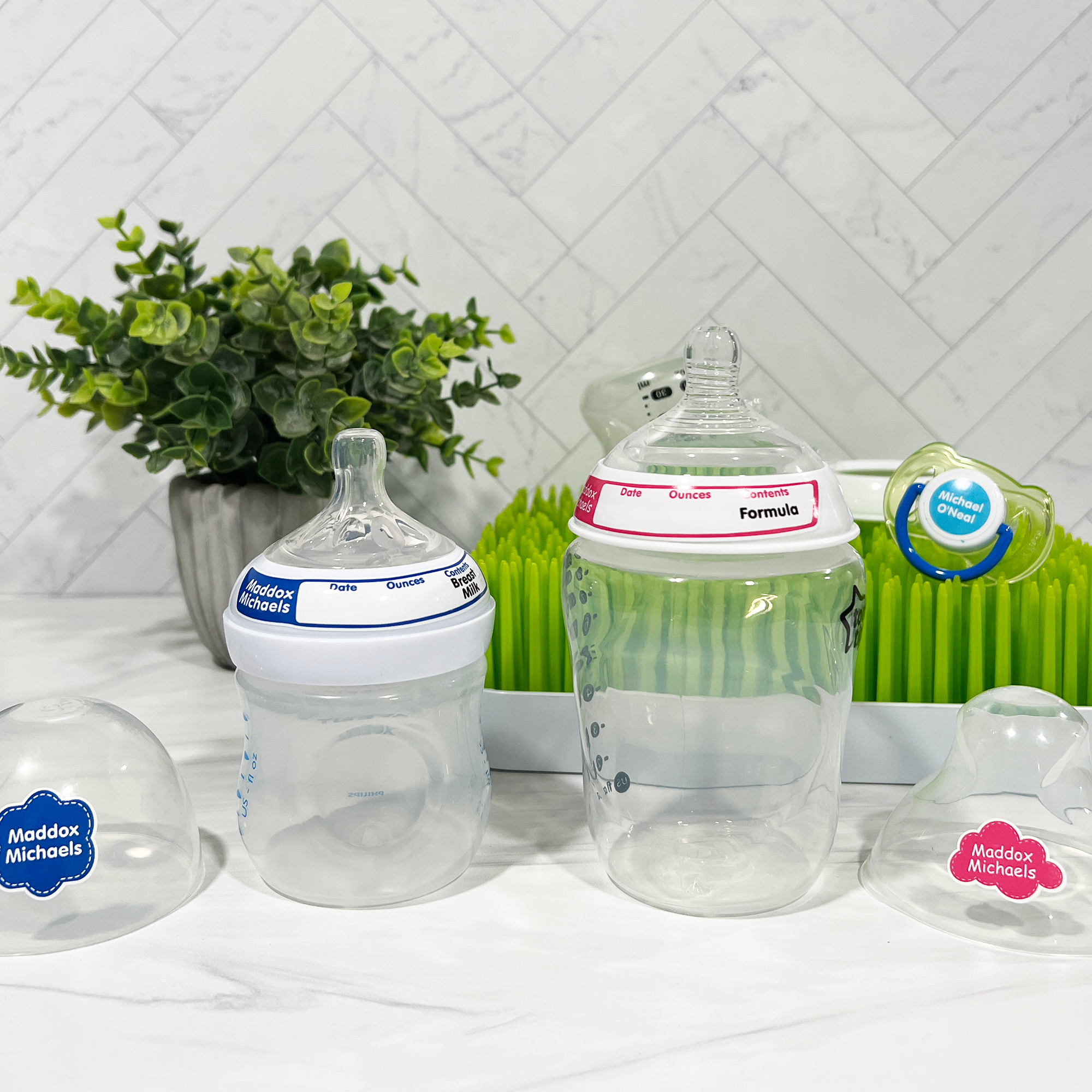
Curved Rim Labels |
Plastic, glass, or metal bottles — labels go on the bottle body
For bottles with a plastic, glass, or metal body, labels can be placed directly on the bottle. Most effective placement is the upper portion of the bottle body where it's clearly visible and won't be obscured when the bottle is held.
- Measure the maximum available space on your specific bottle before ordering — bottle shapes and diameters vary significantly between brands
- Choose a label size that accommodates all required information: name, date, ounces, milk type, and any additional daycare requirements
- Our small rectangle bottle labels and medium rectangle bottle labels are the most commonly used for plastic and glass bottle bodies
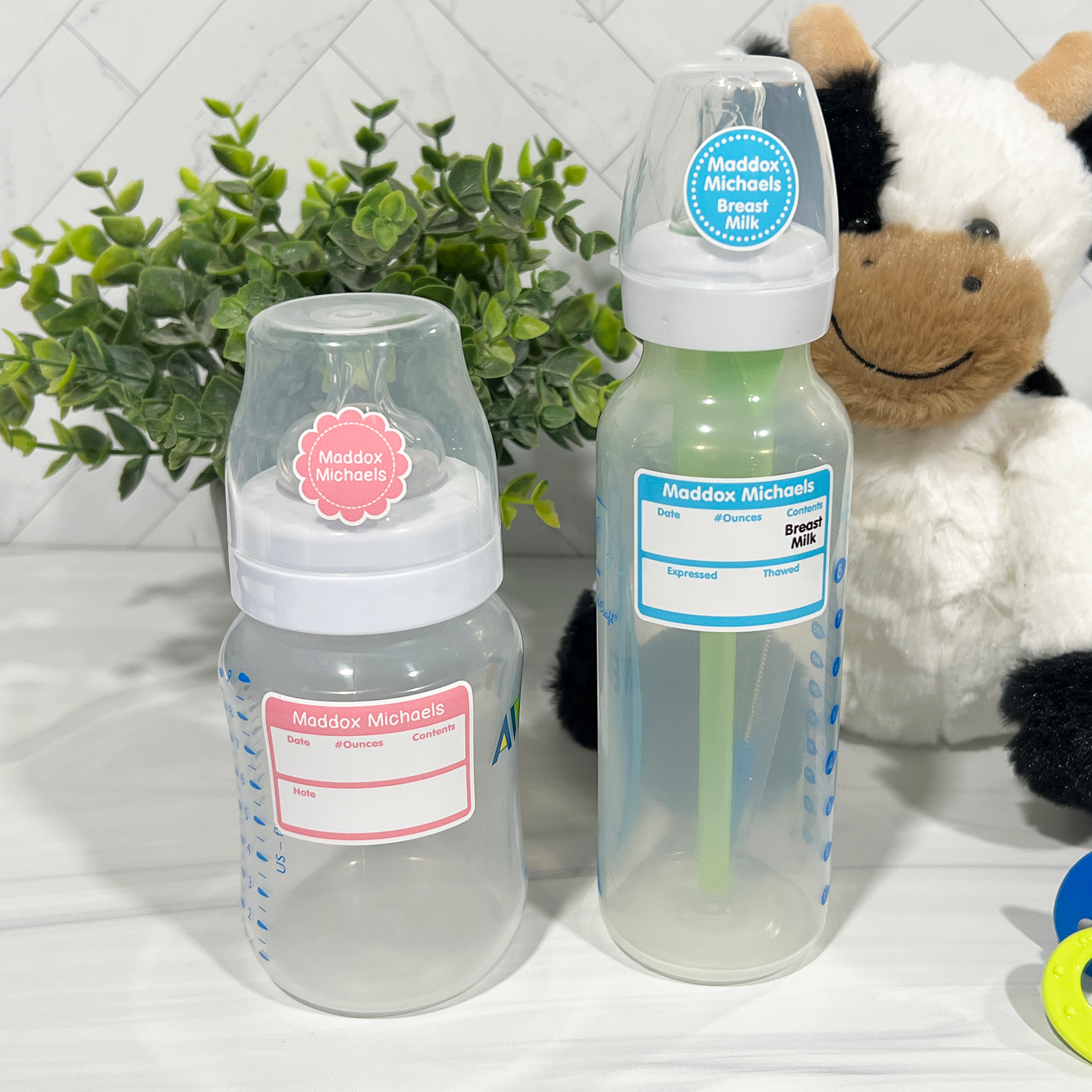
Label size checklist — confirm your label has room for:
- Child's first and last name
- Date prepared
- Milk type (breast milk or formula)
- Total ounces
- For breast milk: expression date and thaw date if applicable
- Any additional information your specific daycare requires
Wax Pencil vs. Marker: Which to Use and When
Once you have the right label on the right bottle, what you write with matters just as much. This is an area where most parents don't get good information upfront — and end up with smeared, unreadable labels at the worst possible moment.
The wax pencil — our top recommendation for daily bottle labeling
Our specially formulated wax pencil is designed specifically for write-on labels and daycare requirements. It is our top recommendation for one reason above all others: it stays legible all day through handling, condensation, and bottle warmers — and wipes clean easily when you're ready to update the information for the next day.
- Stays put all day through handling, condensation, refrigeration, and bottle warmers
- Erases cleanly when you need to update the information — no residue, no ghost writing
- Works perfectly with our waterproof label surface
- Meets state requirements for daily bottle tracking — writing won't wash off during the daycare day
- Easy to use at 6am when you're half asleep — smooth application, no smearing
Our semi-permanent markers — when to use them and when not to
Our semi-permanent markers work on our labels but have real limitations parents need to understand before relying on them for daily bottle labeling:
- Dries quickly but can be wiped off with water — condensation on a cold bottle or heat from a warmer will cause ink to run and smudge
- May become unreadable when handled repeatedly throughout the daycare day
- Best for short-term or low-moisture labeling situations, not daily daycare bottle tracking
Surface Compatibility and Label Care
What surfaces labels work on
- Works on: Plastic, glass, metal, paper and cardboard
- Not recommended: Silicone or rubber surfaces — nothing adheres to these materials reliably, regardless of label brand or adhesive quality
- For silicone bottles: Measure the plastic nipple ring and use our slim rim labels or curved rim labels designed to adhere to the plastic nipple ring only
How to care for labeled bottles so labels last
- Dishwasher safe — top rack only. Avoid the sanitary cycle, which runs at temperatures that can affect adhesive performance over time with repeated exposure.
- Bottle warmer and sterilizer safe. Remove wax pencil writing before placing in the dishwasher or sterilizer — the wax erases cleanly, and this prevents any residue buildup in your equipment.
- Avoid bleach, bleach additives, and essential oils in dish soap or cleaning solutions — these cause label fading and adhesive failure over time.
- Application matters as much as label quality. Apply to a completely clean, dry surface — rubbing alcohol removes any residue that prevents adhesion. Press firmly from center outward, ensuring all edges are fully adhered. Allow several hours of setting time before the first wash. A label applied correctly to a clean, dry surface will outlast the bottle. A label applied to a damp or greasy surface will fail within days regardless of quality.
What makes our labels different
- Ultra-durable: Survives repeated wash cycles including commercial dishwashers
- Easy write-on surface: Designed specifically for wax pencil and daily rewriting
- Clean removal: Comes off without sticky residue when you're done with a bottle
- Temperature resistant: Bottle warmers, refrigerators, and dishwashers won't cause peeling
- Customizable designs: Hundreds of options so your child's bottle stands out in a room of identical-looking bottles — and children learn to recognize their own belongings by design before they can read
Your Complete Daycare Labeling System
Bottles are the most critical label — but they're just the beginning. A complete daycare labeling system covers every item that leaves the house and needs to come home.
Write-On Baby Bottle Labels — for daily bottle information
Large waterproof labels with write-on space for name, date, ounces, milk type, and any additional daycare requirements. Dishwasher safe and designed for the daily bottle routine. Our reviews for these are outstanding — parents asked, we designed and delivered.
Slim Rim and Curved Rim Labels — specifically for silicone bottles
Designed to adhere to the plastic nipple ring on silicone bottles — the only surface on a silicone bottle that labels will bond to. Measure your nipple ring height before ordering.
Write-On Date Labels — for formula and breast milk tracking
Apply once to the container, write date and contents at each prep, wipe clean in the dishwasher, repeat. Required by most daycare centers for all perishable items. Refrigerator, freezer, microwave, and dishwasher safe.
Snack and Lunch Labels — for meal-time organization
Pre-marked for morning snack, lunch, and afternoon snack. One label per container — daycare providers immediately know which container is for which meal without guessing. Eliminates the most common daycare meal-time confusion.
Daycare Label Value Pack — everything in one order
106 waterproof labels in multiple sizes for every item that goes to daycare — bottles, sippy cups, containers, bags, ice packs, and more. The most efficient starting point for first-time daycare parents who want everything covered without ordering separately.
Iron-On Clothing Labels — for every item your child wears
Bond completely into the fabric and survive commercial washing. Daycare involves far more clothing changes than school — accidents, spills, nap-time clothes, outdoor gear. More changes means more mix-ups without labels. Completely flat, no raised edges — the right choice for sensory-sensitive children.
Food Allergy Alert Labels — for children with dietary restrictions
Specific allergen named clearly on the exterior of the lunch bag or diaper bag — visible to any adult at the point of food contact, before any container is opened. As a mom of two boys with food allergies, this is the label I designed first. It travels with the food. The file in the office doesn't.
Browse our full range at Sticky Monkey Labels — including baby bottle labels, daycare label packs, clothing labels, and allergy labels. Questions? Call us at 1-888-780-7734 — I'm always happy to help figure out what will work best for your specific bottles and your specific daycare's requirements.
Frequently Asked Questions
What information does daycare require on baby bottles?
Most daycare centers require the child's full name, date of preparation, milk type (breast milk or formula), and total ounces. For breast milk specifically, many centers also require the expression date and thaw date if the milk was frozen. Requirements vary by state regulation and individual center policy — call your specific daycare before ordering labels to confirm what they need. This ensures you choose a label with enough write-on space for everything required.
What label do I use for silicone baby bottles?
Nothing adheres to silicone or rubber surfaces — this applies to every label brand, not just ours. For silicone bottles, measure the height of your plastic nipple ring and use our slim rim labels or curved rim labels, designed specifically to adhere to the plastic nipple ring. Measuring before you order is important — nipple ring heights vary significantly by bottle brand.
Are your bottle labels dishwasher safe for daycare commercial dishwashers?
Yes — top rack dishwasher safe, including commercial dishwashers. Avoid the sanitary cycle, which runs at temperatures that can affect adhesive with repeated exposure over time. Labels are also bottle warmer and sterilizer safe. Before placing labeled bottles in the dishwasher or sterilizer, wipe off any wax pencil writing — it erases cleanly and this prevents residue buildup in your equipment. Avoid dish soaps containing bleach or essential oils, as these cause fading and adhesive failure.
Should I use a wax pencil or marker on bottle labels?
For daily daycare bottle labeling, use the wax pencil. It stays readable all day through handling, condensation, bottle warmers, and refrigeration — and wipes clean easily when you update the information the next morning. Our semi-permanent markers can be used on labels but will smudge when the bottle gets wet, which is unavoidable in a daycare environment where bottles are handled repeatedly and exposed to condensation and heat throughout the day.
How do I apply bottle labels so they actually last?
Clean the bottle surface with rubbing alcohol and let it dry completely before applying — any residue or moisture prevents proper adhesion. Peel the label carefully, apply where it's clearly visible (not the bottom), press firmly from center outward to eliminate air bubbles, and ensure all edges are fully adhered. Allow several hours of setting time before the first wash. Correct application to a clean, dry surface is the single biggest factor in how long a label lasts — more than label brand or quality.
Do I need to label anything besides bottles for daycare?
Significantly more. Every item that goes to daycare needs a label: sippy cups, snack containers, bibs, clothing including socks, shoes, jackets, ice packs, the lunch bag and diaper bag themselves, personal care items, and any medications. For children with food allergies, allergy alert labels on the exterior of the bag are as important as bottle labels — providers need to see allergy information before they open any container. Our Daycare Label Value Pack includes multiple label sizes for all of these in one order.
How do I choose between the small and medium rectangle bottle labels?
Measure the available space on your bottle before ordering, then compare it to the label dimensions listed on each product page. The key question is whether the label you're considering has enough write-on space for everything your daycare requires. If your daycare asks for name, date, ounces, milk type, and expression date, a larger label gives you room to write clearly. When in doubt, call us at 1-888-780-7734 — we help parents choose the right label for their specific bottle every day and it takes about two minutes.