
From the founder of Sticky Monkey Labels
As a mom of three boys at very different ages and stages, I've built and rebuilt our household chore system more times than I can count. The version that works is the one that's realistic for each child's age, has the right organizational infrastructure, and uses positive reinforcement consistently. Here's everything I've learned.
Chores aren't just about getting the house clean. The research on this is consistent: children who do household chores from an early age develop stronger responsibility, better time management, and higher self-sufficiency as adults than children who don't. The chores themselves matter less than the habit of contributing — and that habit is built through age-appropriate tasks, consistent expectations, and a system that makes the doing easy.
Here's the complete age-by-age guide — what children can realistically do at each stage, how to set up the organizational system that makes chores work, and how to keep them going without constant battles.
Age Ranges Covered
Toddlers (Ages 2–4) — Simple, Fun, and Supervised
Toddlers are natural helpers — they want to do what the adults around them are doing, and at this age the desire to participate is strong and enthusiastic. The goal at this stage is to channel that enthusiasm into genuine small contributions while the motivation exists, establishing the expectation that everyone in the household contributes before the instinct to resist sets in.
Tasks need to be simple enough that a two or three-year-old can complete them successfully without adult intervention at every step, short enough to hold their attention, and physical enough to feel satisfying.
- Putting toys in a labeled bin
- Placing dirty clothes in the laundry hamper
- Wiping up small spills with a cloth
- Feeding pets with supervision
- Helping to make their bed (pulling up the duvet counts)
- Putting away shoes in a labeled spot
Preschool & Early Elementary (Ages 5–7) — Structured and Guided
At five, six, and seven, children can follow multi-step instructions, maintain attention for longer tasks, and complete chores with guidance rather than step-by-step supervision. This is the age when chores can start becoming a genuine household contribution rather than a supervised learning exercise.
The key shift at this stage: tasks with a clear start and end point, and a visible result. Children this age are motivated by completing something they can point to — the made bed, the cleared table, the sorted laundry. Make the result obvious and the satisfaction of completion is its own reward.
- Setting and clearing the table
- Loading (and unloading) the dishwasher — with guidance on what goes where
- Dusting surfaces within reach
- Watering plants on a schedule
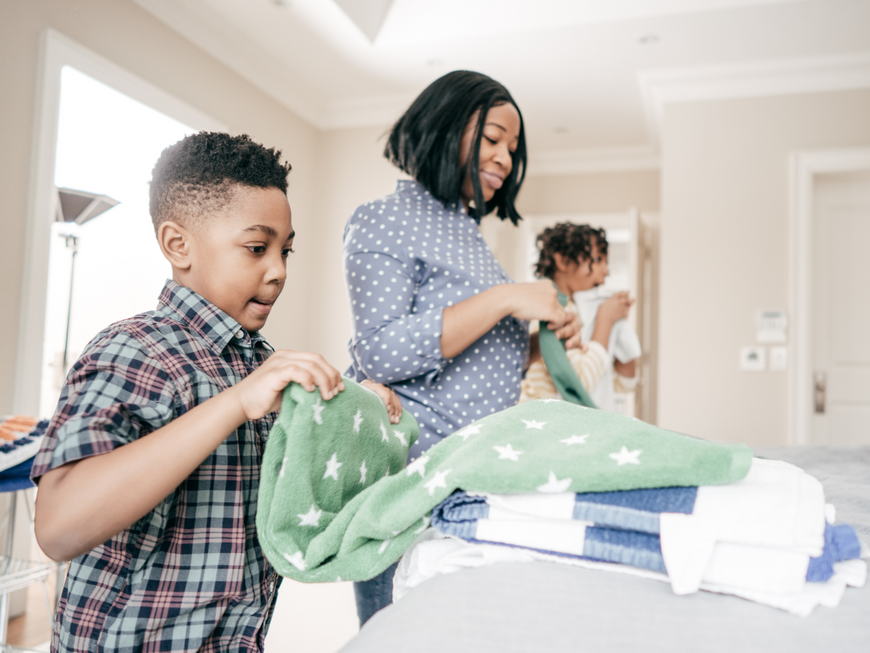
- Folding their own laundry — clothes labeled with their name or color make sorting independent
- Making their bed independently
- Packing and unpacking their own school bag
Elementary & Pre-Teen (Ages 8–12) — Independent Responsibility
Between eight and twelve, children are capable of owning chores fully — start to finish, without reminders, as a consistent part of their routine. The transition from "doing chores when reminded" to "doing chores because that's Tuesday" happens through consistent expectation and consistent consequences, not through escalating reminders.
At this stage, children can also start taking responsibility for their own organizational systems — labeling their own school supplies, managing their own spaces, and maintaining their areas without adult oversight.
- Taking out the trash on schedule
- Washing dishes or loading and unloading the dishwasher fully
- Sweeping and vacuuming
- Managing and organizing their own school supplies — with labeled bins and folders
- Helping prepare simple meals
- Doing their own laundry start to finish
- Cleaning their own room to a defined standard
- Labeling and organizing their own belongings for school and activities
Teenagers (Ages 13–18) — Adult-Level Tasks
By the teenage years, children who have done age-appropriate chores throughout childhood are capable of the full range of household tasks — which is both the goal and the proof that the earlier investment paid off. Teenagers who haven't been doing chores may need to start at a lower level and build up, but the principle is the same: consistent, owned responsibility.
- Doing laundry independently start to finish
- Mowing the lawn and outdoor maintenance
- Cooking full meals for the family on rotation
- Grocery shopping with a list
- Babysitting or supervising younger siblings
- Managing their own personal budget and allowance
- Deep cleaning specific rooms or areas on rotation
For teenagers, the connection between responsibility and privilege is the most effective motivator. Linking completed responsibilities to meaningful autonomy — later curfew, more freedom, trusted use of family resources — models the real-world relationship between accountability and independence that they'll need as adults.
The System That Makes Chores Actually Happen
The age-appropriate task list is the easy part. The system that makes those tasks happen consistently — without daily battles, without constant reminders, and without the chore ending up done by a parent because it's faster — is what takes more thought. A few components that matter:
A Visual Chore Chart
A chart that shows each child's tasks clearly — ideally where they can see it, update it themselves, and track their own progress — removes the need for adults to repeat instructions. Our write-on labels work well for flexible chore charts where tasks rotate between children or change weekly. Write the task, assign it, wipe and reassign the following week.
Reward Stickers for Younger Children
For children aged roughly 3-8, visible progress is powerfully motivating. Our reward stickers placed on a chart for each completed task give children a tangible record of their accomplishments. Connect a defined number of stickers to a meaningful reward — an activity, extra screen time, a small treat — and the system becomes self-sustaining without constant adult prompting.
Labeled Organization That Makes Tasks Possible
Many chores fail not because children won't do them but because the environment isn't set up to support independent completion. A child who can't find the cleaning supplies can't clean. A child who doesn't know where laundry belongs can't sort it. Labeled, accessible organization — bins at child height, clearly marked storage, a consistent place for everything — removes the barriers between a willing child and a completed chore.
Consistency Over Perfection
A chore done imperfectly and consistently is better than a chore done perfectly once. Resist the urge to redo a child's work where it's merely different from how you'd do it rather than genuinely wrong. When children learn that their efforts will be redone, they stop investing effort. When they learn their contribution stands and matters, they invest more.
Browse our reward stickers, write-on labels, Initial Dot clothing labels, and name labels at Sticky Monkey Labels.
Frequently Asked Questions
What chores can a 2-year-old do?
Toddlers can put toys in labeled bins, place dirty clothes in a hamper, wipe small spills, help make their bed, and assist with pet feeding under supervision. Tasks need to be simple, short, and physical — and the environment needs to be set up to make them possible independently. A labeled bin at child height is what makes "put your toys away" an instruction a toddler can actually act on.
At what age should kids start doing chores?
As early as two — when the natural desire to imitate adult behavior is strong and the resistance to being asked hasn't yet developed. The research supports starting early: children who begin household contributions in toddlerhood develop stronger responsibility habits than those who start in middle childhood. Start with simple, supervised tasks and build from there.
How do reward stickers help with chores?
For children roughly 3-8 years old, visible progress is powerfully motivating. A sticker placed on a chart for each completed task gives children a tangible record of their accomplishments that builds over time. Connect a defined number of stickers to a meaningful reward and the system provides consistent motivation without requiring daily adult prompting. Our reward stickers come in a range of designs children enjoy choosing from as their earned reward.
How do write-on labels work for chore charts?
Write-on labels applied to a chore chart, a whiteboard, or directly to storage bins allow you to write each child's task assignments and update them weekly or when responsibilities rotate. Write the task or the child's name, wipe clean with water when the assignment changes, write again. This makes a flexible rotating chore system easy to maintain without reprinting or replacing the chart.
How do labels help children do chores independently?
Labels convert implicit adult knowledge — where things go, whose is whose, what belongs where — into explicit information any child can access and act on independently. A labeled laundry bin means children can sort correctly without asking. A labeled supply caddy means they can start cleaning without hunting for materials. The labeled environment is the infrastructure that makes independent chore completion possible rather than aspirational.