
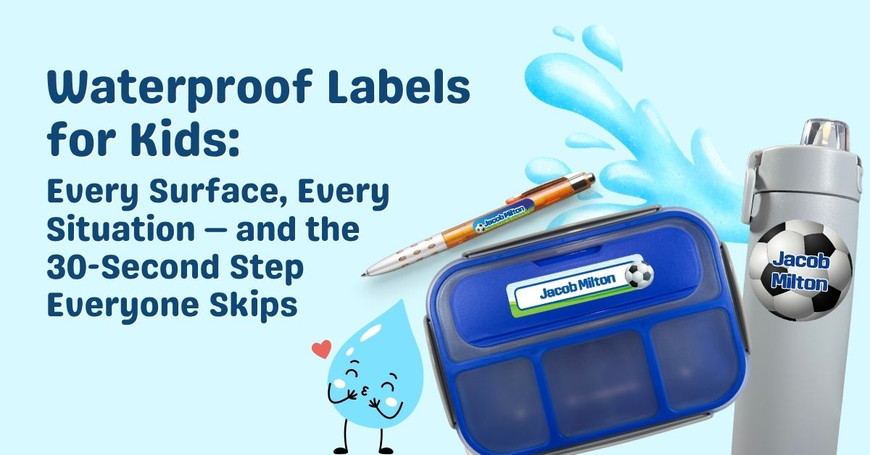
Waterproof labels for kids fail for one reason more than any other — and it's not the label quality. It's a thirty-second step that almost nobody does. Wipe the surface with isopropyl alcohol before you apply the label. That's it. That single step removes the invisible layer of residue on every smooth surface — manufacturing oils, skin oils, dishwasher detergent traces — that prevents the label adhesive from bonding to the actual surface underneath. Skip it and you're bonding to contamination, not to the bottle. The label looks fine for a few days and then lifts from the edges the moment it goes through a dishwasher.
This guide covers the 30-second prep step in full, every surface children's waterproof labels work on, every situation where they're the right label for the job, and the surfaces where they don't work — so you never apply the wrong label to the wrong surface again.
From the founder of Sticky Monkey Labels
I'm Dodie — the original creator of Peel 'n Stix® clothing labels and founder of Sticky Monkey Labels, now in my 15th year. The alcohol prep step is the single piece of advice I give every parent who tells me their labels peeled. It works every time. Here's the full explanation of why — and how to apply it to every surface in your child's labeling setup.
What's Covered
- The 30-second step — what it is, why it works, and why everyone skips it
- The complete application process — every step in order
- Every surface kids' waterproof labels work on
- Where waterproof labels don't work — and what to use instead
- Waterproof labels for school — every situation
- Waterproof labels for daycare — every situation
- Waterproof labels for camp — every situation
- Which label pack for which situation
- Frequently asked questions
The 30-Second Step — What It Is, Why It Works, and Why Everyone Skips It
Every smooth hard surface — a stainless steel water bottle, a plastic lunchbox, a glass food container — looks clean to the naked eye. It isn't. Every surface carries an invisible layer of contamination: manufacturing oils from production, skin oils from handling, dishwasher detergent residue, and general surface contact from packaging and storage. This layer is completely invisible. You cannot see it, feel it, or wash it off with water.
This invisible layer is a barrier. When you apply a waterproof label to a contaminated surface, the adhesive bonds to the contamination layer — not to the surface itself. The label appears to stick. It holds through light handling. Then it goes through a dishwasher and the contamination layer breaks down under the heat and chemical action of the wash cycle, taking the label bond with it. The label starts lifting from the edges. By week two it's off.
Isopropyl alcohol removes this contamination completely. Apply it to the surface where the label will go — a cotton ball, cloth, or alcohol wipe — let it dry for 30 seconds, and the surface is clean down to the actual material. A label applied to this clean surface bonds directly to the bottle, container, or supply — not to a contamination layer that will eventually fail. That bond holds through daily dishwasher cycles for the full school year.
The Complete Application Process — Every Step in Order
Five steps. In this order. Every surface, every time. The prep step is step one — not optional, not skippable, not replaceable with anything else.
- Wipe the surface with isopropyl alcohol. Use a cotton ball, a clean cloth, or an alcohol wipe. Apply to the specific area where the label will go. Let dry completely — about 30 seconds. Do not skip. Do not substitute with water, soap, or hand sanitizer. Isopropyl alcohol is the only agent that removes the invisible oil and residue layer that prevents adhesion. Everything else leaves residue of its own.
- Make sure the surface is completely dry and at room temperature. A bottle fresh from the dishwasher or a warm surface from recent use needs to cool and dry completely before labeling. Applying a label to a warm or damp surface means compromised adhesion from the start.
- Peel the label and position it on the cleaned surface. Handle the label by its edges to avoid transferring finger oils to the adhesive side. Position it where you want it before pressing — you have a moment to adjust before the adhesive makes contact with the surface.
- Press firmly from the center outward. Start at the middle of the label and smooth outward toward every edge. This removes air bubbles and ensures full adhesive contact across the entire label surface.
- Run a thumbnail firmly along every edge. The edges are where dishwasher lifting starts. A thumbnail pressed firmly along all four edges — or around the full perimeter of a round label — ensures full edge bonding. Then wait 24 hours before the first dishwasher cycle. The adhesive continues curing for 24 hours after application. Washing before 24 hours means washing a label that hasn't finished bonding.
Every Surface Kids' Waterproof Labels Work On
Kids' waterproof labels — also called children's waterproof labels or childrens waterproof labels — bond to any smooth, hard, non-silicone surface. Our personalized waterproof labels and custom waterproof labels are made to order with your child's name and chosen design, sized to fit every category of surface below:
Bottles and Drink Containers
- Stainless steel water bottle body
- Powder-coated bottle body
- Hard plastic water bottle body
- Glass bottle body
- Aluminum bottle body
- Hard plastic bottle lid
- Hard plastic sippy cup body
- Hard plastic sippy cup lid
- Thermos body (smooth area)
Food Containers
- Lunchbox exterior
- Hard plastic food containers
- Food container lids
- Ice packs (smooth surface area)
- Stainless steel containers
- Glass food containers
School and Camp Supplies
- Hard plastic pencil case
- Calculator body
- Ruler (smooth flat surface)
- Scissors handle (smooth area)
- Headphones case
- Hard plastic equipment cases
- Smooth notebook covers
- Backpack smooth lining interior
- Backpack luggage tag / ID window
Daycare and Baby Items
- Hard plastic baby bottle body
- Glass baby bottle body
- Hard plastic baby bottle lid
- Formula container (smooth area)
- Personal care tubes (smooth area)
- Pacifier case (hard plastic)
Where Waterproof Labels Don't Work — and What to Use Instead
Understanding where waterproof labels genuinely fail — not because the label is poor quality, but because the surface is incompatible — saves time, money, and frustration. These surfaces will not hold any pressure-sensitive adhesive label reliably, regardless of how much alcohol prep or pressing is applied:
Silicone — nothing adheres to it
The silicone base boot on a Stanley or Hydro Flask, silicone bottle sleeves, silicone lids and spouts, and rubber grips all share the same chemistry problem — silicone is non-polar, meaning pressure-sensitive adhesives cannot form a lasting bond with its surface. A label on silicone peels off within days under normal use. Apply labels to the hard body surface of the bottle above the silicone boot, not to the silicone itself.
Fabric and clothing — use clothing labels instead
Fabric flexes and stretches during wear and washing in ways that break adhesive contact from any surface-applied label. Waterproof labels for clothing don't exist in any reliable form — the surface physics don't allow it. For school clothing, uniforms, and anything going through the washing machine, the right products are our iron-on clothing labels (bonded into iron-safe fabric fiber), our original Peel 'n Stix® stick-on clothing labels (applied to care tags, not fabric), or our Design Duo clothing labels — the fastest option, available in both iron-on and stick-on. All are machine washable through the full school year.
Textured backpack exterior fabric — use tag or lining instead
Most backpack exteriors are textured fabric — labels won't hold reliably. The exterior label goes on the luggage tag, ID window, or any smooth hard surface panel. The interior label goes on the smooth coated lining material inside the main compartment, not on the fabric outer shell.
Pencil and pen barrels — use pencil labels instead
Standard waterproof labels are too wide for pencil and pen barrels — they overlap the edges and peel immediately from a curved narrow surface. Our pencil labels are sized specifically for cylindrical narrow surfaces and wrap cleanly around every writing instrument going to school. Available standalone (90 labels) and included in both school label packs.
Waterproof Labels for School — Every Situation
School is the primary use environment for waterproof labels for kids — and the environment that tests them hardest, because school water bottles and lunchboxes go through the dishwasher daily. The prep step matters most for these items. For a complete checklist of every school item that needs labeling, see our back to school labels checklist.
Every school surface that needs a waterproof label: water bottle body and lid separately (two labels per bottle — the lid detaches and needs its own label), lunchbox exterior, every container inside the lunchbox individually (they separate from the lunchbox at school), ice packs, backpack tag and interior smooth lining, pencil case, calculator, headphones case, and all school supplies with smooth surfaces. For pencils, pens, markers, and crayons — pencil labels from our range, not standard waterproof labels.
The school surfaces most families miss: the water bottle lid (most commonly missed — label it every time), individual containers inside the lunchbox (label every one, not just the box), and the calculator (identical to thirty other calculators in the same shared classroom, and a genuinely expensive item to lose).
Our Ultimate School Label Pack (134 waterproof labels, K–8) and School Essentials Label Pack (67 labels, grades 5–12) include the right sizes for every school hard surface in one order.
Waterproof Labels for Daycare — Every Situation
Daycare waterproof labels have one critical difference from school labels: bottles come home and get washed every evening in a home dishwasher or sterilizer. That's daily high-heat washing, which makes the prep step and the 24-hour cure even more important to get right before the first drop-off. For the complete daycare labeling setup — every item, every surface, which label type for each — see our complete daycare labels guide.
Every daycare surface that needs a waterproof label: every bottle body and lid separately, every sippy cup body and lid, every food container and lid, formula container, ice packs, the daycare bag's smooth lining interior (not the fabric exterior), sunscreen tube, diaper cream tube, and personal care containers. The surfaces most families miss: individual food container lids (they separate from containers during rinsing), the sunscreen tube (identical to every other family's sunscreen in the communal area), and the daycare bag lining (which takes a contact label — name and phone number — as a recovery layer).
For baby bottles specifically: apply only to the hard plastic or glass body — never to silicone sleeves, silicone nipples, or rubber components. Our bottle labels for daycare are sized specifically for the bottle body and lid application. Our daycare label packs cover every hard surface in the daycare bag.
Waterproof Labels for Camp — Every Situation
Camp waterproof labels face outdoor exposure, water activity contact, and the general physical wear of an active camp environment. The prep step matters here too — a label that peels off a water bottle at camp is genuinely lost, because there's no daily recovery opportunity the way there is at school.
Every camp hard surface that needs a waterproof label: water bottle body and lid, sports equipment, flashlight, sunscreen and personal care containers, sleeping bag storage sack tag (fabric sleeping bag body needs a clothing label, not a waterproof label), the duffel bag luggage tag and interior smooth lining, and any hard equipment case. The most consistently missed camp items: the sleeping bag storage sack (separate from the sleeping bag and routinely lost), individual toiletry bottles that escape the toiletry bag, and flip flops or water shoes (which need a label on the smooth inner sole area if available).
For clothing going to camp — every garment, every pair of socks — waterproof labels don't apply to fabric. Our iron-on and stick-on clothing labels handle camp clothing through the shared laundry environment that camp produces. Browse our complete camp labeling range at stickymonkeylabels.com.
Which Label Pack for Which Situation
| Situation | Pack | Labels Included |
|---|---|---|
| School — preschool to grade 8 | Ultimate School Label Pack | 134 waterproof labels in 7 sizes |
| School — grade 5 through high school | School Essentials Label Pack | 67 waterproof labels |
| Daycare — infants | Baby Labels Pack | 104 labels + Duck Shoe Labels |
| Daycare — toddlers | Daycare Labels Pack | 104 labels + Extra Large Rectangle |
| Water bottles specifically | Water Bottle Labels | Sized for body + lid |
| Baby bottles for daycare | Bottle Labels for Daycare | Sized for bottle body + lid |
| Pencils and narrow supplies | Pencil Labels | 90 labels (also in school packs) |
Every pack contains personalized waterproof labels made to order with your child's name and chosen design. Browse our complete range at Sticky Monkey Labels. Questions about which pack covers your specific situation? Call us at 1-888-780-7734.
Frequently Asked Questions
What are waterproof labels for kids and what surfaces do they work on?
Waterproof labels for kids — also called kids waterproof labels or children's waterproof labels — are name labels engineered to stay on smooth hard surfaces through dishwasher cycles, outdoor exposure, and daily physical wear. They work on stainless steel, powder-coated metal, hard plastic, aluminum, and glass surfaces — water bottles, lunchboxes, food containers, school supplies, and daycare items. They don't work on silicone, fabric, or textured surfaces. The prep step (isopropyl alcohol wipe before applying) is what determines whether they hold through daily dishwasher use or peel within the first few washes.
Why do kids' waterproof labels keep peeling off?
Almost always the prep step was skipped. Every smooth surface carries invisible manufacturing oils, skin oils, and residue that prevent adhesive from bonding to the actual surface. A label applied without alcohol prep bonds to this contamination layer — not the surface — and lifts when the contamination layer breaks down under dishwasher heat. The second most common reason is washing within 24 hours of application before the adhesive finished curing. The third is applying to silicone — nothing holds to silicone, regardless of prep. Fix: alcohol wipe on a clean dry surface, apply with firm pressure on every edge, wait 24 hours before first dishwasher cycle.
Are waterproof labels for kids dishwasher safe?
Yes — on the top rack, when applied correctly. Top rack temperatures are significantly lower than bottom rack temperatures, which extend adhesive life through daily use. Applied to an alcohol-prepped smooth surface with 24 hours of cure time before first wash, our dishwasher safe labels for kids handle top-rack dishwasher cycles from August through June without peeling or fading.
Do waterproof labels work on clothing?
No — fabric stretches and flexes during wear and washing in ways that break adhesive contact from any surface-applied label. For clothing, the right products are iron-on clothing labels (bonded into iron-safe fabric, permanent, machine washable) and our original Peel 'n Stix® stick-on clothing labels (applied to care tags, machine washable, removable for hand-me-downs). Both are ordered separately from our waterproof label packs.
What is the 30-second step and why does it matter so much?
The 30-second step is wiping the label surface with isopropyl alcohol before applying. It removes the invisible layer of oils and residue present on every smooth surface that prevents adhesive from bonding directly to the material. Without this step, the label bonds to the contamination layer rather than the surface itself — which fails under dishwasher heat within days to weeks. With the step, the label bonds directly to clean surface material and holds through daily dishwasher cycles for the full school year. It takes 30 seconds per surface. It's the single most impactful thing you can do to make kids' waterproof labels last.
When should I apply waterproof labels for kids?
June or July for school supplies — school starts in August and labels need 24 hours to cure before the first dishwasher cycle. A labeling session in July means every label is fully bonded before August. For daycare, apply before the first drop-off day with 24 hours of cure time. For camp, apply before drop-off day with at least 24 hours of cure before any water exposure. Ordering early means you have time to apply labels properly — not the night before with no cure time built in.
About the Author