
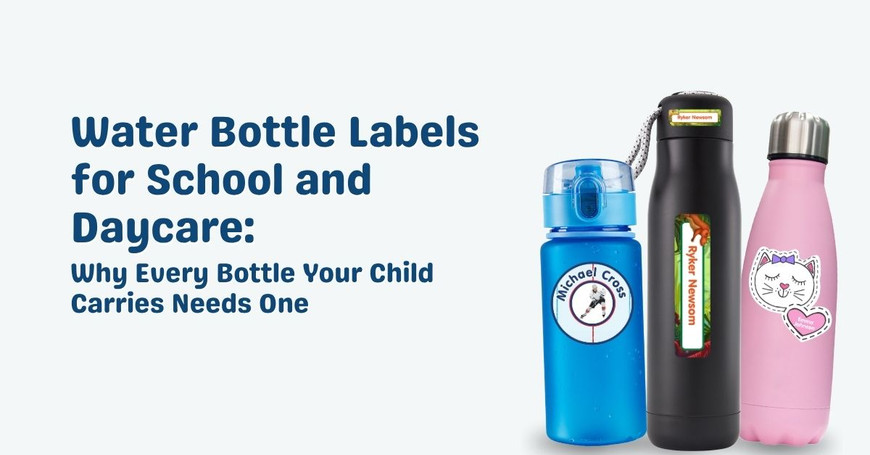
Water bottle labels for school and daycare are the most consistently skipped school supply label — and the most consistently replaced item. Every school cafeteria has a shelf of identical water bottles. Every daycare has a row of identical sippy cups. The ones with names on them go home. The ones without names stay on the shelf until a staff member eventually tosses them.
A water bottle label costs pennies and takes thirty seconds to apply. A replacement Stanley or Hydro Flask costs $30–$45. That math is not complicated. Yet most families label the backpack and the lunchbox and leave the water bottle bare — and then replace it two or three times before the school year ends.
This is the complete guide to water bottle labels for school and daycare — why they fail when applied wrong, how to make them last all year through daily dishwasher cycles, which surfaces work and which don't, and why the prep step is the only thing that separates a label that lasts a week from one that lasts until June.
From the founder of Sticky Monkey Labels
As a mom of three boys and the founder of Sticky Monkey Labels, now in my 15th year, water bottle labels are the product I get the most questions about — specifically "why did it peel off?" The answer is almost always the same, and it's entirely preventable. Here's everything you need to know.
What's Covered
- Why water bottle labels fail — and how to prevent it
- How to apply water bottle labels correctly
- Which surfaces work and which don't
- Labeling Stanley cups, Hydro Flasks, and insulated bottles
- Water bottle labels for school — what teachers and staff need
- Water bottle labels for daycare — the daily wash challenge
- Allergy labels alongside water bottle labels
- Frequently asked questions
Why Water Bottle Labels Fail — And How to Prevent It
The most common question I get about water bottle labels is "why did it peel off?" It's almost never a label quality problem. It's almost always one of three application mistakes — all of which are completely preventable.
Mistake #1 — Skipping the alcohol prep step
Water bottles — especially new ones — carry invisible residue: manufacturing oils, skin oils from handling, cleaning product traces. These form a barrier between the label adhesive and the bottle surface. A label applied to a bottle with this residue appears to stick but starts lifting within the first few washes. A 30-second wipe with isopropyl alcohol before applying removes all of it. This single step is the difference between a label that lasts a week and one that lasts all year.
Mistake #2 — Not waiting 24 hours before the first wash
Water bottle labels need 24 hours to fully bond to the surface before being exposed to dishwasher heat and moisture. Applying a label in the morning and running it through the dishwasher that night means the adhesive hasn't had time to cure. Apply labels at least one day before the first use — ideally during your July labeling session, weeks before school starts.
Mistake #3 — Applying to silicone or textured surfaces
Nothing sticks to silicone. The silicone base boot on the bottom of a Stanley or Hydro Flask, silicone lids, and rubber gaskets are completely incompatible with any adhesive label. The bottle body — the smooth powder-coated or stainless steel surface — is where water bottle labels belong. Every time.
How to Apply Water Bottle Labels Correctly
Four steps. The whole process takes about two minutes per bottle. The prep step is the only one most people skip — don't.
- Wipe the bottle surface with isopropyl alcohol. Use a cotton ball, a cloth, or an alcohol wipe. Wipe the area where the label will go and let it dry completely — about 30 seconds. This removes invisible oils and residue that prevent bonding. Don't skip this step.
- Make sure the surface is completely dry. Moisture under the label prevents adhesion. If the bottle came straight from the dishwasher or has condensation on it, wait until it's fully dry before applying.
- Peel and apply with firm pressure from center outward. Press from the middle of the label toward the edges, smoothing out any air bubbles. Run a thumbnail firmly along every edge. The edges are where lifting starts — making sure they're fully bonded is the key to longevity.
- Wait 24 hours before the first dishwasher cycle. The adhesive continues bonding for 24 hours after application. A label applied and immediately run through a hot dishwasher hasn't had time to cure. Apply today, use tomorrow.
Which Surfaces Work for Water Bottle Labels — And Which Don't
Waterproof water bottle labels work on any smooth, hard, non-silicone surface. Here's the breakdown for every type of bottle your child might take to school:
✅ Works Great
- Powder-coated stainless steel (Stanley, Hydro Flask body)
- Plastic water bottles (hard plastic, BPA-free)
- Aluminum bottles
- Glass bottles with smooth exterior
- Hard plastic lids (smooth surface)
- Metal lids and caps
❌ Does Not Work
- Silicone base boots (bottom of Stanley, Hydro Flask)
- Silicone lids or straws
- Rubber gaskets or grips
- Textured or matte-grip surfaces
- Foam insulation wraps
- Fabric bottle carriers
Labeling Stanley Cups, Hydro Flasks, and Insulated Bottles
Stanley cups and Hydro Flasks are the most common water bottles in schools right now — and the most commonly lost, because every child in the same grade has an identical one. A personalized water bottle label is the only way to distinguish them in a cafeteria full of identical bottles.
Where to place water bottle labels on a Stanley or Hydro Flask
- Body label: Apply to the smooth powder-coated body, above the silicone base boot. This is the largest flat surface and where the label is most visible. Alcohol prep first.
- Lid label: Apply a separate small label to the lid — Stanley lids in particular detach frequently. The lid needs its own label because it separates from the bottle in dishwashers and school bags.
- Never on the silicone base boot: The rubber/silicone bottom of Stanley cups and Hydro Flasks will not hold any adhesive label. Don't try — it will peel within days regardless of prep.
Water Bottle Labels for School — What Teachers and Cafeteria Staff Actually Need
School cafeterias have dozens of identical water bottles on the table at any given lunch period. A labeled water bottle that gets left behind is returned to its owner. An unlabeled one joins the row on the lost-and-found shelf until the school clears it at the end of term.
What school staff consistently say about water bottle labels:
- Full name, not just a first name. "Emma" doesn't help when there are three Emmas in the same grade. First and last name on every water bottle label is the standard that allows staff to match a bottle to the right child without checking class rolls.
- Readable from normal viewing distance. A label that requires picking up the bottle and squinting is not a functional label in a busy cafeteria. Large enough text to read at a glance when scanning a table full of bottles.
- Label the lid separately. Teachers and cafeteria staff report that lids are among the most commonly unclaimed lost items — because families label the bottle body but not the lid. A labeled lid that's left behind comes back. An unlabeled one doesn't.
Our school label packs include the right label sizes for both the water bottle body and the lid: Ultimate School Label Pack (134 waterproof labels for K–8) and School Essentials Label Pack (67 labels for older students). Slim rectangle labels for the bottle body, small round labels for the lid.
Water Bottle Labels for Daycare — The Daily Wash Challenge
Daycare water bottle labels have a harder job than school labels. They go through the dishwasher daily — not occasionally. At daycare, bottles are washed every single day, often in commercial dishwashers that run hotter than home units. The alcohol prep step and 24-hour cure become even more critical in this environment.
Daycare-specific considerations:
- Prep every bottle before the first day. New sippy cups, new water bottles, new training cups — all need the alcohol prep step before the first label goes on. Daycare providers wash everything at once at the end of the day; a label that wasn't properly prepped won't survive the first week.
- Label the bottle and the lid separately. At daycare, lids come off constantly — during feeding, during cleaning, during the general organized chaos of a room full of toddlers. An unlabeled lid on a labeled bottle is a lost lid waiting to happen.
- Include the child's full name plus a phone number. At daycare age, children cannot advocate for their own belongings. A phone number on the bottle label means any staff member can reach the parent directly if a bottle can't be matched to the right child.
Our Daycare Label Pack includes waterproof name labels in the right sizes for bottles, sippy cups, food containers, and all daycare surfaces. Browse our full label range at stickymonkeylabels.com.
Water Bottle Labels — Waterproof Name Labels for Every Bottle
Waterproof name labels designed for water bottles, sippy cups, and tumblers — dishwasher-safe on the top rack, fade-resistant from September to June, sized for both the bottle body and the lid separately. Apply with the alcohol prep step and 24-hour cure for labels that hold through daily school and daycare washing all year.
Works on: Stanley cups, Hydro Flasks, plastic bottles, aluminum bottles, glass bottles, and all smooth hard-surface water bottles. Not for silicone base boots or rubber grips.
Allergy Labels Alongside Water Bottle Labels
For children with food allergies or dietary restrictions, a water bottle label does double duty — it identifies the owner and it can communicate allergy information to any adult handling food or drink near your child.
Our allergy labels apply alongside name labels on water bottles, lunchboxes, and food containers. They carry the child's name and specific allergy information — "PEANUT ALLERGY," not just "ALLERGY" — so any supervising adult has the information they need at the moment of food or drink contact. Applied the same way as all our waterproof labels: alcohol prep, firm pressure, 24-hour cure.
For children who bring medication or have medical conditions, our medical alert labels apply to the same surfaces and communicate critical information to any adult — the regular teacher, the substitute, the field trip chaperone — regardless of whether they've been briefed.
Questions about which water bottle labels are right for your child's specific bottles? Call us at 1-888-780-7734 — we're always happy to help.
Frequently Asked Questions
What are the best water bottle labels for school?
Waterproof name labels applied to a properly prepped smooth surface — that's the answer. The label quality matters, but the prep step (isopropyl alcohol wipe before applying) and the cure time (24 hours before first dishwasher cycle) are what determine whether a water bottle label survives the school year. Our waterproof water bottle labels are dishwasher-safe on the top rack, fade-resistant from September to June, and designed to hold through daily school use. Both our Ultimate School Label Pack (134 labels) and School Essentials Label Pack (67 labels) include the right sizes for bottle body and lid.
How do I get water bottle labels to stay on?
Three steps: wipe the surface with isopropyl alcohol and let dry completely, press the label firmly from center outward running a thumbnail along every edge, and wait 24 hours before the first dishwasher cycle. The alcohol prep step removes the invisible oils and residue that prevent adhesion — this is the step most people skip and the reason most labels peel early. A correctly prepped and cured label handles daily dishwasher cycles on the top rack all year.
Do water bottle labels work on Stanley cups and Hydro Flasks?
Yes — on the smooth powder-coated body only. Apply to the area above the silicone base boot, never to the silicone boot itself (nothing adheres to silicone). Alcohol prep the body surface, apply with firm pressure, wait 24 hours. Label the lid separately with a small round label using the same process. Applied correctly, our waterproof labels hold through daily top-rack dishwasher cycles on Stanley cups and Hydro Flasks through a full school year.
Are water bottle labels dishwasher safe?
Our waterproof water bottle labels are top-rack dishwasher safe — designed for daily school and daycare wash cycles. Top rack only. The lower rack generates significantly more heat and degrades adhesive over time. Applied with the alcohol prep step and 24-hour cure, these hold through top-rack dishwasher cycles from September through June.
Do I need to label the water bottle lid separately?
Yes — always. Lids detach from bottles in school bags, in dishwashers, and on cafeteria tables. A labeled bottle with an unlabeled lid means the lid ends up in the lost-and-found while the bottle comes home. Apply a small round label to the lid with the same process: alcohol prep on a smooth surface, firm pressure, 24-hour cure. Both our school label packs include small round labels in the right size for bottle lids.
What are bottle stickers for school water bottles?
Bottle stickers for school — also called bottle sticker labels or water bottle name labels — are waterproof name labels designed to stay on water bottles through daily school use, dishwasher cycles, and the general wear of a school year. They differ from standard stickers in that they use a pressure-sensitive adhesive engineered for smooth hard surfaces, are waterproof and dishwasher-safe, and are fade-resistant through months of daily use. Our waterproof name labels cover every bottle surface from the body to the lid.
When should I apply water bottle labels for school?
June or July — before the back-to-school rush and with plenty of time for proper application. Water bottle labels need 24 hours to cure before the first dishwasher cycle. A labeling session in July means every label is fully bonded before September. Applying the morning of the first school day and immediately putting bottles in the dishwasher that night is the most common reason water bottle labels fail in the first week.
Can I use the same labels for water bottles and lunchboxes?
Yes — our waterproof name labels work on any smooth hard surface including water bottles, lunchboxes, food containers, ice packs, and all school supplies. The same prep process applies: alcohol wipe, firm pressure, 24-hour cure before first dishwasher cycle. Both our Ultimate School Label Pack and School Essentials Label Pack include multiple label sizes — large rectangles for lunchboxes, slim rectangles for bottle bodies, and small rounds for lids and ice packs. One order covers every hard surface your child takes to school.