
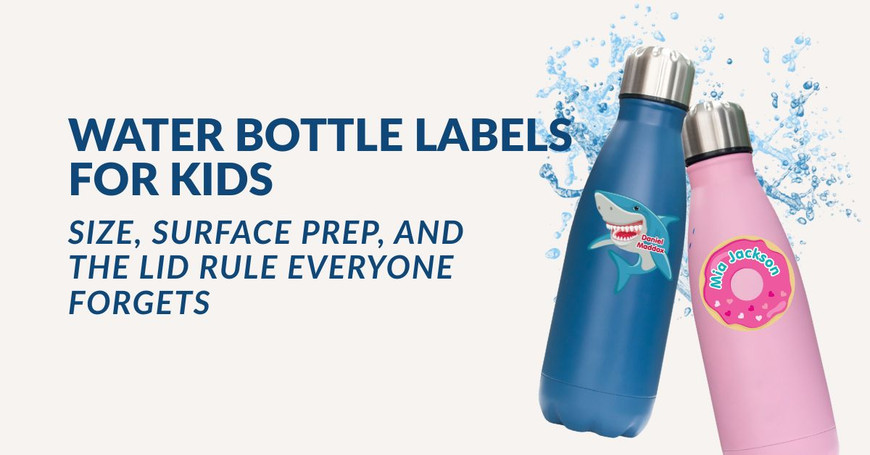
The water bottle is the most commonly lost item at school, at daycare, and at camp. It goes everywhere your child goes, it looks nearly identical to every other child's bottle, and it gets set down and left behind multiple times a day in shared spaces. A name label is the only thing that brings it home.
The label that holds up is not the one written on with a permanent marker that fades by week two. It's not a piece of masking tape with a name on it. It's a properly sized waterproof label applied to a clean, prepared surface — with a second label on the lid, because the lid separates and gets lost independently.
This guide covers every practical detail: which label size works on which bottle, how to prepare the surface so the label actually sticks through daily dishwasher use, where to place it, the lid rule, and the specific bottle types that need special handling. Everything you need to label a water bottle correctly the first time.
From the founder of Sticky Monkey Labels
Dodie here — founder of Sticky Monkey Labels, 15 years in business since 2011, and the person in my house responsible for labeling everything that leaves it. Water bottles specifically have been a constant in this business since day one — they're one of our best sellers and the item parents ask about most. I've applied labels to more bottle types than I can count. Here's what actually works.
What's in this guide
- Why water bottles are the most-lost item — and what a label actually does
- The lid rule — always label the lid separately
- Surface prep — the step that determines everything
- Where to place the label on the bottle
- Label size — matching the label to the bottle
- Bottle type guide — what's different about each one
- Dishwasher use — how to make labels last
- Water bottle labels for school, camp, and daycare
- Frequently asked questions
1. Why Water Bottles Are the Most-Lost Item — and What a Label Actually Does
Water bottles get left behind more than any other item kids carry because of a specific combination of factors: they're carried everywhere, they get set down constantly, they all look the same, and they're handled by multiple people throughout the day — at water stations, lunch tables, activity areas, and cubbies.
A name label changes what happens when a bottle is found without its owner nearby. Without a label: it goes to the lost-and-found, where it sits until pickup or gets mixed in with unclaimed items. With a label: a teacher, counselor, or provider picks it up and returns it directly — or your child walks up to the lost-and-found and immediately identifies it as theirs. That's the practical function of a water bottle label. It gives found property a path home.
2. The Lid Rule — Always Label the Lid Separately
Label the bottle. Label the lid. Separately. Both pieces. Every time.
Lids detach from bottles constantly — in dishwashers, in backpack pockets, at water stations where kids pull the lid off to fill up. Once detached, an unlabeled lid has no connection to the labeled bottle it came with. It ends up in a pile with other lids at the bottom of a lost-and-found box, or matched with the wrong bottle by a well-meaning provider who has twenty other things to manage.
How to label the lid
- Use a small label sized for the flat top or smooth side of the lid — not a full-sized rectangle label that will overhang the lid edges and lift immediately
- Clean the lid surface with alcohol before applying — the same prep as the bottle body
- Apply to the flattest smooth area of the lid: the top surface of a flip-top lid, the smooth side panel of a screw cap, or the flat face of a straw lid
- Avoid placement on any area that twists, flexes, or gets gripped repeatedly during use — these areas stress the label bond over time
- Allow 24 hours before first dishwasher use, same as the bottle body
3. Surface Prep — The Step That Determines Everything
This is the step most parents skip and the one that makes the biggest difference in how long a label lasts. Every bottle surface — even a brand new one straight out of the box — has contamination on it that prevents full adhesive bonding: manufacturing oils, hand oils from handling, dishwasher rinse-aid residue from previous washing, or any combination of these.
Pressure-sensitive adhesive bonds to the surface molecules directly. If those surface molecules are coated in oil or residue, the adhesive bonds to the coating rather than the surface itself — and eventually the coating lets go, taking the label with it.
The prep sequence — do this every time
- Wipe the application area firmly with alcohol on a cloth or cotton pad — visibly wet the surface
- Let it dry completely at room temperature — less than a minute
- Apply the label immediately after the alcohol dries — don't handle the cleaned area with your fingers first
- Press firmly from center outward, running your thumbnail along every edge for full contact
- Allow 24 hours before the first dishwasher cycle
4. Where to Place the Label on the Bottle
Placement affects both visibility and longevity. The goal is a smooth, stable area that's visible to whoever picks up the bottle and away from surfaces that experience the most wear.
Best placement — upper body of the bottle, near the top
Place the label on the upper portion of the bottle body, as close to the top as possible while remaining on the smooth main body surface — away from the base where the bottle sits on wet surfaces repeatedly, and away from silicone sleeves or grip areas. The upper body is where the label is most visible during use and gets the least abrasive contact from surfaces the bottle rests on.
What to avoid
- The base — the bottom of the bottle sits in wet surfaces, puddles, and dishwasher spray zones repeatedly. Labels at the base wear faster.
- Silicone sleeves and grip pads — silicone is non-stick by nature. Nothing bonds to it reliably. If the bottle has a silicone sleeve, find the smooth plastic or metal body above or below it.
- Textured surfaces — raised dots, ridges, or grip patterns prevent full adhesive contact. Labels cannot be applied to textured surfaces. Find the smooth area.
- Over measurement markings — on bottles with graduated ounce markings, place the label above or below the marking area, not over it.
5. Label Size — Matching the Label to the Bottle
Label size matters more than most parents expect. A label that's too wide for the bottle diameter will curve around the body and lift at the edges — the curved surface means the label can't make flat contact across its full width, so the edges bow away from the surface and the dishwasher finds them immediately.
General sizing guide
- Small bottles (8–12oz, infant/toddler size) — use a small or extra-small label. A standard rectangle label is often too wide for these bottle diameters.
- Medium bottles (14–20oz, standard kids' size) — a standard rectangle label works well on the flat panel of the upper body.
- Large bottles (24–40oz, Stanley, Hydro Flask, YETI size) — a larger label works here since the diameter is wide enough to accommodate it without curving. Our large die-cut name labels are specifically sized for these bigger bottles — and the fun cutout shapes make it easy for kids to spot their own bottle instantly in a lineup of identical Stanleys.
- Lids — always use a small label for lids regardless of bottle size. The flat top of most lids is much smaller than the bottle body.
6. Bottle Type Guide — What's Different About Each One
Different bottle materials and designs present different labeling considerations. The prep and application principles are the same — the specific execution varies by surface type.
Plastic bottles
The most straightforward surface for waterproof labels. Clean with alcohol, dry completely, apply to the smooth upper body. Most standard kids' water bottles are plastic and label extremely well when prepped correctly. The main issue with plastic bottles is the base area — avoid it.
Stainless steel — plain finish
Excellent surface when prepped correctly. Stainless steel holds oils and fingerprints well — which is exactly what prevents adhesion — so the alcohol prep step is especially important here. Wipe firmly, allow to dry completely, apply immediately. Plain stainless steel bonds very well and labels applied correctly last years through daily dishwasher use.
Powder-coated stainless steel (Stanley, Hydro Flask, YETI, similar)
The colored matte finish on popular insulated bottles. Bonds well after alcohol prep — the powder coat is a smooth, paintable surface that holds labels reliably. Use a large label sized for the wider diameter of these bottles. Avoid the silicone base boot that many of these bottles have — that's a silicone surface and nothing sticks to it. Place the label on the powder-coated body above the boot.
Bottles with silicone sleeves or silicone grips
Silicone is non-stick — nothing bonds to it reliably. If a bottle has a silicone sleeve covering part of the body, find the smooth plastic or metal surface above or below the sleeve. If the silicone sleeve covers the entire bottle body, place the label on the smooth plastic or metal neck area above the sleeve. Never try to label a silicone surface directly.
Glass bottles
Glass is a clean, smooth surface and labels bond to it very well after alcohol prep. The main consideration is that many glass water bottles have a silicone protective sleeve over the glass body — which brings you back to finding the smooth glass or hard plastic surface above or below the sleeve. On bare glass, labels apply beautifully and last well.
7. Dishwasher Use — How to Make Labels Last
Our waterproof labels are designed for dishwasher use and last for years through daily washing when applied correctly. The two factors that determine longevity in a dishwasher are application quality and initial cure time.
24-hour cure before first wash
The adhesive continues curing after application. A label applied in the morning and run through the dishwasher that evening has not finished bonding. 24 hours at room temperature before the first dishwasher cycle is the cure window that sets the bond. Label bottles the night before or several days before they're needed — not the morning they go out the door.
Top rack recommended
Top rack placement reduces direct exposure to the heating element at the bottom of the dishwasher. Labels survive bottom rack washing too — but top rack placement extends longevity over months and years of daily use. If your family consistently uses the top rack for bottles and sippy cups anyway, you're already doing the right thing.
8. Water Bottle Labels for School, Camp, and Daycare
The label and application are the same regardless of where the bottle is going. What changes is which label size fits the specific bottle and how urgently you need the label to be in place.
School
Water bottles at school get left behind at lunch tables, water fountains, gym class, and after-school activities. Label it before school starts in August and it goes all year. Label the lid separately. Most school-age kids carry a 14–20oz plastic or stainless steel bottle — standard label sizing works well. For middle and high schoolers with Stanley or Hydro Flask bottles, use our large name labels.
Camp
Water bottles at camp go everywhere for the entire session — hiking, swimming, meal times, activity areas. The label needs to survive the session. Apply before drop-off with the full prep sequence and 24-hour cure time. Label both the bottle body and the lid — camp kitchens fill, rinse, and stack bottles quickly and lids separate constantly. For sunscreen and bug spray bottles going to camp, add a clear label overlay — the oils in those products are slow-acting solvents for label ink over a full summer season.
Daycare
Daycare has specific bottle labeling requirements — full name, date, contents, ounces. A water bottle going to daycare as a supplement to bottles needs the same identification. Apply to the upper body of the bottle, label the lid separately, use the wax pencil add-on to write the daily date and ounces in the write-on field. See our full bottle labels for daycare guide for the complete daycare-specific requirements.
Browse our full range of waterproof name labels and large die-cut name labels at Sticky Monkey Labels. The die-cut shapes are especially popular for kids who want to spot their own bottle fast — the fun cutout shape stands out even when a dozen identical bottles are lined up on a shelf. Not sure which size fits your specific bottle? Call us at 1-888-780-7734 — we'll sort it in a minute.
Frequently Asked Questions
My water bottle label keeps peeling off. What am I doing wrong?
Almost certainly the surface wasn't cleaned with alcohol before applying, or the bottle went into the dishwasher before the 24-hour cure time. These two steps account for the vast majority of labels that peel early. Start fresh: clean the surface thoroughly with alcohol, let it dry completely, apply with firm pressure across every edge, and give it 24 hours before the next dishwasher cycle. A correctly prepped and applied label does not peel from regular dishwasher use.
Can I put a water bottle label in the dishwasher?
Yes — our waterproof labels are designed for dishwasher use and last for years. Top rack recommended for maximum longevity. The key is the 24-hour cure window before the first cycle and alcohol prep before application. Both are non-negotiable if you want the label to hold through daily washing.
Will a label stick to a Stanley or Hydro Flask?
Yes — with proper prep. The powder-coated finish on these bottles is a smooth surface that holds labels well. Clean with alcohol first, let dry, apply a large name label sized for the wider bottle diameter, press firmly across every edge, and give it 24 hours before the first wash. Avoid the silicone base boot — place the label on the powder-coated body above it. Labels applied this way to these bottles last for years.
How do I label a bottle that has a silicone sleeve covering most of it?
Silicone is non-stick — no adhesive label will bond to it reliably. Find the smooth plastic or metal surface above or below the silicone sleeve and apply there. On most sleeved bottles there is a smooth neck area above the sleeve that labels well. If the sleeve genuinely covers the entire body with no exposed smooth surface, place the label on the smooth area of the lid instead. The lid needs a label anyway.
Does the label need to be waterproof even if the bottle isn't going in the dishwasher?
Yes — water bottles get wet from the outside too. Condensation, wet hands, being left in the bottom of a wet swim bag, being rinsed at a camp water station. A paper or non-waterproof label doesn't survive these conditions regardless of washing method. Waterproof is the right choice for any label that lives on a water bottle.
My child is starting middle school and wants a Stanley. What label do I use?
Our large die-cut name labels are sized for the wider diameter of Stanley, Hydro Flask, YETI, and similar insulated bottles — and the fun cutout shapes mean your kid can identify their bottle at a glance from across the lunch table. Clean the powder-coated body surface with alcohol, avoid the silicone base boot, apply the label to the upper smooth body, press firmly across every edge, and give it 24 hours before the first wash. Also label the lid separately with a small label on the smooth top surface. Your middle schooler may resist the label — remind them that a $40 Stanley without a name on it is a $40 gift to whoever finds it in the gym.