
From the founder of Sticky Monkey Labels
I'm Dodie — mom of three boys, two with food allergies and one with special needs, and founder of Sticky Monkey Labels. I'm now in my 15th year of business, which started in 2011. I started this business because I needed labels that actually held up to real kid life — daycare, school, camp, and everything in between. Iron-on labels are the ones I reach for when something absolutely cannot come off. This is everything I know about them.
If you've ever picked up an unlabeled sock from the school lost-and-found and had no idea whether it belonged to your child, you already understand the problem iron-on name labels solve.
Here's what I've learned after 15 years of making them and testing every single one in my own house with my own three boys: the label almost never fails. The application almost always does. And the fix is simpler than you think.
This guide covers everything — which items genuinely need iron-on labels versus which ones are better served by stick-on, step-by-step application so yours last the full season, placement by item type, why iron-on is the only sensory-safe option for children who feel everything in their clothing, and the specific mistakes that cause labels to peel before they should.
What's in this guide
- What iron-on name labels actually are (and how the bond works)
- Which items need iron-on — and which ones don't
- Iron-on labels and sensory-sensitive kids
- Placement guide by item type
- Step-by-step application — the right way
- The seven mistakes that make iron-on labels peel
- Iron-on labels for school
- Iron-on labels for daycare
- Iron-on labels for camp
- Frequently asked questions
1. What Iron-On Name Labels Actually Are (And How the Bond Works)
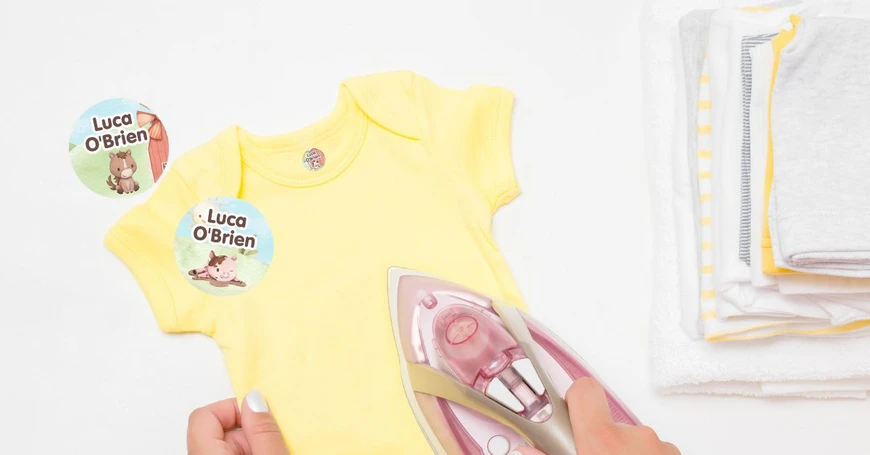
An iron-on name label is a printed fabric label with a heat-activated adhesive backing. When you press a hot iron against the label, the adhesive melts into the fibers of the fabric beneath it. As it cools, it re-solidifies — fused into the fabric rather than sitting on top of it. Done correctly, the bond isn't between the label and the fabric surface. It's inside the fabric. That's why it survives washing.
This is completely different from a pressure-sensitive adhesive — what stick-on labels use. Stick-on labels bond to surfaces through contact and pressure. They work brilliantly on smooth hard surfaces like care tags, plastic bottles, and metal containers. They work reasonably well on smooth fabric care tags. They do not work on raw fabric, because the adhesive has nothing to grip at a fiber level. Iron-on adhesive bypasses the surface entirely and bonds at the fiber level — which is why iron-on labels are the only reliable option for items without a care tag to put a stick-on label on.
2. Which Items Need Iron-On — And Which Ones Don't
Iron-on labels are not the right choice for everything. Understanding which items need them and which are better served by stick-on labels is how you label efficiently, spend correctly, and avoid applying labels to surfaces where they'll fail.
Items that require iron-on labels
Socks
Socks have no care tag and are made of wide-weave knit fabric that stretches, compresses, and gets washed harder than any other garment. Nothing adheres reliably to sock fabric except a heat-bonded iron-on label. Place inside the cuff. Yes, every single sock — parents who skip sock labeling at overnight camp consistently lose 40–60% of the supply by the second week of a month-long session.
Underwear
Underwear frequently has a waistband label too small to put a stick-on label on, and the elastic waistband fabric has the same adhesion problem as socks. Iron-on inside the waistband is the reliable option. This matters especially at camp and during gym class at school, when clothing gets mixed up in shared changing spaces.
Tagless clothing
Many modern children's clothing brands have eliminated traditional care tags and replaced them with a printed tagless imprint — a small ink print on the fabric itself. Stick-on labels can go on the largest, flattest part of a tagless imprint, but the surface area is small and the bond is limited. Iron-on directly into the fabric alongside or overlapping the tagless imprint is more reliable and more permanent for clothing that will be washed frequently.
Swimwear and rash guards
Swimwear stretches constantly during wear and washing. Even if a swimsuit has a care tag, the constant stretch during chlorine exposure and high-heat drying compromises stick-on label adhesion over a full camp season. Iron-on on any iron-safe area of the swimsuit is the more durable choice for items going through repeated swim and laundry cycles.
Bedding (sleepaway camp and boarding school)
Sheets, pillowcases, and blankets going through communal laundry need iron-on labels. Commercial laundry cycles use high heat that compromises stick-on adhesive, and the flat fabric surface of bedding has nothing for a stick-on label to grip reliably through repeated high-temperature washes.
Anything going through communal laundry
If clothing is going to be washed in bulk with other people's laundry — at overnight camp, boarding school, or any shared-laundry environment — iron-on is the right choice for all fabric items regardless of whether they have a care tag. The permanent bond is what survives repeated industrial wash cycles.
Items where stick-on labels work better than iron-on
Stick-on clothing labels are the right choice for garment care tags — they peel and press onto the tag quickly, hold through home laundry, and can be removed cleanly when you want to pass clothing down to a younger sibling. Jackets, hoodies, school uniforms with accessible care tags, and most daily school clothing with readable tags are all well-served by stick-on labels.
Stick-on labels also work on hard surfaces — plastic bottles, metal containers, and glass — where iron-on has no application at all. Water bottles, lunch containers, sippy cups, and school supplies all need stick-on waterproof labels, not iron-on.
3. Iron-On Labels and Sensory-Sensitive Kids
For children with sensory processing differences — autism spectrum disorder, sensory processing disorder, tactile hypersensitivity, or any condition that causes heightened sensitivity to physical sensation — clothing labels are a genuine daily problem. A raised label edge inside a shirt collar isn't an inconvenience. For a sensory-sensitive child, it's a constant distraction that can make an entire school day harder.
Iron-on labels, when applied correctly, are the only labeling option that eliminates this problem entirely. Here's why:
The bond is into the fabric, not on top of it
A correctly applied iron-on label fuses into the fabric fibers and lies completely flat. There is no raised edge, no corner that lifts, no thickness difference the child can feel through their clothing. From the inside, the label feels like the fabric because it has become part of the fabric.
No hard edges or stiff patches
Stick-on labels have a physical edge that sensory-sensitive children will often notice — especially when placed inside a collar or waistband where skin contact is direct. Even thin stick-on labels have a perimeter the child can feel. Our iron-on labels are designed specifically to be super soft, with no rough edges and no stiff patch feel. When properly applied, they are indistinguishable from the surrounding fabric by touch.
Nothing to pick at or feel during washing
Children who are sensitive to physical sensation often notice changes in texture that adults wouldn't detect. A label that lifts slightly at one corner after washing creates a new sensation — and sensory-sensitive children will often pick at it until it peels entirely. A fully bonded iron-on label gives them nothing to find and nothing to pick. The application quality matters here more than anywhere else — a partially bonded label is worse than no label for this specific use case.
4. Placement Guide by Item Type
Where you place an iron-on label determines how long it lasts and how comfortable it is to wear. The goal is a spot with good flat fabric contact and minimal friction from wear and washing.
| Item | Best Placement | Notes |
|---|---|---|
| T-shirts and tops | Inside back collar | Flat area, low friction during wear. Avoid the spine of the collar where the seam creates an uneven surface. |
| Shorts and pants | Inside waistband — flat fabric area | Place on the flat inner fabric of the waistband, not on the elastic itself. Elastic stretches and compresses in ways that stress the label bond. |
| Underwear | Inside waistband — flat fabric area | Same rule as shorts — flat fabric alongside the elastic, not on the elastic. For sensory-sensitive children, place at the back center where skin contact is minimal. |
| Socks | Inside cuff | The cuff gets the least friction during wear. Stretch the sock over a flat surface (a book works) before ironing so the fabric is as flat as possible during application. |
| Sweatshirts and hoodies | Inside back collar or inner back hem | The collar area on fleece or French terry can be textured — look for the smoothest flat area possible. The inner back hem works well on tagless sweatshirts. |
| Pajamas | Inside collar or inside waistband | Both the top and bottom need their own label — pajama tops and bottoms frequently get separated in laundry. |
| Swimsuits and rash guards | Inside back of neckline or inner waistband flat area | Test the fabric first — iron-on labels require iron-safe fabric. Avoid placing on areas with decorative prints or metallic fibers. Check the care label for iron-safe designation. |
| School uniforms | Inside back collar for tops; inside waistband for trousers and skirts | Avoid the inside chest area — this places the label against skin for long periods and is the placement parents most often report causing discomfort. |
| Bedding — sheets | Corner furthest from where the child's head rests | A low-friction corner on the flat fabric of the sheet — not on a seam or hem edge. Label both the fitted sheet and flat sheet separately. |
| Bedding — pillowcases | Inside seam near the open end | Place on the inside fabric near the open end — this area experiences less friction during use than the pillow-contact area. |
5. Step-by-Step Application — The Right Way
Every step in this sequence affects the final bond quality. Skipping or rushing any of them is the most common cause of labels that peel before they should.
Step 1: Start with clean, dry fabric
Freshly laundered and fully dried fabric gives the best bond.Never apply iron-on labels to damp fabric. Any moisture in the fabric traps steam under the label during ironing and prevents proper bonding.
Step 2: Preheat your iron — cotton setting, no steam
Iron set to the cotton or high setting. No steam. This is important: steam introduces moisture that works against the heat-adhesive bond. If your iron has a steam button you might accidentally press, check that it's off before you start. Allow the iron to reach full temperature — starting with a cold or partially warm iron is a common mistake that results in incomplete bonding.
Step 3: Place the garment on a hard, flat surface
An ironing board is ideal. Avoid soft padded surfaces that compress during ironing — the downward pressure that bonds the label to the fabric requires a firm surface underneath.
Step 4: Position the label adhesive-side down, cover with parchment paper
Place the label with the printed side facing up and the adhesive backing against the fabric. Cover with the parchment or silicone sheet included in your order — this protects the label from direct iron contact and distributes heat evenly. Parchment paper from your kitchen also works. Do not iron directly onto the label without a protective cover.
Step 5: Press with firm pressure using a press-and-lift technique — total 60–90 seconds
Press the iron down firmly, hold for several seconds, then lift and reposition slightly — working across the full label surface in overlapping sections. Don't slide the iron (that shifts the label before it bonds) and don't hold it completely stationary in one spot for the full duration (that concentrates heat and risks scorching). A slow, deliberate press-and-lift rhythm gives you even heat distribution across the entire label. Aim for 60–90 seconds total contact time across the whole label surface. This is longer than it sounds — time it once so you have a real sense of it. Most under-bonded labels were pressed for 15–20 seconds total.
Step 6: Cool completely before touching the label
Remove the parchment and let the label cool fully to room temperature before touching it, stretching the fabric, or checking the edges. The adhesive is still in a semi-liquid state immediately after ironing — any pressure or stretch during cooling can lift edges before they've re-solidified into the fabric. "Let it cool" means at least two minutes at room temperature, not a quick breath of air.
Step 7: Check all edges and reinforce any that haven't bonded
After cooling, run your thumbnail firmly around all four edges of the label. They should feel flush with the fabric with no lifting. Any edge that feels raised or loose needs to be re-pressed immediately — cover with parchment, press firmly for another 30 seconds on that specific edge, and cool again. Addressing partial bonds right after application is easy. Addressing them after the first wash is much harder.
Step 8: Wait 24 hours before the first wash
The adhesive continues curing for up to 24 hours after application. Labels applied correctly and washed immediately have not finished bonding — the hot water and agitation of a wash cycle can disrupt the bond before it has fully set. This is the step most parents skip in the rush of label day. The 24-hour wait is what separates a label that lasts one season from one that starts lifting after three washes.
6. The Seven Mistakes That Make Iron-On Labels Peel
After 15 years of hearing from parents about label failures, the same seven mistakes come up repeatedly. Every one of them is avoidable.
Mistake 1: Damp fabric
Applying to fabric that came straight from the dryer but still feels slightly warm and damp. The fabric must be fully dry. Room temperature is ideal — if the fabric is warm from the dryer, let it cool to room temperature first.
Mistake 2: Steam
The steam setting on an iron introduces moisture at the exact moment the heat-adhesive needs dry heat to activate. Turn steam off completely before applying any iron-on label. Check the iron's water tank and make sure there is no residual steam being released.
Mistake 3: Not pressing long enough
Most parents press for 15–20 seconds. The required time is 60–90 seconds. Time it once. The difference between these two durations is the difference between a partial bond that fails at the edges within a few washes and a full bond that lasts the school year.
Mistake 4: Sliding the iron instead of pressing and lifting
Sliding the iron back and forth across the label shifts it during bonding and creates uneven pressure. The correct technique is press, hold for a few seconds, lift, reposition slightly, and press again — working across the label in firm overlapping sections. Never hold the iron completely stationary for the entire 60–90 seconds either; that concentrates heat in one spot and risks scorching the fabric. A slow, deliberate press-and-lift rhythm across the full label surface gives you even heat distribution without damaging the material underneath.
Mistake 5: Soft surface underneath
Applying over the padded end of an ironing board, a folded towel, or any compressed surface reduces the downward pressure needed to push the adhesive into the fabric fibers. Use the firm flat section of an ironing board, a hard table surface, or for small items like socks, a hardback book.
Mistake 6: Touching or stretching the label before it cools
Removing the parchment and immediately pinching the label edge to check if it stuck — while it's still hot — is the most reliable way to create a lifted edge that will peel during the first wash. Let it cool fully. Two minutes of patience here saves you a label.
Mistake 7: Washing within 24 hours
The adhesive continues curing after application. Labels washed before the 24-hour mark have not finished bonding. The first wash is the most stressful cycle a label will ever go through — hot water, agitation, and heat drying all at once. A fully cured label handles this fine. A partially cured label often doesn't.
7. Iron-On Labels for School
School clothing goes through the wash more often than almost anything else kids own — sometimes multiple times a week. Iron-on labels are the right choice for items where this wash frequency would wear a stick-on label down over the school year, and for any items your child wears during activities where clothing gets mixed up.
The items that most consistently end up in the school lost-and-found are the ones that are hardest to identify at a glance: identical navy hoodies, white athletic socks, and gym uniform shorts. These are precisely the items that benefit most from iron-on labels — placed where staff can check quickly without holding each item up to the light looking for a tiny stick-on label on a care tag.
School uniform labels specifically
School uniforms are washed more frequently than any other clothing category and need labels that survive a full academic year, not just a term. Iron-on in the back collar of polo shirts, in the inner waistband of trousers and skirts, and in the collar of blazers. For PE kit, iron-on in the collar of PE tops and the waistband of shorts — these get changed in shared changing rooms multiple times per week and are highly susceptible to mix-ups.
Which school items need stick-on labels instead
School supplies — pencils, folders, notebooks, water bottles, lunchboxes — need waterproof stick-on waterproof name labels, not iron-on. Jackets and hoodies with large, accessible care tags work well with stick-on clothing labels if you plan to pass them down to a younger sibling. The back-to-school label system for most families is iron-on for clothing items worn against skin and stick-on for everything else.
8. Iron-On Labels for Daycare
Daycare labeling has specific requirements that differ from school. Staff change rooms frequently and need to identify your child's belongings quickly without a system they've learned over time. Labels need to be immediately readable, in the right spot, and survive both the daycare's laundry facilities and their commercial dishwashers.
For daycare clothing — onesies, sleepers, everyday outfits — iron-on labels in the inside back collar are the right choice for anything going through daycare laundry. Daycare facilities often wash clothing in larger batches at higher temperatures than home machines, which is exactly the environment iron-on adhesive was designed to survive.
9. Iron-On Labels for Camp
Camp is the most demanding environment iron-on labels face. Communal laundry at high temperatures, clothing mixed with dozens of other campers' items, repeated washing over a multi-week session — this is where the difference between a correctly applied iron-on label and an incorrectly applied one becomes completely apparent.
For overnight camp, iron-on labels are the right choice for every piece of clothing in the trunk, every sock, every piece of underwear, every pajama set, and every piece of bedding. The permanent bond into fabric is what survives communal laundry. This is not the situation for relying on stick-on labels — even good ones — for fabric items.
Camp gear, bottles, and toiletries need stick-on labels
Water bottles, sunscreen bottles, bug spray, shampoo, conditioner, flashlights, shower caddy — everything that isn't fabric needs waterproof stick-on labels, not iron-on. For sunscreen and bug spray bottles specifically, add a clear label overlay — the oils in these products are slow-acting solvents for label ink and will fade an unprotected label by week three of a camp session.
Browse our full range of iron-on name labels at Sticky Monkey Labels. Questions about which label is right for your child's specific situation? Call us at 1-888-780-7734 — after 15 years of helping families label everything from baby bottles to camp trunks, I can usually answer in two minutes.
Frequently Asked Questions
Will iron-on labels survive the washing machine and dryer?
Yes — when applied correctly. Our iron-on labels are guaranteed for household washer and dryer use. Correct application means clean dry fabric, no steam, full temperature iron, firm pressure for 60–90 seconds, complete cool-down before stretching, and 24 hours before the first wash. Labels that fail early almost always failed at one of these steps, not because of adhesive quality. If your camp or school uses commercial laundry equipment, iron-on is the more robust choice over stick-on for all fabric items.
Can I use iron-on labels on all fabric types?
Iron-on labels work on iron-safe fabrics — cotton, cotton blends, polyester, and most standard children's clothing materials. They do not work on fabrics with care labels that say "do not iron," fabrics with metallic fibers or decorative heat-sensitive elements, nylon, leather, or vinyl. If the garment's care label says it can be ironed, an iron-on label can be applied. When in doubt, test the iron temperature on a hidden seam of the fabric before applying the label to the main fabric area.
Can I remove an iron-on label if I want to pass clothes down?
Iron-on labels are designed to be permanent — that's the feature that makes them survive communal laundry and repeated washing. If you plan to pass specific items down to a younger sibling and want easy relabeling, stick-on labels on care tags are the better choice for those items. Iron-on is the right choice for anything going through demanding laundry conditions.
Are iron-on labels safe for babies and young children?
Yes. Our iron-on labels are made with materials appropriate for children's clothing and are tested against skin contact standards. For infants and young toddlers specifically, place labels in the back collar or back waistband area where skin contact is minimal during normal wear. For very young babies in onesies, the inside back collar placement positions the label against the back of the neck rather than the front, away from face and mouth contact.
My iron-on label started peeling after one wash — what went wrong?
Nearly always one of seven things: the fabric was damp when applied, the iron had steam on, the pressing time was under 60 seconds, the iron was moved instead of held in place, the surface underneath was soft, the label was touched or stretched before it cooled, or it was washed within 24 hours of application. Check which step was skipped, peel the label off completely, and reapply correctly. A label that partially bonded cannot be fixed by re-ironing over it — remove it fully and start again for the best result.
Do I need iron-on labels or stick-on labels for a complete back-to-school or camp setup?
Both. Iron-on and stick-on labels serve different surfaces and different purposes — they work together rather than competing. Iron-on for fabric items without care tags, items going through demanding laundry, socks, underwear, and sensory-sensitive children's clothing. Stick-on clothing labels for items with accessible care tags where you want the option to relabel later. Waterproof stick-on labels for all hard surfaces — water bottles, lunch containers, school supplies, toiletry bottles. Our camp label packs and school label packs include a balanced mix of both types because most labeling situations genuinely need both.
How far in advance should I order iron-on labels before camp or school?
We ship all orders within 1–2 business days — that turnaround is something I'm proud of after 15 years. That said, I recommend ordering at least 10–14 days before your first use date. You need time for shipping, time to apply labels across a full trunk or school wardrobe without rushing, and the 24-hour cure window before the first wash. Labels applied the night before camp drop-off and washed immediately have not finished curing. Give yourself a week of unhurried labeling time and the results will be significantly better than a last-minute session.