
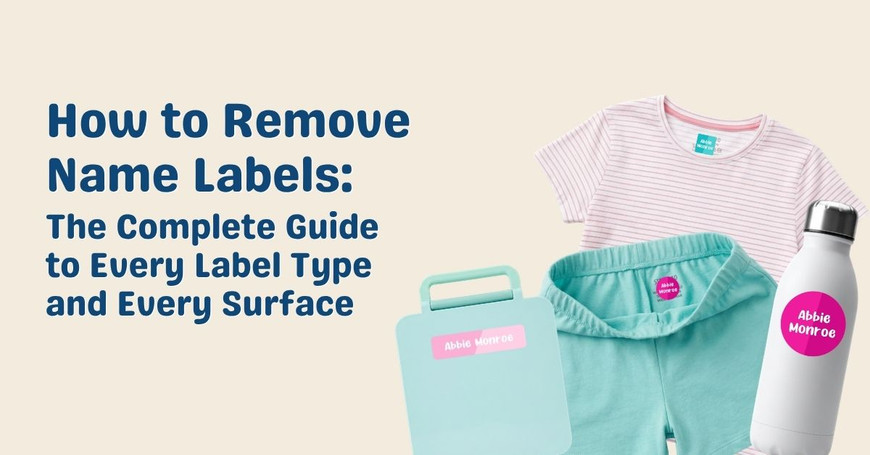
How to remove name labels is one of the most searched label questions — and the answer is completely different depending on which type of label you're removing and what surface it's on. Removing a waterproof label from a water bottle is straightforward — they release from smooth hard surfaces cleanly and any remaining adhesive is handled with a simple trick. Stick-on clothing labels on care tags peel off and can be re-labeled. Pencil labels come away with a slow peel. Iron-on clothing labels are the exception — they bond permanently into fabric fiber and are not removable. This guide covers every type accurately.
This is the complete removal guide for every label type — waterproof labels on hard surfaces, iron-on clothing labels on fabric, stick-on clothing labels on care tags, and pencil labels on narrow barrels. It also covers why you'd want to remove a label (hand-me-downs, seasonal items, corrections, and upgrades), and what to do after removal when you want to re-label the same item with a new name.
As someone who has been making and testing labels for 15 years, I've seen every removal scenario. Here's what works and what doesn't for each one.
From the founder of Sticky Monkey Labels
I'm Dodie, founder of Sticky Monkey Labels and the original creator of Peel 'n Stix® clothing labels — now in my 15th year. Label removal questions come up in every context — hand-me-downs, name corrections after a nickname changes, re-labeling for camp, and seasonal items that need a fresh label each year. Here's the full guide.
Jump to Your Label Type
- Why remove a label — the four most common reasons
- Removing waterproof labels from hard surfaces
- Removing iron-on clothing labels from fabric
- Removing stick-on clothing labels from care tags
- Removing pencil labels from narrow barrels
- Dealing with adhesive residue after removal
- Re-labeling after removal — how to do it right
- Frequently asked questions
Why Remove a Label — The Four Most Common Reasons
Understanding why you're removing a label matters because the end goal affects how careful you need to be with the removal process. The four most common removal scenarios each have slightly different priorities:
Hand-me-downs — passing clothing or items to a younger sibling
The most common removal reason. A school uniform, jacket, or piece of camp gear labeled with one child's name needs the label removed and replaced with the next child's name. For stick-on labels on care tags this is straightforward — peel and re-apply. For iron-on labels this is more involved, because iron-on bonds permanently into the fabric fiber. The approach varies significantly by label type.
Name change or correction — nickname updated, name misspelled
A child who goes by "Charlie" starts being called "Charles" at school. For waterproof labels on hard surfaces, removal and replacement is easy. For iron-on labels on fabric it's trickier — but a new label applied over or adjacent to the old one is often the practical solution when full removal would damage the fabric.
Seasonal re-labeling — camp items, seasonal gear
Camp equipment and seasonal gear that's stored between uses needs label updates periodically. This is specifically why stick-on clothing labels are recommended for camp clothing — the removability is a design feature, not a limitation. Iron-on labels are permanent and are not the right choice for camp clothing you plan to re-label or hand down. For daycare bottles and containers that rotate between children, see our bottle labels for daycare — the waterproof format releases cleanly from hard surfaces for re-labeling.
Label failure — a waterproof label that peeled and left residue
A waterproof label applied without the alcohol prep step, applied to silicone, or washed before the 24-hour cure was complete may have partially lifted and left adhesive residue behind. Removing the residue cleanly before applying a new label correctly is the first step. The residue removal process is covered in Section 6.
Removing Waterproof Labels from Hard Surfaces
Waterproof labels release from smooth hard surfaces cleanly — this is one of the most straightforward label removal situations. Lift a corner with a fingernail and peel. The label comes away from stainless steel, plastic, glass, and powder-coated surfaces without damage to the surface and without significant residue in most cases. The adhesive is designed for hard surfaces, not absorbed into them the way it is with fabric.
How to remove a waterproof label from a hard surface:
- Lift a corner with a fingernail. Start at one corner and lift slowly. The label releases from the smooth surface cleanly. Keep the peel angle low and flat against the surface — a shallow angle pulls the full label away more cleanly than peeling upward at a steep angle.
- Peel slowly and evenly. Once a corner is lifted, peel in one continuous motion. Patience here pays off — slow peeling leaves minimal residue. Fast aggressive peeling is more likely to tear the label and leave adhesive behind.
- Remove any remaining adhesive — the fast way. If any adhesive remains on the surface after the label is removed, simply stick the peeled label back down over the residue and peel it off again. Repeat this a few times and the remaining adhesive lifts away with the label. This works because the label adhesive bonds to itself more readily than to a clean hard surface.
- For any residue that remains after that: A small amount of vegetable oil or any cooking oil rubbed onto the residue area, left for 30–60 seconds, then wiped away, dissolves any remaining adhesive completely. Follow with a rinse and the surface is clean and ready for re-labeling.
Removing Iron-On Clothing Labels from Fabric
Iron-on clothing labels are not removable. This is not a flaw — it is the product's core feature. The thermobond adhesive in an iron-on label flows into the fabric fiber during application and becomes part of the garment itself. That permanent bond is what allows iron-on labels to survive years of school washing, hot dryer cycles, and the general physical demands of gym clothes and school uniforms. Reversing that bond is not possible without damaging the fabric.
If you're dealing with a hand-me-down that has an iron-on label from the previous child, the solution is not removal — it's replacement. Apply a new iron-on label directly over the existing one, or immediately adjacent to it inside the collar. A fresh label bonded cleanly over the top covers the old name completely. Most school uniform collar areas have enough space to accommodate both labels side by side if needed. This is faster, safer for the fabric, and produces a cleaner result than any attempted removal.
This is also why we specifically recommend stick-on clothing labels for camp clothing, seasonal items, and any garment that will change hands — the Peel 'n Stix format on care tags is machine washable, laundry safe through the full season, and fully removable when the item needs re-labeling. Iron-on is the right choice when permanence is the goal. Stick-on is the right choice when flexibility matters.
Complete iron-on application guide: iron-on clothing labels complete guide →
Removing Stick-On Clothing Labels from Care Tags
Stick-on clothing labels — our original Peel 'n Stix® format — are specifically designed to be removable. This is one of their key practical advantages over iron-on labels for clothing that will be handed down or seasonally re-labeled. The care tag surface that makes them machine washable also makes them cleanly removable when needed.
Because stick-on clothing labels go through the heat of the washer and dryer, some adhesive does remain on the care tag after removal — this is expected and completely normal. The care tag surface is firm and non-absorbent, so the residue sits on top rather than soaking in, which makes it manageable.
How to remove a stick-on clothing label from a care tag:
- Lift a corner with a fingernail and peel slowly. The label peels away from the care tag surface. Slow and steady is better than fast — a slow peel brings more of the adhesive away with the label itself.
- Use the label itself to remove remaining adhesive. Take the peeled label and press it back down over any adhesive residue remaining on the care tag, then peel it off again. Repeat this several times — the label adhesive bonds to the residue and lifts it away. This is the most effective method and requires no products at all.
- Apply a new label over any remaining residue. If a small amount of residue still remains after the peel-on-peel-off method, the new label can go directly over it. The new label bonds to the care tag surface and covers any residue cleanly. This is the practical approach — the new label will hold fine over a minimal residue layer on a care tag.
After re-labeling: firm pressure on every edge of the new label, 24 hours before the first wash. Browse our full range of stick-on clothing labels →
Removing Pencil Labels from Narrow Barrels
Pencil labels — the narrow strip labels designed for pencil, pen, marker, and crayon barrels — are applied to cylindrical surfaces. Removal is usually straightforward because the curved barrel means the label adhesive is under slight tension, which makes initial edge lifting easier than on a flat surface.
How to remove a pencil label:
- Find the edge of the label — one end of the narrow strip where it doesn't quite overlap itself
- Lift with a fingernail and peel slowly around the barrel
- For stubborn labels, warm water or 10 seconds of gentle hair dryer warmth loosens the adhesive
- Remove residue with an isopropyl alcohol wipe before re-labeling
Most pencil labels come away cleanly because the barrel surface doesn't absorb adhesive. The plastic or lacquered wood surface of most pencils responds well to warm water and slow peeling. Marker and pen barrels are usually even easier because the harder plastic surface holds adhesive on top rather than letting it penetrate.
Dealing with Adhesive Residue After Removal
Adhesive residue after label removal is normal — it's what remains when the adhesive layer transfers partially to the surface rather than lifting fully with the label. The approach depends on the surface:
Hard surfaces — water bottles, lunchboxes, containers, school supplies
Step one: press the peeled label back down over any residue and peel it off again. Repeat several times — this lifts the majority of adhesive residue without any products. For any residue that remains, apply a small amount of vegetable oil or any cooking oil to the area, let it sit for 30–60 seconds, and wipe away. The oil dissolves adhesive residue on hard surfaces completely. Follow with a dish soap wash and rinse to remove the oil before re-labeling. Then do a fresh isopropyl alcohol wipe — the surface must be completely clean and oil-free before the new label goes on.
Care tags — after stick-on clothing label removal
Use the same peel-on-peel-off method — press the removed label back onto the residue and lift repeatedly. This removes most care tag residue cleanly. For any that remains, the new label can go directly over it. Do not use oil on care tags — it can wick into surrounding fabric and leave a stain. The peel-on-peel-off method or direct re-labeling over minimal residue is the right approach for care tags.
Iron-on labels — no residue removal needed
Iron-on labels are not removable. There is no residue removal step because the label itself is not removed. For hand-me-downs, apply a new iron-on label directly over the existing one using the full application process. The new label bonds over the old and covers the previous name completely.
Re-Labeling After Removal — How to Do It Right
Re-labeling is the end goal for most removal scenarios, and the fresh label application is the most important part of the whole process. A new label applied over uncleaned residue, on a still-warm surface, or without cure time will fail faster than the original label. The prep step matters even more on a surface that has had a previous label — old adhesive residue is exactly the kind of contamination layer that prevents new adhesive from bonding directly to the surface.
Re-labeling sequence after removal — every surface type:
- Remove all adhesive residue completely. The surface needs to be fully clean of old adhesive before the new label goes on. Any remaining residue means the new label bonds to old adhesive rather than the surface itself.
- Allow the surface to dry and reach room temperature. Moisture or warmth from the removal process affects new adhesive bonding. Give the surface 5–10 minutes to normalize before applying.
- For hard surfaces: fresh isopropyl alcohol wipe. Even after residue removal, a fresh alcohol prep wipe ensures the surface is completely clean. Let dry 30 seconds.
- Apply the new label using the full application process. For waterproof labels: press from center outward, thumbnail along every edge, 24-hour cure before first dishwasher use. For iron-on: pressing cloth, 60–90 seconds firm press-and-lift, no steam, 24-hour cure. For stick-on: press onto care tag, firm edge pressure, 24-hour cure before first wash.
Browse our complete label range for re-labeling — school label packs, iron-on clothing labels, stick-on clothing labels, water bottle labels, and pencil labels — at stickymonkeylabels.com. Questions? Call us at 1-888-780-7734.
Frequently Asked Questions
What is the easiest way to remove name labels?
It depends on the label type. Waterproof labels on hard surfaces peel cleanly — lift a corner, peel slowly, and use the label itself to remove any remaining adhesive by pressing and lifting it over the residue a few times. Any stubborn residue comes off with a small amount of vegetable oil. Stick-on clothing labels on care tags peel directly — use the same peel-on-peel-off method for any remaining adhesive, or apply the new label directly over minimal residue. Iron-on clothing labels are not removable — apply a new label over the existing one for hand-me-downs. Pencil labels: lift from one end and peel around the barrel.
How do you remove iron-on name labels from clothing?
Iron-on clothing labels are not removable. They bond permanently into the fabric fiber during application — this is the feature that makes them survive years of school washing. For hand-me-downs, apply a new iron-on label directly over the existing one using the full application process (pressing cloth, cotton setting, no steam, 60–90 second firm press-and-lift, 24-hour cure). The new label bonds cleanly over the old and covers the previous name completely. This is the correct approach for re-labeling any garment with an existing iron-on label.
How do you remove waterproof labels from water bottles?
Waterproof labels release cleanly from hard surfaces — lift a corner with a fingernail and peel slowly at a low angle. If any adhesive remains on the bottle surface after the label comes off, press the peeled label back down over the residue and lift it again. Repeat a few times and the adhesive comes away with the label. For any residue that remains after that, rub a small amount of vegetable oil over the area, leave 30–60 seconds, then wash with dish soap, rinse, and wipe with isopropyl alcohol before applying the new label.
Can iron-on clothing labels be fully removed?
No. Iron-on clothing labels bond permanently into fabric fiber and are not removable. For hand-me-downs, the solution is to apply a new iron-on label directly over the existing one. The new label bonds cleanly over the top and fully covers the previous name. This is the correct approach — not removal.
How do you remove sticky label residue from a water bottle?
Two methods, in this order. First: press the peeled label back down over the residue and peel off again — repeat several times. The label adhesive grabs the surface residue and lifts it away. This works for most residue without any products. Second: if residue remains, apply a small amount of vegetable oil or any cooking oil to the area, let sit 30–60 seconds, then wipe away with a cloth. Follow with dish soap, rinse, and a final isopropyl alcohol wipe before applying the new label. Do not use oil on care tags or fabric — oil can stain. Oil is for hard surfaces only.
Are Sticky Monkey Labels' stick-on clothing labels removable for hand-me-downs?
Yes — our original Peel 'n Stix® stick-on clothing labels are designed to peel cleanly from care tags when removal is needed. This is one of their key advantages over iron-on labels for clothing that will change hands. Peel from one corner of the care tag, remove any residue with the peel-on-peel-off method, and the care tag is ready for a fresh label with the new child's name. Our stick-on clothing labels are available at stickymonkeylabels.com.
Can I apply a new label immediately after removing the old one?
Almost — but not immediately. After removal, the surface needs to be fully clean of adhesive residue, dry, and at room temperature before the new label goes on. For hard surfaces: complete residue removal, fresh isopropyl alcohol wipe, 30-second dry, then apply. For care tags: residue removal, dry completely, then apply. The new label then needs its own 24-hour cure before first use. Applying a new label over residue or onto a still-damp surface means the new label is bonding to contamination rather than the clean surface — the same failure mode as the original skipped prep step.