
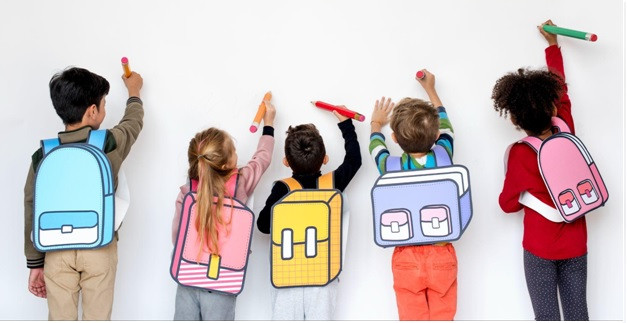
A disorganized school bag costs more than it seems. Five minutes at the start of class rummaging for a pencil. The worksheet that was definitely in there somewhere. The water bottle that leaked over the notebook. The homework that got done but never made it back to the teacher because it was buried under everything else. Small moments of chaos that add up to significant lost time and low-level daily stress — for your child and for you.
An organized school bag takes about thirty minutes to set up properly and fifteen minutes to maintain each week. But the setup only stays organized when every item in the bag has a designated place, a visible label, and a name on it. School labels for kids are what make the organization system self-sustaining — a child who can read their own subject label on a folder finds it without asking. A labeled water bottle that rolls under a cafeteria bench comes back instead of disappearing.
Here's the step-by-step system for organizing school bags, books, and supplies — with the right school labels for each surface — for students from preschool through high school.
From the founder of Sticky Monkey Labels
As a mom of three boys and the founder of Sticky Monkey Labels, I've watched the difference a well-organized, well-labeled school bag makes — not just for convenience, but for a child's ability to focus and feel in control of their day. Here's the system that works.
Steps Covered
Step 1: Declutter Before You Organize
There's no point organizing a bag full of things that don't need to be there. Before any system goes in, everything comes out. This is especially important at the start of a new school year if you're reusing a bag from the previous year — old notes, broken pencils, used-up pens, empty wrappers, and mystery objects accumulate over a school year in ways that genuinely surprise most parents when they empty the bag.
The declutter process:
- Empty the bag completely. Every pocket, every compartment. Put everything on a flat surface where you can see it all at once.
- Clean the bag before refilling it. Shake out loose debris, wipe down compartments with a damp cloth, and check for damage to zips or straps while it's empty. Starting the year with a clean bag sets the right tone.
- Sort into three piles: keep (needs to go to school), store elsewhere (belongs at home), discard (broken, empty, or no longer needed).
- Be ruthless. The goal is a bag that contains only what's needed for school. Every unnecessary item is weight your child carries and clutter that makes finding necessary items harder.
Step 2: Use Dividers and Pouches to Compartmentalize
The most common school bag problem — everything ends up in one undifferentiated pile — is solved by compartmentalization. When every category of item has a designated space and returns to that space consistently, finding things becomes automatic rather than a search operation.
A practical compartment system for most school bags:
- Main compartment — books, notebooks, folders, and larger items organized by subject (see step 3).
- Pencil case or pouch — all writing instruments, ruler, eraser, sharpener. A dedicated pouch means school supplies never get loose at the bottom of the main compartment.
- Front or side pocket — water bottle, small personal items, anything accessed quickly without opening the main compartment.
- Small inner pocket — bus pass, emergency money, medical items if relevant. Small, secure, and always in the same place.
Bag organizer inserts are available for bags without built-in compartments — they convert a single large space into multiple organized sections and are worth the small investment for children who consistently struggle with bag organization.
Step 3: Arrange Books and Notebooks by Subject
Once the compartment system is in place, books and notebooks need a consistent order the child can navigate quickly. The two most effective approaches:
Subject labels on notebooks and folders. School supply labels applied to each notebook and folder make identification immediate — the child finds the right one without opening each one to check. For students with multiple subjects, color-coding by subject (matching the label color to the notebook color) adds a second identification layer that works even faster than reading. Subject labels are also the foundation of a system that works independently — meaning your child can find what they need without asking you.
Consistent ordering in the bag. Assigning a position to each subject — maths always first, English always second — means the right notebook is always in the same place. Some students prefer numbered ordering; others prefer grouping by day. The best system is the one the student will actually maintain, so involve them in choosing the approach.
Step 4: Protect Books and Notebooks
Books and notebooks that go in and out of a school bag every day take significant physical wear over a school year — bent corners, torn covers, spill damage. Book covers and clear protective covers extend the life of materials considerably, which matters practically (fewer replacements) and organizationally (materials that are intact are easier to work with).
- Clear covers let the original book or notebook cover show through — which matters for quick visual identification in a bag.
- If you use book covers, apply school supply labels to the cover rather than the book itself — the cover can be replaced if it wears out, the label stays accurate.
- For school-issued textbooks, check whether the school requires or prohibits covering — some schools have specific policies.
Step 5: School Labels — The Right Label for Each Item and Each Age
School labels do two distinct things: they organize (subject labels help navigate the bag) and they protect (name labels ensure lost items come back). Both matter, and the right label type depends on what surface you're labeling and how old your child is.
School labels for younger children — preschool through grade 5
Full name labels on everything that goes to school — pencil case, water bottle, lunchbox, backpack (inside and outside), and every individual school supply. At this age, children benefit from seeing their name on their belongings — it reinforces identity, builds ownership, and gives teachers and staff an unambiguous way to return items. Bold designs help younger children identify their belongings visually before they can read their own name. Our Ultimate School Label Pack (134 labels) covers everything for K–8 students in one order — the right sizes for clothing, shoes, water bottles, lunchboxes, backpacks, and pencil-sized school supplies.
School labels for older students — middle school and high school
Teenagers often resist labels that look like children's stickers — understandably. But they still lose expensive things at school, and unlabeled items still don't come back. The solution is age-appropriate design — clean, minimal labels that look intentional rather than parent-imposed. Our School Essentials Label Pack (67 labels) covers the key items for older students — water bottle, backpack, calculator, jacket, and most-used school supplies — without the volume a younger child requires.
Quick guide: which school label for which item
- Water bottle, lunchbox, containers — waterproof name labels for school — alcohol prep, smooth surfaces, 24hr cure before first dishwasher cycle
- School uniforms and PE kit — iron-on clothing labels — bonds permanently into fabric fiber, completely flat, sensory-safe, cotton setting no steam, 60–90 sec press-and-lift
- Jackets, hoodies, non-iron-safe clothing — stick-on clothing labels — care tag or tagless imprint only, peel and press
- Notebooks, folders, and binders — school subject labels — color-coded by subject for instant visual identification
- Pencils, markers, crayons — extra small rectangle labels — fit directly on pencil barrels, an option our competitors don't carry
- Shoes — all footwear — shoe labels — inner sole at the heel, waterproof, washer and dryer safe
- Backpack (inside) — waterproof name label or contact label — your child's full name plus a phone number for recovery
Step 6: Maintain the System Weekly
An organized bag set up at the start of the school year drifts toward disorder without periodic maintenance. The good news is that maintenance is quick — fifteen minutes once a week is enough to keep the system working.
A simple weekly bag check:
- Empty and check — remove everything, check for items that don't belong, pull out any rubbish.
- Check school supplies — are pencils still working? Does anything need replacing? Better to notice on Sunday evening than Tuesday morning.
- Check school labels — are all labels still legible and adhered? A correctly applied waterproof label should still be going strong, but a quick check takes thirty seconds and keeps the identification system working. Replace any that have worn — especially on high-use items like water bottles and lunchboxes.
- Repack in order — everything back in its designated place, in the right order for the coming week.
Involving older children in the weekly bag check builds the habit of independent organization — which is the long-term goal. A child who manages their own school bag and their own school labels independently by secondary school has developed an organizational skill that serves them well into adulthood.
Browse our Ultimate School Label Pack (134 labels for K–8), our School Essentials Label Pack (67 labels for older students), and our full range of school labels at Sticky Monkey Labels. Questions about which label is right for a specific item? Call us at 1-888-780-7734.
Frequently Asked Questions
What's the best way to organize a school bag for a primary school child?
Keep the system simple — a main compartment for books and folders, a pencil case, and a water bottle pocket. Label every item with your child's name using school labels so lost items can be returned. Use subject labels on notebooks and folders so the child can find what they need independently. The simpler the system, the more consistently a child maintains it. Our Ultimate School Label Pack includes the right school labels for every surface — clothing, shoes, water bottle, lunchbox, and school supplies — in one order.
Which school labels do I need for my child's school bag?
For the bag itself: a waterproof name label on the outside tag plus a contact label inside. For the contents: waterproof labels for the water bottle and lunchbox, subject labels for notebooks and folders, and extra-small rectangle labels for pencils and markers. For clothing going in and out of the bag — PE kit, jacket, spare clothes — iron-on clothing labels for iron-safe fabrics or stick-on clothing labels for care tags. Our Ultimate School Label Pack (134 labels) covers all of these in one order for K–8 students. The School Essentials Label Pack (67 labels) covers the key items for older students.
How do I keep my teenager's school bag organized?
Involve them in setting up the system — teenagers maintain organization systems they chose far more consistently than ones imposed on them. Compartmentalize with pouches and dividers, use subject labels on notebooks, and label high-value items (water bottle, calculator, headphones) with clean minimal labels rather than children's designs. Our School Essentials Label Pack is designed specifically for this age — 67 labels covering the key items in a range of designs older students actually choose for themselves. A weekly fifteen-minute bag check keeps the system working without major intervention.
What labels work best for school notebooks and folders?
School subject labels are designed specifically for this — they clearly identify which notebook or folder belongs to which subject, making it fast to find the right one in a bag. Combining subject labels with color-coding (matching label color to notebook color) gives a second identification layer that works even faster than reading. Your child's name label on the cover ensures a folder left in the wrong classroom comes back. The right labels for school supplies are what make the organization system self-sustaining rather than parent-dependent.
Should I label pencils and small school supplies?
Yes — especially for younger children. Pencils and pens are the most consistently borrowed and least consistently returned school supplies. Our extra small rectangle labels fit directly on pencil barrels — school supply labels for the exact surface standard labels won't fit. This is also an option competitors don't offer. A labeled pencil that rolls under a desk comes back to your child. An unlabeled one just gets picked up.
How often should a school bag be organized and labels checked?
A full setup at the start of the school year, then a brief weekly check — fifteen minutes to empty, check school supplies, repack in order, and verify school labels. Correctly applied waterproof labels last all year, but a quick check every few weeks takes thirty seconds and maintains the system. Building the weekly check into a consistent routine (Sunday evenings work well for most families) makes it a habit rather than a chore.