
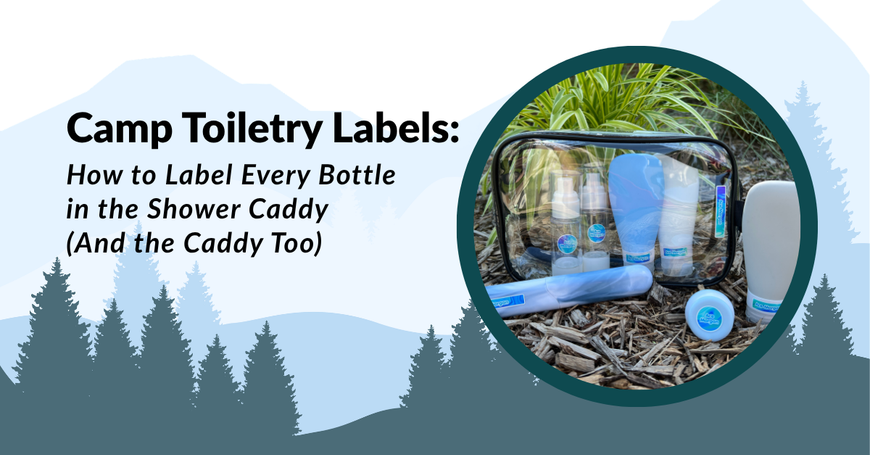
The shared cabin bathroom is one of the most chaotic spaces at overnight camp. Eight to twelve children, one shower area, and a shelf of toiletry bottles that all look exactly the same from three feet away. By day four of a session, unlabeled shampoo and conditioner have become communal property — used by whoever reaches for the closest bottle. By week two, they may not be on the shelf at all.
Toiletries are the category parents most consistently forget to label before camp drop-off. The focus goes to clothing, shoes, and bottles — and the shower caddy gets packed last, quickly, without labels. Then a bottle of shampoo goes missing by the end of the first week and the replacement arrives in a care package instead of the session budget going toward something more fun.
This post covers the complete shower caddy labeling system: which bottles need labels, why sunscreen and bug spray specifically need a clear overlay on top, how to apply waterproof labels to toiletry bottles correctly, and why the caddy itself needs a label as much as everything inside it.
From the founder of Sticky Monkey Labels
Dodie here — founder of Sticky Monkey Labels, boy mom of three, 15 years in business since 2011. The toiletry labeling question comes up most often in the weeks after a camp session when parents are reporting what didn't come home. Label the caddy. Label every bottle in it. This post tells you exactly how.
What's in this guide
- Why toiletries go missing at camp
- Label the caddy first
- Every bottle in the caddy — the full list
- Sunscreen and bug spray — why these need a clear overlay
- Applying labels to toiletry bottles correctly
- Toiletry bottle surfaces — what holds and what doesn't
- Doing the whole caddy in one session
- Frequently asked questions
1. Why Toiletries Go Missing at Camp
Toiletries go missing at camp for the same reason everything else does — shared spaces, identical-looking items, and no systematic return process. The shared bathroom shelf is an especially vulnerable environment because no one is in charge of it. Unlike laundry, which at least goes through a centralized process, bathroom items just live on a shelf and migrate to wherever they get used.
The specific ways toiletries disappear
- Borrowed and not returned — a cabin mate uses your child's shampoo once because theirs ran out. Then again. Then it lives on their shelf.
- Left in the shower — your child sets a bottle down in the shower area and forgets it. Without a name on it, no one knows whose it is or where to return it.
- Mixed into the wrong caddy — caddies get set next to each other, bottles get picked up from the wrong caddy, and if neither the caddy nor the bottle is labeled there's no way to tell them apart.
- Lost in transition — on activity days that involve swimming, bottles travel with the group and end up at the pool or waterfront rather than back in the cabin.
A label doesn't prevent all of these — but it eliminates most of them. A clearly labeled bottle that ends up in the wrong caddy can be returned. A labeled caddy left in the bathroom can be identified immediately. The label gives every item a visible connection to its owner.
2. Label the Caddy First
Before labeling any individual bottle, label the shower caddy itself. The caddy is the one item that, when found anywhere in the cabin or bathroom area, immediately tells a counselor which bunk it belongs to and gets everything back at once — including whatever unlabeled bottles are inside it.
Caddy label placement
- Place on the outside front panel — the face of the caddy that's visible when it's sitting on a bathroom shelf or hung on a hook
- Use a label large enough to be read from a short distance — a small label on a mesh caddy gets lost visually
- Clean the plastic frame or solid panel area with alcohol before applying — mesh or fabric caddy surfaces won't hold a label reliably, so find the plastic handle, frame bar, or any solid smooth component
- If the caddy is entirely mesh or fabric with no hard smooth surface, use a luggage tag style label tied to the handle instead
3. Every Bottle in the Caddy — The Full List
Every individual bottle that goes into the shower caddy needs its own label. The caddy label covers the situation where the whole caddy is found together. Individual bottle labels cover the situation where a bottle comes out of the caddy and ends up somewhere else — which happens constantly at camp.
| Item | Label Needed | Notes |
|---|---|---|
| Shampoo | Waterproof label | Front label panel of the bottle. Shampoo residue on wet hands handles the bottle constantly — clean with alcohol before applying. |
| Conditioner | Waterproof label | Same as shampoo. Label both even if the bottles look different — they may not look different in the dim light of a shared shower. |
| Body wash or soap | Waterproof label | Label the bottle. Bar soap in a case needs a label on the case, not the soap itself. |
| Sunscreen | Waterproof label + clear overlay | The clear overlay is essential for sunscreen — see Section 4 for why. |
| Bug spray / insect repellent | Waterproof label + clear overlay | Clear overlay is non-negotiable for bug spray — see Section 4. |
| Toothbrush | Waterproof label | Small label on the handle. Shared bathroom cup holders mix toothbrushes constantly — one of the most unpleasant mix-up scenarios at camp. |
| Toothpaste | Waterproof label | Small label on the flat body of the tube. |
| Deodorant | Waterproof label | Label the side of the tube. Important from age 8–9 onward in shared cabin bathrooms. |
| Face wash | Waterproof label | Front panel of the tube or bottle. |
| Hairbrush or comb | Waterproof label | Small label on the smooth back of the handle. Brushes travel further than people expect at camp. |
| Razor or razor case | Waterproof label | Label the handle or the case. For older campers only. |
| Shower puff or loofah handle | Waterproof label | Apply to the smooth plastic handle where the rope attaches, not the mesh puff surface. You can also place two labels back-to-back sandwiching the handle between. |
4. Sunscreen and Bug Spray — Why These Need a Clear Overlay
Sunscreen and bug spray are the two toiletry items most likely to have labels that degrade mid-session, and both for the same reason: the active ingredients and carrier oils in these products are slow-acting solvents for label ink and adhesive.
It works like this: every time sunscreen or bug spray is applied, some of it ends up on the hands that are holding the bottle. Those hands handle the bottle multiple times a day throughout a camp session. Over several weeks of daily use, the oils and active ingredients from the product gradually work on the label surface — not enough to notice on any given day, but enough to fade the ink significantly and begin degrading the adhesive over the course of a full session.
What happens without a clear overlay
By week three of a month-long camp session, a sunscreen label applied without a clear overlay often has faded ink and lifting edges. By week four, the name may be illegible. The label that started as clear and readable has been gradually degraded by the product it's labeling.
What a clear overlay does
A clear overlay is a transparent protective layer applied over the name label. It creates a barrier between the label surface and whatever the hands are carrying when they pick up the bottle. The oil from sunscreen-covered hands contacts the overlay rather than the label ink — so the overlay takes the degradation instead of the label. Apply the name label first, then apply the clear overlay over it. The label underneath stays intact through the full camp session.
5. Applying Labels to Toiletry Bottles Correctly
Toiletry bottles present the same application requirements as any waterproof label surface — and the same failure mode when the requirements are skipped. The prep step matters as much here as it does for water bottles and food containers.
Application sequence for every bottle
- Clean the application area with alcohol. Toiletry bottles — especially new ones — have manufacturing oils on them. Existing bottles have product residue from previous use. Wipe the application area firmly with alcohol and let it dry completely before applying.
- Apply to the smooth front panel of the bottle, away from raised text or textured grip areas. The flat front label area of most toiletry bottles is designed for label adhesion.
- Press firmly from center outward — run your thumbnail along every edge for full contact. No air bubbles, no lifted corners.
- For sunscreen and bug spray, apply the clear overlay immediately over the name label after pressing. Press the overlay the same way — firm center-out pressure along every edge.
- Allow 24 hours before the bottles go into the caddy or are used. The adhesive cures during this window. Label toiletry bottles a few days before packing — not the night before camp drop-off.
6. Toiletry Bottle Surfaces — What Holds and What Doesn't
Most toiletry bottles are hard plastic — an excellent label surface when properly prepped. A few specifics worth knowing:
Surfaces that work
- Hard plastic bottles and tubes — standard shampoo, conditioner, body wash, and sunscreen bottles. Clean with alcohol, apply to the smooth front panel, press firmly.
- Metal aerosol cans — bug spray is often in an aerosol can. The smooth metal or plastic body of the can accepts labels well after alcohol prep. Avoid placing on the crimped top or embossed areas.
- Hard plastic deodorant tubes — the flat smooth side panel. Not the curved top.
- Toothbrush handles — the smooth plastic section of the handle below the head. Small label only.
Surfaces that don't work
- Textured grip areas — many sunscreen and bug spray bottles have a molded grip texture on the sides. Labels cannot be applied to textured surfaces. Find the smooth flat front panel.
- Flexible squeeze tubes — thin flexible plastic that compresses when squeezed (like toothpaste tubes) will eventually crack any adhesive bond. Apply to the flattest section of the tube body, not the center where most squeezing happens.
- The mesh or fabric surface of a caddy — use the plastic frame, handle bar, or any solid smooth component for the caddy label. Not the mesh itself.
7. Doing the Whole Caddy in One Session
The toiletry labeling session is faster than the clothing labeling session — there's no ironing involved, no waiting for cool-down, just peel, press, and move on. The whole caddy can realistically be done in 20–30 minutes if you prep the bottles first and work through them in order.
The efficient approach
- Line up all the bottles that need labels on a flat surface
- Wipe the application area of every bottle with alcohol — do this for all bottles before applying any labels, so everything is dry and ready
- Apply labels to all the standard bottles first — shampoo, conditioner, body wash, deodorant, toothbrush, hairbrush, etc.
- Apply labels to sunscreen and bug spray, then immediately apply clear overlays over those labels
- Label the caddy last — by then you've handled every other bottle and the caddy label goes on cleanly
- Set everything aside for 24 hours before packing into the caddy
Browse our waterproof name labels and clear label overlays at Sticky Monkey Labels. Questions about which label size works on a specific bottle? Call us at 1-888-780-7734.
Frequently Asked Questions
Do toiletry labels really need the full alcohol prep, or is that just for bottles and food containers?
Yes — the alcohol prep is just as important for toiletry bottles as for any other surface. Toiletry bottles are often handled with product residue on the hands, which means they accumulate exactly the kind of surface contamination that prevents adhesion. New bottles from the store have manufacturing release agents. Both situations require alcohol prep before applying. Skip it and the label peels faster. Do it and the label lasts the full session.
Can I use a permanent marker on toiletry bottles instead of a label?
Marker on plastic toiletry bottles fades quickly — shampoo residue and handling wear it off faster than on bottles that only get handled dry. A waterproof label on a properly prepped surface lasts the full camp session. Marker typically doesn't make it past week two of daily handling with wet, product-covered hands.
Does every bottle need a clear overlay or just sunscreen and bug spray?
Clear overlays are specifically important for sunscreen and bug spray because the active ingredients and carrier oils in those products actively degrade label ink over time. Standard shampoo, conditioner, and body wash don't have the same effect — a waterproof label without an overlay holds fine through a camp session on those bottles. The overlay is a targeted solution for the specific problem that sunscreen and bug spray create, not a universal requirement for all bottles.
My child's camp provides sunscreen — do I still need to send labeled sunscreen bottles?
Check with your specific camp. Many camps provide communal sunscreen for scheduled application times but expect campers to have their own for other times — waterfront activities, hikes, or personal application. If your child is sending any sunscreen at all, label it and add the clear overlay. If the camp is providing everything, confirm this in writing with the camp director before drop-off.
What if the caddy is all mesh with no smooth surface to label?
Use a luggage-tag style label tied or attached to the handle — a small card with your child's name in a waterproof sleeve that ties to the caddy's carry handle. This gets the name visible on the caddy exterior without needing to adhere directly to a mesh surface. Alternatively, a label on a piece of white athletic tape attached to a mesh panel can work as a temporary surface — not as durable as a direct application but better than no caddy label at all.
Is labeling toiletries worth the time for a one-week camp session?
For a one-week day camp where your child comes home every evening — probably not worth the full session. The toiletry labeling system is most valuable for overnight camp sessions of two weeks or longer, where shared bathroom use accumulates over time and items migrate between caddies repeatedly. For a one-night or weekend camp, a piece of masking tape with a marker name on the shampoo bottle is sufficient. For anything a week or longer overnight, the proper label session is worth it.