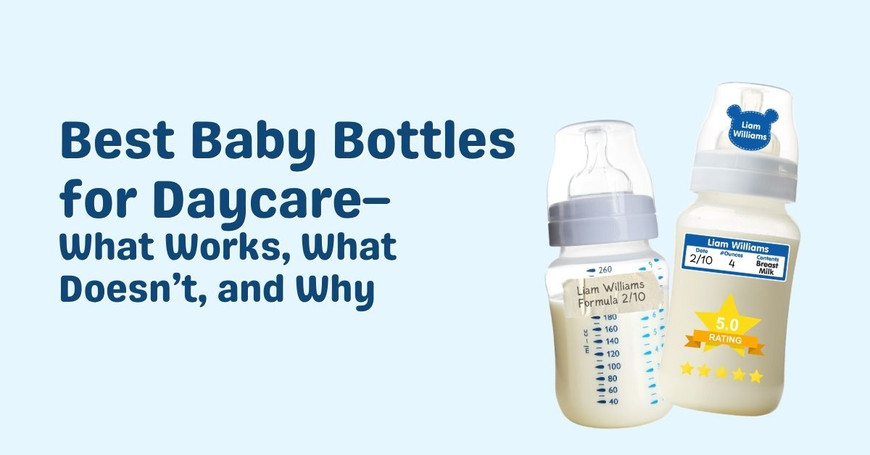
Every baby bottle review on the internet will tell you about nipple flow rates, anti-colic venting systems, the thickness of the borosilicate glass, and which bottles are easiest to clean. What no review mentions: whether the label you put on it will still be there in six weeks. That might sound like a small thing. It isn't. An unlabeled baby bottle at daycare is a health and safety issue, staff cannot confirm it hasn't been used by another child. An unlabeled bottle of breast milk is breast milk that won't be given to your baby if staff can't confirm whose it is. These are real stakes, and they're connected to the bottle you choose.
I've watched parents send bottles to daycare with every label type imaginable, craft store stickers, permanent marker, kitchen tape, and waterproof labels, and I know which ones come home labeled and which ones come home as mystery bottles by December. Here's what I know that the reviews don't cover.
From the founder of Sticky Monkey Labels
I'm Dodie, mom of three boys and founder of Sticky Monkey Labels, now in my 15th year. Two of my boys were bottle-fed in daycare settings. The bottle labeling question is one I've answered for thousands of parents, and it turns out the answer connects directly to which bottle you buy.
What's Covered
Why Label Compatibility Matters When Choosing a Bottle
Daycare staff are managing feeding schedules for multiple children simultaneously. At any given point in the day, there are bottles in the bottle rack, lids in the rinsing area, nipples drying on the counter, and formula containers on the shelf. Every single component needs your child's name on it, not as a nice-to-have, as a requirement.
Here's what happens with unlabeled bottles: they get set aside. A bottle that can't be confirmed as belonging to a specific child can't be given to that child, it's a cross-contamination risk. For breast milk in particular, daycare facilities have strict protocols about unidentified milk. An unlabeled bottle of pumped milk is breast milk that won't be given to your baby. This is why the bottle you choose, and whether it can actually hold a label, is a real factor worth weighing before you buy, not something to discover after the fact.
Which Bottle Surfaces Hold Labels and Which Don't
This is the thing no review covers: the material of the bottle determines whether a waterproof label can stay on it. One material, silicone, cannot hold any adhesive label regardless of label quality, prep, or application technique. This is not a label problem. It's surface chemistry.
✅ Labels Hold
- Hard plastic bottle body (BPA-free, Tritan)
- Glass bottle body (smooth exterior)
- Hard plastic lid or cap
- Hard plastic collar and ring
❌ Labels Won't Hold
- Silicone bottle sleeves (any brand)
- Silicone nipple and collar area
- Rubber grip or base
- Any textured or embossed surface
- Entirely silicone bottles
The silicone problem comes up most with popular modern bottles that use silicone sleeves or covers on the bottle body, the sleeve adds grip and insulation, but it also covers the label-compatible hard surface underneath. For these bottles, find the exposed hard surface above or below the silicone sleeve, which may be a narrow area but is usually there on standard bottle designs. For bottles that are entirely silicone-bodied, some collapsible or ultra-flexible designs, no waterproof adhesive label will hold reliably, and date-tracking write-on labels are the practical alternative.
Best Baby Bottles for Daycare by Label Compatibility
Choosing the right bottle for daycare involves the same factors every review covers, nipple flow rate, anti-colic design, ease of cleaning, plus the factor nobody covers: how easily can you label it. Here's the label-compatibility reality for the bottle types most common in daycare settings.
Classic hard plastic and glass bottles — Best for labeling ✅
Avent Classic, Dr. Brown's Original (glass or plastic), Nuk, Tommee Tippee, and similar bottles with smooth hard plastic or glass bodies are the easiest to label reliably. The body is hard, smooth, and non-silicone all the way down. Labels go on cleanly and survive daily home sterilizer and dishwasher cycles. These are the bottles where labeling is straightforward.
Bottles with silicone sleeves — Label the exposed hard surface ⚠️
Dr. Brown's Wide-Neck with silicone sleeve, Comotomo (glass with silicone cover), and similar designs have the hard surface underneath the silicone sleeve. Find the exposed hard glass or plastic at the neck or base above the sleeve, that's where the label goes. It may be a smaller label area than expected, but it holds reliably once you find the right spot. Never label the silicone sleeve itself.
MAM anti-colic bottles — Label the hard plastic body ✅ with note ⚠️
MAM bottles have a self-sterilizing base that requires assembly. The hard plastic body and ring components hold labels well. The base assembly area is often curved and textured, apply labels to the flat smooth section of the body, not the curved base sections.
Fully silicone or collapsible bottles — Use write-on labels ❌ for adhesive
Some modern collapsible bottle designs and ultra-soft silicone bodies have no hard label surface available. For these bottles, write-on waterproof labels that track daily dates and contents work better than any adhesive label, since they're reusable and wipe clean rather than relying on adhesive bond.
Labeling Whatever Bottle You Choose
Once you've identified the hard, label-compatible surface on your chosen bottle, the application process is the same as for any bottle: clean the surface with isopropyl alcohol, let it dry, apply the label with firm pressure to every edge, and allow 24 hours before the first wash. For the complete step-by-step application guide and the prep step that determines whether a label lasts ten days or ten months, see our complete bottle labeling guide.
Shop bottle labels for daycare, sized specifically for the bottle body and the lid separately so the label doesn't overlap curved areas and compromise the edge bond. For everything else in the daycare bag beyond the bottle, see our labeling for daycare guide.
Questions about whether a specific bottle will hold a label? Call 1-888-780-7734, we can usually tell you based on the bottle name and brand. For the daily bottle write-on system once your labels are applied, see our guide on wax pencil vs marker for bottle labels. For placement guidance specific to your bottle shape, see our bottle label placement guide.
Frequently Asked Questions
What are the best baby bottles for daycare?
The best daycare bottles have smooth hard plastic or glass bodies that hold waterproof labels reliably through daily sterilizer and dishwasher cycles. Classic hard plastic and glass designs are the most label-friendly. Bottles with silicone sleeves can work but require finding the exposed hard surface. Entirely silicone bodies don't hold adhesive labels at all.
Why won't labels stick to silicone baby bottles?
Silicone has a non-polar surface chemistry that prevents pressure-sensitive adhesive from forming a lasting bond. This is surface chemistry, not a label quality issue. For bottles with silicone sleeves, label the exposed hard plastic or glass body. For entirely silicone bottles, use write-on labels instead.
How can I tell before buying if a bottle will hold a label?
Run a hand along the full exterior of the bottle body. Smooth, firm, non-flexible material is where a label will hold. If the entire exterior is soft and flexible, that bottle needs a different labeling approach.