
From the founder of Sticky Monkey Labels
I'm Dodie — mom of three boys, two with food allergies and one with special needs, and founder of Sticky Monkey Labels since 2011. In 14 years of packing lunches for kids with allergies, a toddler in daycare, and a child in a special needs school program, I've tested every system, container, and label on the market. What's in this article is what actually works — not what sounds good in theory at 2pm on a Tuesday.
Picture this: It's 7:45 AM. You're pulling drawers apart looking for a matching lid while one kid announces he doesn't want a sandwich anymore and the other can't find his water bottle. The lunch scramble is one of the most consistently dreaded parts of the school morning — and it doesn't have to be.
Whether you're packing bento box lunches for a school-age kid, managing daycare bottle labels and snack containers for a toddler, navigating food allergies, or trying to get multiple kids organized at once, the right system makes the difference between a chaotic morning and one that runs on autopilot. These 18 hacks cover all of it.
What's Covered in This Guide
- Foundation — setting up your lunch packing station
- Advanced organization strategies
- Time-saving meal prep strategies
- Smart storage and food safety
- Daycare lunch packing — everything you need to know
- Building independence and managing food allergies
- Your 30-day lunch organization challenge
- Frequently asked questions
Foundation: Setting Up Your Lunch Organization System
Before any individual hack matters, you need a physical setup that makes the right action the easy action. Every minute you spend hunting for containers, lids, or labels at 7am is a minute your morning loses.
Hack #1 — Create a dedicated lunch packing station
Transform a single kitchen cabinet, drawer, or counter section into your lunch command center. Everything needed to pack lunch lives here — boxes, containers, lids together, ice packs, personalized food container labels pre-marked for breakfast, lunch, snack-am, and snack-pm, and write-on date labels for dating perishables. When everything has a designated home, packing becomes a routine you move through automatically instead of a decision chain you have to make under pressure.
Hack #2 — Master the Sunday meal prep strategy
Dedicate 90 minutes every Sunday to prepare the week's lunch components. Wash and cut all fruit and vegetables, cook grains in bulk, prepare 3–4 protein options, and portion everything into labeled containers. Label every prepped container with contents and date using write-on date labels so nothing gets forgotten at the back of the fridge. This single weekly investment eliminates daily decision-making entirely.
Hack #3 — Implement the container-size method
Use different sized containers to naturally control portions and create visual variety — large for the main dish, medium for fruit and vegetables, small for snacks and treats. Label each with personalized food container labels showing meal type so kids and caregivers always know what's what at a glance. The container itself guides the portion without measuring or weighing.
Advanced Organization Strategies
Once your foundation is in place, these strategies layer on top to reduce friction further and keep multiple kids organized without extra mental load.
Hack #4 — Create color-coded family systems
Assign each child a specific color for all their lunch items. This prevents mix-ups at school and daycare, makes identification instant for teachers and providers, and gives kids a sense of ownership over their belongings that makes them less likely to lose things. Use waterproof name labels and water bottle labels in each child's designated color for a fully cohesive system.
Hack #5 — Master bento box organization
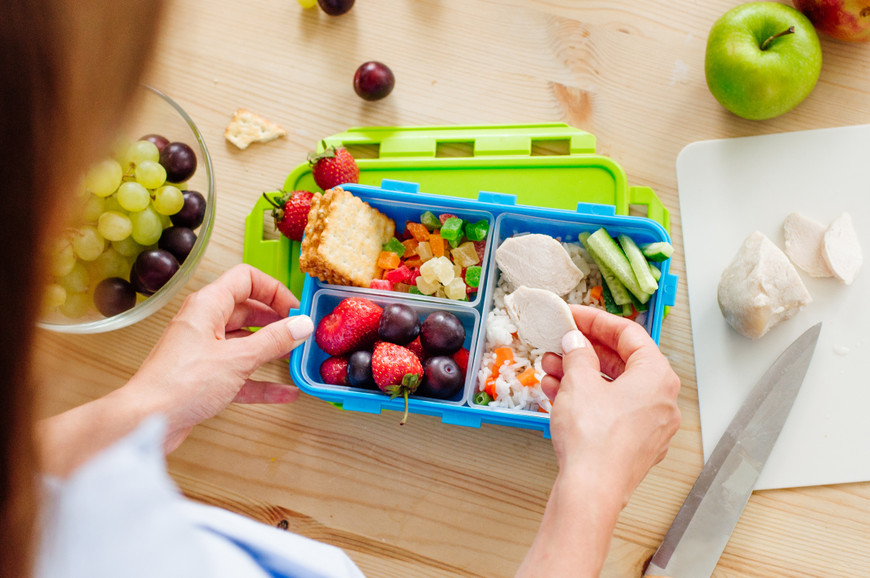
Follow the 4-3-2-1 rule for balanced bento lunches: 4 parts carbohydrate, 3 parts protein, 2 parts vegetables, 1 part treat. Use silicone cupcake liners as flexible dividers for oddly shaped foods. Label bento boxes with waterproof dishwasher-safe name labels that survive daily washing. For food allergies, always add allergy alert labels to the bento box lid where they're seen immediately.
Hack #6 — The grab-and-go breakfast-for-lunch strategy
Turn breakfast foods into lunch options. Kids love familiar flavors, and breakfast items are faster to prep and often easier to eat — which means a better chance your child actually eats their lunch. Mini pancakes batch-cooked on Sunday, overnight oats portioned into labeled containers, breakfast muffins with hidden vegetables, and yogurt parfaits in clear containers all work well. Batch once, use all week.
Time-Saving Meal Prep Strategies
Hack #7 — The assembly line approach
When packing for multiple kids — or multiple days at once — an assembly line cuts prep time in half. Lay out all lunch boxes with waterproof name labels facing up. Add main dishes to all boxes before moving on, then fruit and vegetables across all boxes, then snacks. You move through one category across all containers before moving to the next, rather than packing one complete lunch at a time. Apply personalized food container labels for meal types on separate snack containers as you go.
Hack #8 — Create lunch kits for different moods
Pre-plan 5–7 named lunch combinations with a shopping list for each: a "Comfort Food Kit" (mac and cheese, apple slices, goldfish), a "Protein Power Kit" (hard-boiled eggs, cheese cubes, berries), an "International Kit" (hummus, pita, olives, grapes), a "Breakfast-for-Lunch Kit" (yogurt parfait, mini muffin, fruit). Post the list inside your lunch cabinet. When a child picks a kit by name, you know exactly what goes in and what you need at the store.
Hack #9 — The leftover transformation method
Last night's dinner becomes today's lunch — transformed, not just repackaged. Roast chicken becomes chicken salad wraps. Taco meat becomes taco salad in a jar. Pasta becomes cold pasta salad. Rice becomes rice balls. This reduces food waste, saves money, and means you're never starting from zero in the morning. Use write-on date labels on every leftover container so you always know exactly when it was made.
Smart Storage and Food Safety Solutions
Hack #10 — Food safety and temperature control
Cold foods need to stay below 40°F — anything above that and bacteria multiply rapidly. Use insulated lunch boxes labeled with waterproof name labels that won't peel in the wash. Include ice packs for any dairy, meat, or egg-based items. Date all perishables with write-on date labels so nothing mystery-aged ends up in a lunch box. Pack perishables last, unpack first when the bag comes home.
Hack #11 — Smart container storage system
The biggest source of morning chaos isn't what goes in the lunch — it's finding the containers and lids. Always store containers with lids already on. Use personalized food container labels to identify sizes at a glance. Keep the lunch packing area in a low cabinet so kids can access it and help. Store labeled ice packs in a designated freezer bin — not loose — so you're never hunting for them at 7am.
Daycare Lunch Packing: Everything You Need to Know
Packing lunches for daycare is a completely different challenge from packing for school-age kids. Bottles and sippy cups go through commercial dishwashers running at temperatures far higher than your home machine. Snack containers get separated from lunch bags in busy rooms. Providers are managing meals for a dozen children simultaneously. And your toddler's items will mix up with someone else's if they're not clearly labeled — which is a safety problem if your child has allergies.
Here's what actually works, drawn from 14 years of daycare label conversations with parents and from packing for my own kids when they were in daycare.
Hack #12 — Label every single thing that leaves the house
In a daycare room, unlabeled items don't just get lost — they get used by another child. The rule is absolute: if it goes to daycare, it has a label on it. Every baby bottle and sippy cup needs waterproof bottle labels rated for commercial dishwashers. Every snack container needs a name and meal time using snack and lunch labels. The lunch bag itself needs a label — not just what's inside it. Ice packs need labels — the most consistently lost daycare item and the most expensive to keep replacing. Formula and breast milk containers need name and date using write-on date labels so providers know exactly when it was prepared. Clothing items need iron-on clothing labels on every item your child changes into or out of at daycare.
Hack #13 — Pack for the daycare schedule, not your home schedule
Most daycare centers run a morning snack, lunch, and afternoon snack at set times that have nothing to do with when you'd feed your child at home. If you pack one big unlabeled bag, providers may not know which container is for which meal. A labeled 3-container system fixes this: Container 1 — Snack AM (crackers, fruit slices, cheese cubes, labeled "Morning Snack" with a personalized snack label); Container 2 — Lunch (finger foods and small pieces, no prep required at the table); Container 3 — Snack PM (slightly more substantial since toddlers are extra hungry after nap, labeled "Afternoon Snack").
Best daycare lunch ideas for toddlers: quartered grapes, diced strawberries, or banana slices; small cubes of cheese and soft deli meat; cold pasta with mild sauce (toddlers don't mind cold); soft cooked vegetables — peas, carrots, corn, green beans; mini pancakes or muffins from your Sunday prep batch; yogurt in a labeled container with fruit on the side to prevent sogginess.
Hack #14 — Make allergy information impossible to miss at daycare
In a daycare room managing a dozen children, a verbal heads-up about a food allergy is not a reliable safety system. Allergy information must be on the food itself, visible before anyone opens a container. Place a food allergy alert label on the outside of the lunch bag — the first thing anyone sees when they pick it up. Label individual containers near the allergen. Include an emergency contact label directly on the lunch bag, not only in the child's file in the office. Refresh labels weekly so they're always clean and legible. A smeared allergy label is as useless as no label at all.
Building Independence and Managing Food Allergies
Hack #15 — Age-appropriate lunch packing tasks
Teaching kids to help pack their own lunches builds independence, reduces your workload, and dramatically increases the chance they'll eat what's in the box — because they chose it. Ages 4–6: choose between 2 pre-approved options for each category. Ages 7–9: pack non-perishable items and snacks independently. Ages 10 and up: plan and pack complete lunches with light supervision. Start small and expand responsibility as they prove reliable — having a clearly labeled lunch station with a posted menu makes this possible without you hovering.
Hack #16 — Complete food allergy management system
For children with food allergies, lunch organization is a safety issue, not just a convenience one. Your system needs to account for substitute teachers, field trips, after-school programs, and any situation where someone unfamiliar handles your child's food. Food allergy alert labels belong on the lunch box exterior — visible before the bag is opened. Waterproof name labels on every container prevent confusion about whose food is whose. Allergen-free foods are packed in completely separate, clearly marked containers — never in unlabeled shared ones. Emergency contact information goes directly on the lunch bag, not only in the school office.
Hack #17 — Create a lunch choice board
A visual choice board eliminates morning negotiation by giving kids real choices within boundaries you've already approved. They feel heard; you stay in control of nutrition. Set up four categories — main dish, fruit and vegetable, snack, drink — with 2–3 options per category, pictures for pre-readers. Use colorful round labels as moveable choice indicators — kids physically move their label to their selection, which makes it feel like a real decision. The board posts inside the lunch cabinet so kids can do this independently while you're making coffee.
Hack #18 — Add love notes and encouragement
A small note turns an ordinary meal into a moment of connection. For kids who struggle with the school day — including those with anxiety, special needs, or social challenges — finding a message from home at lunch can genuinely change the trajectory of their afternoon. Jokes or riddles to share with a friend give shy kids a social opener. A specific encouragement works better than a generic one: "Good luck at tryouts today!" lands differently than "Have a great day!" Use larger write-on labels to create a reusable note space inside the lunch box lid — write with a dry-erase marker, wipe clean each evening.
Labels That Make the System Work
Snack and Lunch Labels — for meal-time organization
Pre-marked for breakfast, lunch, snack-am, and snack-pm. Apply to containers once — they survive repeated dishwasher cycles. Daycare providers and teachers know immediately which container is for which meal without guessing or asking.
Write-On Date Labels — for meal prep and daycare containers
Apply once to the container, write contents and date each time you prep, wipe clean in the dishwasher, repeat. Required by most daycare centers for all perishable items including formula and breast milk. Refrigerator, freezer, microwave, and dishwasher safe.
Waterproof Bottle Labels — for daycare bottles and sippy cups
Rated for commercial dishwasher temperatures — not just home machines. Stay adhered through repeated high-temperature washing. Apply to clean, dry surface; allow 24 hours before first wash for best adhesion.
Food Allergy Alert Labels — for children with dietary restrictions
Specific allergen named clearly. Apply to the exterior of the lunch bag — visible to any adult at the point of food contact. Waterproof so they don't smear when the bag is wet. Particularly critical for daycare and substitute teacher situations where verbal communication isn't reliable.
Waterproof Name Labels — for lunch boxes, containers, and ice packs
Dishwasher safe and durable through daily washing. A clearly named container goes home with the right child and comes back to the right family. Particularly useful in daycare and school settings where multiple children have similar containers.
Browse the full range at Sticky Monkey Labels — or call us at 1-888-780-7734. I'm always happy to talk through what will work best for your specific situation.
Your 30-Day Lunch Organization Challenge
Don't try to implement all 18 hacks at once. Build the system gradually over four weeks and it will actually stick.
Week 1 — Foundation setup
- Set up your dedicated lunch packing station
- Label all lunch boxes, water bottles, daycare bottles, and ice packs
- Create your first 3 lunch kits with shopping lists
- Do your first Sunday prep session
Week 2 — Efficiency systems
- Switch to the assembly line method for packing
- Try 2 leftover transformation meals
- Build your lunch choice board
- Try bento box organization for the first time
Week 3 — Kid independence
- Assign age-appropriate packing tasks to each child
- Let kids choose from the choice board independently
- Review food safety rules together
- Start adding a daily love note
Week 4 — Fine-tuning and mastery
- Evaluate what's working and cut what isn't
- Add 2 more lunch kit varieties to your rotation
- Time your morning routine — you should be well under 10 minutes
- Celebrate the fact that you've built a system that runs itself
Frequently Asked Questions
What labels work best for daycare bottles?
You need waterproof labels rated for commercial dishwashers — not just home dishwashers. Commercial machines run at much higher temperatures and most standard labels will peel or blur within a week. Our waterproof bottle labels for daycare are specifically designed to survive commercial washing. Apply to a clean, dry surface and allow 24 hours before the first wash for best adhesion.
How do I label daycare containers for different meals?
Use personalized snack and lunch labels that include both your child's name and the meal time — "Snack AM," "Lunch," and "Snack PM." Apply one label per container. This takes about 60 seconds per week to set up and completely eliminates meal-time confusion in a busy daycare room.
What are the best lunch ideas for toddlers in daycare?
Focus on finger foods, small pieces, and foods that don't require reheating or table prep. Quartered grapes, cheese cubes, cold pasta, soft vegetables, mini muffins, and yogurt in labeled containers all work well. Avoid anything that requires a caregiver to do prep work before serving — in a room of 8 toddlers, that's not realistic and your food may end up served incorrectly or not at all.
How do I communicate my child's food allergy to daycare?
Start with formal documentation through the daycare administration — an allergy action plan on file. Then add a physical label layer: food allergy alert labels on the outside of the lunch bag and on individual containers near the allergen. The label travels with the food in the moment — the file in the office doesn't. Both layers are necessary.
How do I use date labels for daycare food?
Write-on date labels are essential for formula, breast milk, and any pre-prepped food going to daycare. Write the date and time of preparation clearly. Most daycare centers require date labeling on all perishables by policy. Apply directly to the container, not the lid — lids get separated.
How long does it take to set up the assembly line lunch system?
The first Sunday prep session takes about 90 minutes as you get organized. By week three most families are completing their full prep in 45–60 minutes. Daily morning packing, once the system is running, should take under 10 minutes — often closer to 5 if your kids are helping.
What's the most important lunch box organization hack for multiple kids?
Color coding, without question. Assign each child a color, put that color's waterproof name label on every item they own, and use the same color for their containers, water bottle, and ice pack. In a busy school or daycare environment, color identification is faster and more reliable than reading names — for your kids, for their teachers, and for the daycare providers managing a whole room of similar-looking items.